The Entity Mirage: Why Setting Up a Private Limited Company Before 25 Headcount Burns Cash and Focus
Thinking of incorporating a subsidiary in India? Discover why early incorporation drains Seed and Series A runway and why a boutique EOR is the optimal bridge.
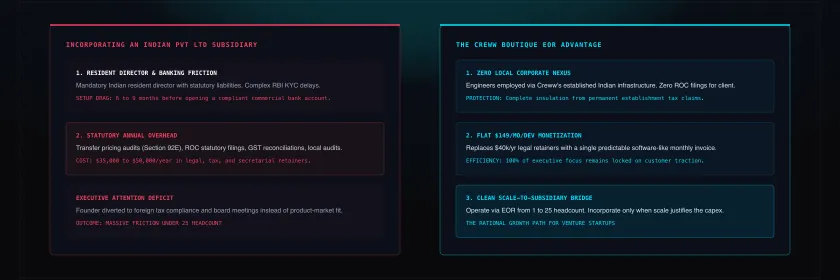
Executive Summary: Incorporating a wholly owned Private Limited subsidiary in India before reaching at least 25 to 30 full-time engineers is one of the most common, capital-destructive mistakes made by venture-backed technology startups. While well-meaning corporate attorneys often advise founders to “set up your own entity right away,” the operational reality involves 6 to 9 months of bureaucratic setup friction, mandatory appointment of an Indian resident director with personal statutory liability, complex Reserve Bank of India (RBI) foreign direct investment filings (Form FC-GPR), annual transfer pricing audits (Section 92E), and $35,000 to $50,000 in recurring annual legal and accounting retainers. Operating via a boutique Employer of Record (EOR) provides 100% legal compliance, zero corporate entity nexus, and deployment in under 14 days for a flat $149/mo fee—preserving executive bandwidth until scale justifies the subsidiary capex.
Disclaimer: This analysis provides operational and strategic guidance for startup founders and does not constitute formal legal or tax counsel. Companies should consult cross-border corporate attorneys regarding their specific corporate structuring.
Shortly after closing a $3,000,000 to $5,000,000 Series A funding round, technology founders frequently receive the same piece of advice from traditional corporate advisors:
“Now that you have institutional capital, you should immediately incorporate an Indian Private Limited subsidiary to hire your engineers directly. It gives you 100% control, looks institutional to your board, and establishes your permanent footprint.”
The pitch sounds mature and strategic. Founders picture a clean Delaware-India corporate structure, with their Delaware C-Corp holding 100% of the equity in a Bangalore-based tech entity.
What the advisors rarely explain—and what founders only discover after writing the initial retainer checks—is that incorporating and maintaining a private limited company in India is an immense, ongoing administrative burden.
Instead of focusing on product iterations, customer discovery, and hiring high-ownership builders, the founding team spends the next nine months wrestling with notarized apostilles, Reserve Bank of India (RBI) Foreign Inward Remittance Certificates (FIRCs), resident director liabilities, and transfer pricing audits.
Setting up a foreign subsidiary is not a badge of honor. It is an expensive, inflexible piece of corporate machinery.
Unless your engineering headcount exceeds 25 to 30 people, incorporating in India is an unnecessary distraction that drains cash and burns executive focus.
1. Incorporating an Indian Subsidiary vs. Boutique EOR: The Cost & Friction Matrix
To understand the hidden overhead of premature incorporation, review the side-by-side comparison between establishing an Indian Private Limited subsidiary and deploying through a boutique Employer of Record:
| Operational Dimension | Incorporating an Indian Pvt Ltd Subsidiary | Operating via Creww Boutique EOR Bridge |
|---|---|---|
| Time to First Hire | 6 to 9 Months (Entity, RBI approvals, bank accounts) | Under 14 Days |
| Upfront Legal & Setup Capex | $25,000 – $40,000 (Law firms, secretarial retainers) | $0 Upfront Capex |
| Annual Recurring Compliance Overhead | $35,000 – $50,000 / year (Audits, ROC, transfer pricing) | Flat $149 / mo / dev platform fee |
| Resident Director Requirement | Mandatory: Must appoint an Indian resident with personal liability. | None: Creww entity absorbs local statutory employer responsibilities. |
| Banking Setup Timeline | 3 to 5 Months: Complex RBI KYC checks for foreign-owned entities. | Instant: Operational from day one via established commercial accounts. |
| Transfer Pricing Audits (Section 92E) | Mandatory: Annual arm’s length documentation & Form 3CEB filing. | Zero: Arm’s length commercial MSA between Delaware C-Corp and EOR. |
| Permanent Establishment (PE) Tax Nexus | Directly creates corporate nexus in India; complex tax filings. | Complete statutory insulation under cross-border EOR umbrella. |
| Wind-Down / Dissolution Complexity | 18 to 24 Months: Lengthy court process (NCLT / Fast Track Exit). | 30 Days: Simple termination of EOR contract with zero residual liabilities. |
The numbers reveal an obvious trade-off: for a 6-person engineering team, incorporating a subsidiary adds $35,000 to $50,000 per year in pure administrative dead-weight loss—money that could directly fund an additional Senior Product Engineer’s salary in Bengaluru.
2. The 4 Hidden Hazards of Premature Incorporation
Why is incorporating in India so complex for a foreign startup? Four statutory and regulatory bottlenecks create continuous operational friction:
Hazard 1: The Resident Indian Director Trap
Under Section 149(3) of the Indian Companies Act, 2013, every Indian company must have at least one director who resides in India for a minimum of 182 days during the financial year.
- Foreign founders who live in San Francisco or London cannot serve as sole directors.
- You must find an Indian national or resident willing to sit on your board of directors.
- In India, company directors bear personal statutory liability for corporate compliance defaults, unpaid payroll taxes (TDS), and employee provident fund filings.
- Finding a trusted professional willing to take on personal legal liability for an early-stage foreign startup typically requires paying expensive “nominee director” services ($12,000 to $20,000/year) or thrusting immense personal liability onto your first engineering hire.
Hazard 2: The Foreign Direct Investment (FDI) & Banking Nightmare
Opening a commercial corporate bank account for a foreign-owned Indian subsidiary is a multi-month ordeal.
- Under the Foreign Exchange Management Act (FEMA), foreign equity capital transferred into India must be reported to the Reserve Bank of India via Form FC-GPR within 30 days of share allotment.
- Indian commercial banks (HDFC, ICICI, Axis) operate under strict anti-money laundering (AML) protocols. They require physical, apostilled copies of parent company incorporation certificates, board resolutions, and beneficial ownership declarations for every US shareholder owning over 10% of the Delaware parent.
- If a single notarization is stamped incorrectly, the bank account freezes, and you cannot process local payroll.
Hazard 3: Transfer Pricing Compliance (Section 92E)
A US Delaware C-Corp and its wholly owned Indian subsidiary are classified as “Associated Enterprises” under Indian tax law.
- You cannot simply transfer money to India to cover exact payroll.
- Under Section 92 of the Income Tax Act, all intercompany transactions must reflect an “Arm’s Length Price.”
- In practice, Indian tax authorities require the US parent to pay the Indian subsidiary on a Cost + 15% to 18% markup basis.
- The Indian entity must pay local corporate income tax (typically 22% to 25%) on that synthetic 15% markup.
- You must hire a specialized accounting firm every year to prepare a formal Transfer Pricing Study and file Form 3CEB, costing $10,000 to $15,000 in recurring accounting fees.
Hazard 4: The Wind-Down Trap (You Cannot Easily Close an Entity)
In Delaware, closing an inactive corporation takes a two-page filing and a $200 fee.
In India, winding down a Private Limited company is a byzantine legal process:
- A Fast Track Exit (FTE) under Section 248 of the Companies Act requires obtaining no-objection certificates from tax authorities, closing all bank accounts, and waiting 12 to 18 months for official striking off by the Registrar of Companies (ROC).
- If an audit dispute or tax query arises, closing the entity can drag on for three years. If your startup pivots or is acquired in an asset sale, an unresolved Indian subsidiary can stall your entire M&A transaction.
3. The Rational Inflection Point: When SHOULD You Incorporate?
Operating through an Employer of Record is not a permanent ideological stance; it is a pragmatic scaling strategy.
There is an exact inflection point where the mathematics reverse and incorporating a subsidiary becomes financially rational:
| Scale Threshold | Headcount | Optimal Architecture | Economic & Operational Justification |
|---|---|---|---|
| Early Stage | 1 to 20 Builders | Boutique EOR (Creww) | Flat $149/mo/dev ($1,800 to $36,000/yr total admin cost); saves $50k+ in subsidiary retainers; zero executive drag. |
| Inflection Zone | 25 to 35 Builders | Evaluate Subsidiary Incorporation | Total EOR fees approach $45,000 to $60,000/yr; subsidiary overhead becomes cost-neutral; company has Series B capital to hire local Finance Director. |
| Institutional Scale | 40+ Builders | Wholly Owned Indian Subsidiary | Corporate scale fully amortizes legal, audit, and transfer pricing overhead; execute free unencumbered transfer from Creww EOR. |
If your engineering team is under 20 people, you are well below the inflection threshold. Every dollar spent on incorporation lawyers is a dollar stolen from engineering velocity.
4. The Creww EOR Bridge: All the Upside, None of the Baggage
Under Creww’s boutique Employer of Record framework, you receive 100% of the operational benefits of a local subsidiary with zero corporate liabilities:
- Direct Operational Control: Your engineers report directly to you in Slack and GitHub, participate in daily standups, and follow your engineering culture.
- Airtight IP Assignment: 100% of code, algorithms, and trade secrets transfer perpetually and globally to your Delaware C-Corp via a Delaware-governed Master Services Agreement.
- Turnkey Physical Hubs: Your team sits together in high-energy private pods in Indiranagar and HSR Layout, backed by redundant fiber and generator power.
- Clean Exit Guarantee: When your team reaches 30+ engineers and you decide to incorporate, Creww executes a 100% free, unencumbered transfer of employment records, Provident Fund accounts, and assets to your new Indian entity with zero buyout penalties.
Conclusion: Focus on Product-Market Fit First
Early-stage startups do not win by building complex multi-jurisdictional corporate structures.
They win by shipping exceptional software faster than their competitors before their capital runs out.
Do not let traditional advisors sell you the entity mirage. Keep your corporate structure clean, your burn rate low, and your executive focus locked on customer value.
Deploy your team in 14 days under a transparent EOR bridge. Build great software. Incorporate when your scale earns it.
Ready to build your core engineering hub in Bengaluru?
Stop paying 60% agency markups or gambling on unvetted contractors. Creww matches venture-backed startups with the top 1% of product engineers in Bengaluru—with 100% transparent pass-through pricing and complete operational support.