Why Remote Developers in India Leave After 90 Days (And the 3 Retention Levers That Keep Them)
Discover why offshore engineers quit right after onboarding, the hidden cost of developer turnover, and the 3 operational levers that drive 94% retention.
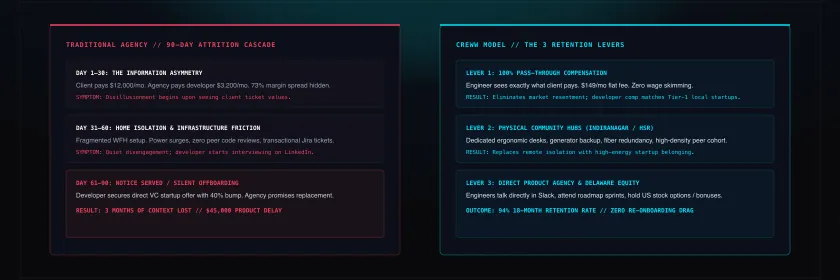
Executive Summary: Remote developers in India typically quit 90 days after onboarding not because of lack of loyalty or commitment, but due to three structural flaws in traditional offshore arrangements: opaque agency margin spreads of 60% to 70%, physical isolation in fragile home office environments, and exclusion from core product architecture. When agencies bill a startup $12,000 per month while passing only $3,200 to the developer, the engineer inevitably discovers the disparity and seeks direct employment. Startups achieve 94% 18-month retention by applying three operational levers: 100% transparent pass-through compensation via a flat $149/mo EOR fee, physical community hubs in Bengaluru startup corridors (Indiranagar and HSR Layout), and direct Delaware equity participation.
Around the 85th day of an offshore engagement, founders often notice the warning signals. Pull request comments grow sparse. Responses in Slack drift from minutes to hours. Camera feeds during daily standups switch to static avatars, accompanied by explanations of fluctuating local broadband.
Then comes the formal email: the developer has accepted an offer from a venture-backed tech firm offering a 35% compensation increase, effective immediately at the end of their probation cycle.
The startup is left holding half-written feature branches, unmerged database migrations, and an onboarding debt that resets the roadmap by three full months.
When this sequence plays out repeatedly across offshore hires, founders usually draw the wrong conclusion: they assume that remote talent in India is inherently opportunistic, prone to offer-shopping, and impossible to retain.
Before accepting that cynical premise, examine the structural economics of the engagement. If an engineer walks away after 90 days, the failure rarely originates in developer character. It is the predictable outcome of an economic and operational architecture designed to fail from day one.
1. The Anatomy of the 90-Day Cliff: The Attrition Cascade
In the Indian technology ecosystem, 90 days is a sacred statutory and cultural interval. For permanent employees, it represents the standard contractual notice period or the end of initial probationary evaluation.
For third-party agency contractors, it is the exact window when information asymmetry collapses.
Here is how the 90-day attrition cascade develops within traditional agency arrangements:
| Timeline | Developer Experience | Founder Perception | Structural Root Cause |
|---|---|---|---|
| Days 1–30 | High enthusiasm; navigates unfamiliar codebase; learns PR conventions. | “Great hire. Fast onboarding; responsive in Slack.” | Novelty masks underlying economic friction; developer assumes agency markup is reasonable. |
| Days 31–60 | Discovers client ticket values and true contract billing through shared tooling or project invoices. | “Shipping cadence is steady, though questions about product vision have slowed down.” | Information Asymmetry Shock: Engineer discovers they receive $3,000 of a $10,000 monthly invoice. Resentment sets in. |
| Days 61–75 | Physical isolation bites. Power outages, solo WFH fatigue, zero local peer reviews. | “Slight communication drag; responses seem transactional.” | Home office friction combined with feeling treated like an interchangeable ticket-taker. |
| Days 76–90 | Reactivates LinkedIn profile; receives multiple direct inbound offers from Tier-1 product startups. | Sudden resignation notice delivered during a critical release sprint. | Competitive market clearing: local venture-backed startups offer direct comp without agency skimming. |
The cost of this churn is catastrophic for an early-stage startup. Replacing an engineer who departs at day 90 does not cost three months of lost salary; it consumes institutional context, code review bandwidth from your US team, and the compound momentum of your product release cycle.
2. The True Cost of 90-Day Developer Turnover
When an offshore engineer resigns at the three-month mark, most founders calculate their loss as the recruitment fee paid to the agency plus the developer’s salary during their tenure.
That accounting misses the primary balance sheet destruction. The genuine cost includes senior engineering distraction, lost product velocity, and duplicate management overhead:
| Expense Category | Direct & Indirect Resource Consumption | Financial Impact (USD) |
|---|---|---|
| Direct Sunk Compensation | 3 months of agency billing ($10,000/mo) | $30,000 |
| US Leadership Time | CTO & Staff Engineer time spent interviewing, onboarding, and reviewing PRs (120 hrs @ $125/hr) | $15,000 |
| Product Velocity Delay | 6-week roadmap freeze while sourcing and onboarding a replacement | $25,000 – $40,000 in delayed ARR milestones |
| Code Refactoring & Cleanup | Technical debt left behind by a departing contractor with uncommitted context | $12,000 |
| Total Capital Drain | Cumulative loss per 90-day developer failure | $82,000 – $97,000 |
If a startup experiences developer churn twice in a single year across a four-person remote pod, they have burned nearly $200,000 in phantom capital—enough to fund an entire additional engineer’s salary for two years in Bengaluru.
3. The Three Structural Catalysts of Developer Churn
Why do senior engineers leave after 90 days? When you interview senior developers who departed agency contracts, three systemic issues emerge consistently:
Catalyst 1: The Resentment of the 60% Margin Siphon
When an engineer with seven years of systems architecture experience discovers that the US client pays an agency $75 per hour while the agency pays them ₹28,00,000 annually (roughly $28/hr loaded), psychological disengagement is instantaneous.
The developer realizes that every hour of overtime or architectural problem-solving primarily lines the pockets of an intermediary sales team in London or New York. The moment an engineer feels economically exploited, their loyalty shifts from shipping your product to finding a direct employer who respects their market clearing rate.
Catalyst 2: The Loneliness and Infrastructure Fragility of Isolated WFH
Working remotely from an apartment in Bengaluru or a tier-2 Indian city is fundamentally different from working remotely in suburban California.
Frequent power grid fluctuations require battery inverters; consumer broadband lines drop during monsoon downpours; and working from a bedroom desk across a 13.5-hour time difference leads to severe cognitive isolation.
Without a physical workspace or daily interaction with peer engineers who share their technical caliber, the developer experiences your company merely as a disembodied stream of Jira tickets. Disembodied relationships are trivial to terminate.
Catalyst 3: The “Ticket Implementer” Trap vs. Product Ownership
Traditional agencies deliberately enforce communication silos. Account managers insist that all requirements pass through ticket coordinators or scrum masters to prevent the client from realizing how little technical guidance the agency actually provides.
Senior product builders despise being treated as feature factories. When an experienced engineer is prohibited from speaking directly to the founder, debating roadmap trade-offs, or understanding customer retention data, their work becomes purely mercenary. Mercenary engineers switch contracts for a $500 monthly difference.
4. The 3 Retention Levers: How to Engineer 94% 18-Month Retention
Retaining top-tier engineering talent in Bengaluru does not require restrictive non-competes, legal threats, or intrusive keystroke surveillance software.
It requires aligning your operational model with the economic realities of top-performing builders through three concrete levers:
| Retention Lever | Mechanical Execution | Operational Outcome |
|---|---|---|
| 1. 100% Pass-Through Compensation | Pay the engineer 100% of the agreed salary directly. The EOR charges a flat administrative fee ($149/month). | Eradicates margin resentment. A ₹45L CTC ($54,000) salary places the engineer in the top 5% of local compensation. |
| 2. Physical Community Infrastructure | Provide dedicated ergonomic desks in vetted coworking hubs (Indiranagar / HSR Layout) with power redundancy. | Solves WFH isolation. High-density peer cohort creates cultural belonging and professional pride. |
| 3. Direct Equity & Architectural Agency | Issue unencumbered US stock options (Delaware C-Corp ESOPs) and invite engineers to weekly design sprints. | Converts outsourced contractors into distributed founding engineers who care about enterprise valuation. |
Lever 1: Radical Compensation Transparency
Under Creww’s pass-through model, the startup knows exactly what the engineer takes home down to the single rupee, and the engineer knows exactly what the startup pays.
When an engineer receives ₹45,00,000 to ₹60,00,000 in direct annual CTC with a transparent $149/month platform fee, they are earning significantly more than their peers at legacy IT consultancies, while the startup spends 50% less than traditional agency billing rates.
Because their compensation reflects true Tier-1 startup benchmarks, local recruiters cannot easily lure them away with 20% salary bumps.
Lever 2: Physical Coworking Hubs in Startup Corridors
High-performing engineers thrive in environments with peers. Instead of leaving developers stranded in solo home offices across six different cities, Creww concentrates your pod in physical coworking hubs in Bengaluru’s primary tech corridors—Indiranagar and HSR Layout.
These spaces provide enterprise-grade redundant fiber lines, uninterrupted power supply (UPS) backed by diesel generators, ergonomic workstations, and soundproof meeting booths for asynchronous Loom recording and synchronous video reviews. More importantly, they provide an engineering community. When an engineer arrives at a high-energy space every morning, they feel part of an ambitious technical cohort rather than an isolated offshore cog.
Lever 3: Real Product Agency and Equity Upside
Senior developers stay where they have impact. Treat your Bengaluru team as an extension of your founding room:
- Include them in direct Slack channels with no intermediary account handlers.
- Involve them in customer interview syntheses and sprint architecture debates.
- Structure legitimate stock option grants through Delaware C-Corp stock option plans (ESOPs) with standard 4-year vesting and a 1-year cliff.
When an engineer owns 0.25% to 0.75% of your company, their psychological calculus fundamentally transforms. They no longer measure their tenure in 90-day billing intervals; they measure it against the company’s next funding round or liquidity event.
5. The Skeptic’s Defense: Answering the Hard Counter-Arguments
Counter-Argument 1: “If we pay transparent top-of-market salaries, won’t aggressive unicorns like Swiggy or CRED still poach them?”
Large Indian unicorns frequently offer aggressive compensation packages, but they also bring corporate bureaucracy, rigid promotion ladders, and legacy code maintenance.
Senior L5 and Staff-level engineers in Bengaluru deliberately look for Seed and Series A international startups because they want ownership over greenfield codebases and direct founder collaboration.
When you combine Tier-1 cash compensation with genuine US equity and a flat hierarchy, you offer an employee value proposition that domestic unicorns cannot match.
Counter-Argument 2: “Doesn’t providing a coworking space compromise our IP and data security?”
Fragmented home offices are far more vulnerable to security breaches than professional coworking spaces. Unsecured consumer Wi-Fi routers, unmanaged personal laptops, and shared domestic spaces represent severe compliance liabilities.
Creww provisions MDM-managed Apple silicon hardware, enforces endpoint encryption via Jamf or Kandji, and secures physical access through dedicated private team pods in enterprise-grade WeWork or BHIVE facilities. Your code repository access remains strictly gated through hardware-backed security keys and single sign-on (SSO).
The Economics of Long-Term Alignment
Developer retention is not an HR puzzle to be solved with superficial perks, virtual happy hours, or branded merchandise.
It is an economic equation.
When you remove the 60% intermediary spread, provide robust physical infrastructure, and respect technical autonomy, the 90-day churn cycle disappears. Engineers stay, context compounds, and your product velocity accelerates.
Stop leasing interchangeable contractors who look for an exit the day they onboard. Build a permanent distributed engineering pod that stays for the long run.
Ready to build your core engineering hub in Bengaluru?
Stop paying 60% agency markups or gambling on unvetted contractors. Creww matches venture-backed startups with the top 1% of product engineers in Bengaluru—with 100% transparent pass-through pricing and complete operational support.