Why Hourly Billing for Developers Incentivizes Slow Code and Tech Debt
Hourly billing rewards developers for time spent rather than problems solved. Discover why venture-backed startups are moving to monthly pass-through squads.
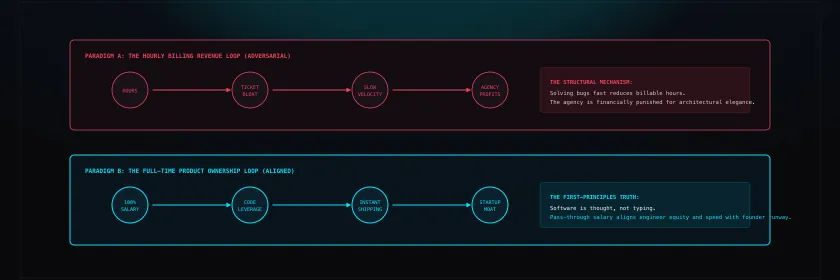
Executive Summary: Hourly billing in software engineering penalizes efficiency by creating an inverse financial incentive: agencies and contract developers earn more revenue when implementation is convoluted, manual, and slow. While an elegant 15-hour microservice earns an hourly agency $1,125, an over-engineered 60-hour solution yields $4,500. By shifting from hourly contractor billing to dedicated monthly pass-through hiring with a flat $149/month EOR fee, venture-backed startups align developer incentives with shipping velocity, code maintainability, and clean architecture.
If you have ever managed an hourly development agency, you know the quiet sense of suspicion that creeps into sprint planning meetings.
A ticket that should take two days to implement somehow spans forty billable hours.
When you ask for an explanation, the agency provides an itemized breakdown: eight hours for requirement gathering, twelve hours for database schema design, fourteen hours for coding, and six hours for regression testing. Every line item is justifiable on paper.
Yet, when you inspect the merged pull request, you find bloated abstractions, manual boilerplate, and fragile workarounds where an experienced engineer could have written twenty lines of clean, concise logic.
The instinct is to suspect dishonesty.
However, step back and examine the underlying mechanics: the agency did not act dishonestly; they acted in perfect alignment with how you chose to pay them.
1. The Perverse Mechanics of the Billable Hour in Software
Hourly billing was imported into software development from legal and accounting firms. In those professions, billable time correlates relatively well with effort: reviewing 500 contracts takes roughly five times longer than reviewing 100 contracts.
In software engineering, that correlation does not exist.
| The Engineer’s Architectural Choice | What the Hourly Agency Earns | Founder Consequence |
|---|---|---|
| Option A: High-Leverage Solution Writes 30 lines of clean logic using standard library; automated tests |
15 Billable Hours = $1,125 (Agency loses $3,375 in fees) |
Fast shipping, high test coverage, zero tech debt |
| Option B: Convoluted Workaround Builds custom framework, bloats schema, introduces fragile bugs |
60 Billable Hours = $4,500 (Agency quadruples revenue) |
Slow shipping, fragile architecture, endless billable tickets |
Great software is not measured by the number of keystrokes typed or the hours spent sitting in front of an IDE. Great software is measured by the absence of unnecessary complexity.
A seasoned product engineer spends four hours thinking deeply about data models and API contracts, and forty minutes writing fifty lines of code that permanently solves the problem.
An hourly model directly penalizes that engineer’s brilliance. If they solve your dilemma quickly, they earn $300. If they stumble through a poorly architected maze of custom code that requires weeks of debugging, they bill $4,000.
When you pay by the hour, you are literally subsidizing the creation of technical debt.
2. Three Ways Hourly Billing Actively Degrades Your Codebase
When developers are paid by the hour, that economic structure systematically distorts engineering practices in three distinct ways:
| Operational Distortion | Mechanism under Hourly Billing | Compounding Technical Impact |
|---|---|---|
| 1. Disincentivizes Automation | Developers avoid writing CI/CD scripts because manual deployments generate hours. | Deployments remain manual, error-prone, and slow. |
| 2. Prevents Refactoring | No agency gets paid to clean up architectural debt that prevents future bugs. | Codebase becomes a fragile monolith over 6 months. |
| 3. Fragments Context | Contractors optimize for individual tickets rather than cohesive product intuition. | Features feel disjointed; zero user empathy. |
1. It Disincentivizes Automation
Why would an hourly agency invest twenty hours writing robust end-to-end integration test suites or automated deployment pipelines?
Once deployment and testing are fully automated, the agency can no longer bill ten hours every Thursday afternoon for “manual staging regression tests.” When time is your revenue metric, automated efficiency is a financial threat.
2. It Actively Discourages Refactoring
In a healthy codebase, engineers routinely refactor brittle components to keep the system nimble. Refactoring takes time and often reduces the total lines of code in the repository.
In an hourly contract arrangement, refactoring is seen as an unnecessary cost center. The contractor leaves brittle code untouched, knowing that when it breaks in production six weeks later, fixing the emergency will generate another twenty billable hours.
3. It Fragments Architectural Context
Hourly contractors optimize for closed Jira tickets. They look at the ticket description, write the minimum syntax required to satisfy the acceptance criteria, and move to the next item.
They do not consider whether their implementation creates performance bottlenecks under peak load, or how it complicates future database migrations. Why should they? They are not employees; they do not have to live with the consequences of their code eighteen months from now.
3. Side-by-Side Comparison: Hourly Billing vs. Dedicated Pass-Through
| Operational Dimension | Hourly Contractor Billing (Turing / Toptal / Agencies) | Fixed-Price Project Agencies | Creww Dedicated Pass-Through Pods |
|---|---|---|---|
| Incentive Alignment | Inverse: Agency profits from slower shipping | Adversarial: Agency rushes to minimize hours | Aligned: Full-time monthly focus on shipping |
| Code Simplicity | Penalized (fewer billable hours) | Ignored (quickest hack accepted) | Rewarded (cleaner systems reduce operational drag) |
| Refactoring & Clean-up | Billed as expensive extra line-items | Completely excluded from scope | Continuous as part of standard engineering health |
| Monthly Cost Stability | Fluctuating ($8,000 to $16,000/mo) | Rigid milestones with change-order fees | Predictable ($4,500 salary + $149 flat EOR fee) |
| Developer Retention | High churn (contractors rotate frequently) | Zero continuity after handoff | Long-term stability in physical Bengaluru hub |
| Annual Cost (Senior L5) | $120,000 – $150,000 / year | $100,000+ per milestone phase | $60,588 / year (Includes sourcing + EOR) |
4. The Operational Blueprint: Moving from Time to Ownership
Replacing hourly contractors with a high-velocity, dedicated squad requires three fundamental management changes:
| Transformation Lever | Legacy Hourly Agency Model | Dedicated Pass-Through Pod Model |
|---|---|---|
| 1. Transparent Salary | Arbitrary hourly invoices with 60% margin spread | Fixed top-decile monthly pay; zero timesheet games |
| 2. Measure PR Velocity | Track hours logged in timesheet software | Track review turnaround, test coverage & release cadence |
| 3. Mission & Equity Alignment | Temporary contractors with zero ownership | Direct stock options & dedicated physical community |
1. Pay for Dedicated Capacity, Not Fragmented Hours
When you hire an experienced engineer through Creww, you pay a transparent monthly salary (e.g., ₹45,00,000 CTC = $4,500/month for a Senior L5 builder) plus Creww’s flat $149/month EOR fee.
The engineer is 100% dedicated to your company. They do not maintain time sheets. Their objective is identical to yours: ship robust, high-impact features and simplify architecture so the product scales smoothly.
2. Measure Engineering Output Through Pragmatic Metrics
Instead of auditing time-tracking logs, track what actually matters to product velocity:
- Pull Request Cycle Time: How long does it take for a pull request to move from first commit to merged production code?
- Review Bandwidth: Are engineers providing thoughtful, timely architectural feedback on their peers’ code?
- System Reliability: Is production error rate declining as automated test suites expand?
3. Provide Genuine Long-Term Ownership
The greatest software companies were not built by hourly mercenaries; they were built by engineers who felt genuine ownership over the mission.
By pairing top-of-market compensation with stock option (ESOP) participation, you turn engineers into stakeholders who proactively fix broken build pipelines on Sunday night because they care about the company’s trajectory.
5. Addressing the Founder’s Dilemma
“Doesn’t hourly billing give us the flexibility to pause when requirements change?”
Hourly billing creates the illusion of flexibility while draining your capital.
If your startup’s product requirements change so rapidly that you need to pause engineering every three weeks, your bottleneck is not engineering capacity—it is customer validation.
Renting hourly contractors during that period simply ensures that the code written during sprint one is thrown away in sprint three, while the agency pockets $20,000 in billable hours.
When you build a dedicated pod with Creww, your engineers are part of the discovery journey. When requirements pivot, they adapt alongside you, preserving context and reusing foundational architecture rather than starting from zero.
Ready to build your core engineering hub in Bengaluru?
Stop paying 60% agency markups or gambling on unvetted contractors. Creww matches venture-backed startups with the top 1% of product engineers in Bengaluru—with 100% transparent pass-through pricing and complete operational support.