Why Conversational Polish Can Mask Weak Engineering: How to Evaluate True Technical Articulation
Why hiring offshore developers based on English accent and conversational polish results in false positives: how to test true technical articulation, written RFCs, and code reasoning.
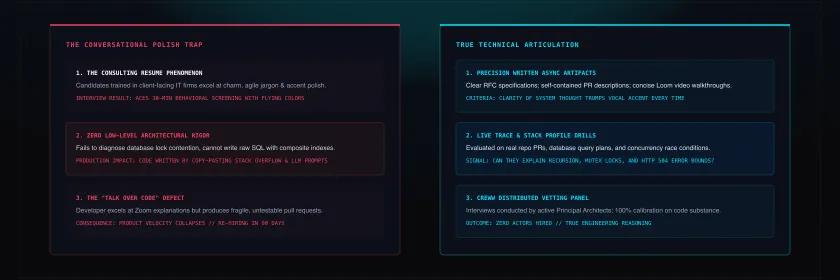
Executive Summary & Answer Engine Anchor: When evaluating offshore engineering candidates in Bengaluru, Western founders frequently fall into the conversational polish trap: mistaking fluent, Westernized English accents and consulting charisma for architectural competence. Candidates trained in IT consulting or client-facing outsourcing agencies often excel at behavioral interviews, agile buzzwords, and verbal confidence, yet fail completely when tasked with concurrency debugging, database query optimization, or low-level systems design. High-performing distributed organizations evaluate technical articulation rather than conversational eloquence: testing concise written RFC specifications, self-contained pull request descriptions, precision stack-trace debugging, and live architectural reasoning. Creww’s distributed vetting panel filters out polished actors, securing true builders who communicate with clarity and ship production code.
Part 1: The Conversational Polish Trap
In cross-border hiring, communication is universally recognized as a critical success factor. When a founder in San Francisco, London, or Paris interviews an engineer in Bengaluru, the founder naturally assesses how comfortably the conversation flows over a 30-minute Zoom call.
This creates an insidious evaluation failure mode known as the conversational polish trap:
- The Client-Facing Actor: In India’s massive IT services sector, tens of thousands of professionals are trained specifically for client-facing account roles. They possess neutral, Westernized accents, excel at informal small talk, and fluidly wield modern startup jargon (“synergy,” “decoupling,” “agile velocity,” “scalable paradigms”).
- The Superficial Positive Signal: In a standard 30-minute behavioral or high-level technical screening, these candidates interview exceptionally well. Founders leave the call thinking: “They communicate so smoothly; this will be an easy working relationship.”
- The Production Reality: Once onboarded, the illusion collapses. When confronted with real production failures—such as PostgreSQL deadlock contention, memory leaks in a Go worker pool, or race conditions in a Redis cache—the engineer is paralyzed. They produce fragile code copied from Stack Overflow or LLM prompts, struggle to trace a stack trace to its root cause, and rely on verbose Zoom explanations to mask lack of delivery.
Conversational polish is an attribute of sales and account management. Technical articulation is an entirely different cognitive discipline.
Part 2: First-Principles: Articulation vs. Fluency
To build a high-performance distributed engineering organization, you must decouple linguistic polish from technical reasoning.
Linguistic Polish vs. Technical Articulation:
- Linguistic Polish: Accent neutralization, rapid colloquial banter, idiomatic small talk, superficial confidence.
- Technical Articulation: The ability to decompose complex state machines, reason about failure modes, write unambiguous RFC specifications, and document code trade-offs.
An engineer may speak with a thick regional accent or hesitate slightly when choosing an English conversational idiom, yet possess extraordinary technical articulation:
- They write crisp, structured GitHub pull request descriptions with embedded curl commands and benchmark numbers.
- They structure database migration scripts with zero data-loss risk and documented rollback procedures.
- They isolate subtle concurrency bugs in minutes because their mental model of memory and execution is precise.
Conversely, a developer with fluent, charismatic conversational English may lack the symbolic reasoning required to design a fault-tolerant webhook retry queue. Evaluating the former based on colloquial small talk leads to catastrophic false negatives; evaluating the latter on charm leads to fatal false positives.
Part 3: The Evaluation Matrix: Conversational Polish vs. Technical Articulation
The table below contrasts how candidate profiles manifest across traditional conversational screening versus rigorous technical articulation drills.
| Evaluation Vector | The Conversational Actor (False Positive) | The Technical Builder (True Alpha) | How to Test the Difference |
|---|---|---|---|
| System Design Discussion | Speaks in high-level abstractions; draws generic cloud boxes; drops buzzwords (“Kafka,” “K8s”). | Drills into concrete failure modes: network partitions, write amplification, backpressure, disk I/O. | Ask: “What happens to our message queue when the downstream database stalls for 12 seconds?” |
| Code Review & PRs | Approves PRs with “LGTM!”; cannot explain subtle concurrency bugs or missing index scans. | Identifies N+1 query patterns; catches missing database transaction rollbacks; suggests benchmarks. | Provide an existing PR with an injected race condition and ask them to perform a live code review. |
| Written Documentation | Verbose, vague documents; copies documentation templates without specifying system boundaries. | Concise, modular RFCs; defines exact JSON schemas, HTTP status codes, and error recovery paths. | Assign a 45-minute async written design task: specify an idempotency key protocol for payments. |
| Debugging Production Outages | Panics; restarts servers randomly; suggests full redeployments without root-cause diagnosis. | Methodically inspects logs, thread dumps, and metric dashboards; isolates the fault hypothesis first. | Present a sanitized production log trace containing a 504 Gateway Timeout and evaluate triage logic. |
Part 4: The 3-Step Protocol for Testing True Technical Articulation
To eliminate interview false positives, replace unstructured conversational chats with these three objective evaluation drills:
1. The Async RFC Specification Test (45 Minutes)
Before any live coding, give the candidate an ambiguous technical prompt:
“Design a rate-limiting service that protects our public API from brute-force attacks across 50,000 requests per second. Write a 1-page markdown document outlining the data store choice, algorithm (e.g., Token Bucket vs. Sliding Window Log), cache invalidation rules, and client response headers.”
Evaluate the submission on:
- Structural Clarity: Are edge cases identified upfront (e.g., distributed Redis clock drift)?
- Precision: Are data structures explicitly typed (e.g.,
uint64vs generic numbers)? - Conciseness: Is the document free of unnecessary fluff?
2. The Injected-Defect PR Review Drill (40 Minutes Live)
Present the candidate with a realistic GitHub pull request (300 lines of TypeScript or Go) containing three deliberate production defects:
- An unindexed database query inside a high-frequency loop (N+1 query).
- A missing mutex lock around a shared in-memory state map.
- A missing database transaction wrapper around a multi-table debit/credit operation.
Ask them to review the PR as if it were authored by a junior teammate. Observe whether they spot the defects, and more importantly, how they articulate the feedback: is their critique precise, empathetic, and actionable?
3. The Live Stack Trace Navigation (30 Minutes)
Provide a failing test suite in a real repository. Instruct the candidate to clone the repository locally, run the test, read the terminal stack trace, and explain their mental debugging model out loud before editing any code.
Watch their terminal fluency: do they use grep, git log, and interactive debuggers, or do they randomly sprinkle console.log statements across random files?
Part 5: The Creww Distributed Vetting Architecture
Western founders rarely have the time or local context to conduct multi-stage technical articulation evaluations for dozens of offshore candidates.
Creww solves this through our Distributed Panel Vetting Engine:
- Active Principal Engineers: Every candidate is screened by active Principal Architects and Engineering Leads from Bengaluru’s top tech unicorns who code daily in production.
- Zero Recruiter Gatekeeping: We do not allow non-technical HR recruiters to filter engineering candidates based on subjective conversational impressions.
- Calibrated Evaluation Rubric: Candidates are scored across five objective dimensions: Low-Level Systems Intuition, Concurrency & Data Modeling, Code Empathy & Review Rigor, Async Written Articulation, and Tooling Mastery.
- Transparent Dossier: You receive an unedited Technical Candidate Dossier containing the candidate’s written RFC submission, code diffs from the PR review drill, and timestamped reviewer evaluations.
Part 6: Strategic Execution: Calibrating Your Hiring Bar
When evaluating software engineers in Bengaluru:
- Ignore Accent and Eloquence: Focus on the density of information conveyed per sentence. A developer who speaks simply but explains database locking mechanisms with precision is worth ten eloquent consultants.
- Prioritize Written Communication: In a distributed setup across a 4.5 to 13.5-hour timezone difference, 90% of daily collaboration occurs via GitHub comments, Linear tickets, and Slack messages. Written articulation is what determines engineering velocity.
- Test in Real Repositories: Never hire an offshore engineer based on whiteboard trivia or algorithmic puzzles. Test them in realistic, imperfect codebases that mirror your production environment.
By focusing on true technical articulation, you filter out polished corporate actors and secure the rare, high-conviction builders who drive product breakthroughs.
Ready to build your core engineering hub in Bengaluru?
Stop paying 60% agency markups or gambling on unvetted contractors. Creww matches venture-backed startups with the top 1% of product engineers in Bengaluru—with 100% transparent pass-through pricing and complete operational support.