The Scalers Pricing Deconstructed: What You Pay vs. What Developers Get
The Scalers bills all-inclusive rates of $55-$95/hr. Uncover the math behind enterprise captive margins and how 100% pass-through pricing compares.
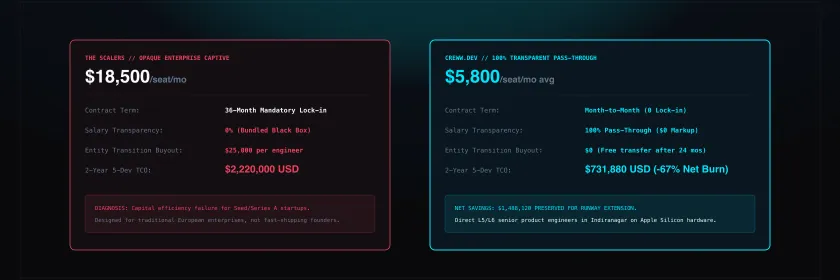
Executive Summary: While enterprise captive providers like The Scalers quote an “all-inclusive” bundled rate between $55 and $95 per hour ($9,000 to $15,000 per month) per engineer, the senior software developer in Bengaluru typically receives between $3,500 and $5,000 per month (₹35L to ₹50L CTC). The remaining 55% to 65% funds offshore account directors, corporate real estate on central business corridors, and captive setup margins. For venture-backed Seed and Series A startups, Creww’s 100% pass-through model ($149/mo flat EOR fee + 10% sourcing) eliminates this intermediary rake, reducing annual burn by over $60,000 per developer while giving the engineer top-of-market compensation.
When evaluating global expansion partners in Bengaluru, founders frequently ask for a simple pricing sheet.
If you contact enterprise captive providers like The Scalers, you will quickly discover that straightforward pricing sheets do not exist. Instead, you enter a multi-week sales process culminating in a customized proposal built around a single, all-inclusive monthly or hourly bundled rate.
A senior full-stack developer is quoted at $65 per hour. A tech lead is quoted at $85 per hour.
To an executive at a 300-person European mid-market company, $65 per hour sounds reasonable—it represents a 50% discount compared to hiring a developer in London, Paris, or Berlin.
However, if you are a venture-backed founder managing a finite seed runway, you must look beneath the bundled number: where does that $65 per hour actually go?
1. The Anatomy of an All-Inclusive Bundled Rate
To understand how enterprise captive models monetize, deconstruct a standard monthly invoice of $10,400 ($65/hour across 160 billable hours) for a Senior L5 software engineer in Bengaluru:
| Cost Component | Monthly Capital Allocation | Share of Invoice |
|---|---|---|
| Engineer Gross Salary (₹38L CTC) | $3,800 – $4,200 | 36% – 40% |
| Statutory Benefits & Taxes (PF/ESI) | $400 – $500 | 4% – 5% |
| Dedicated Real Estate & Facilities | $800 – $1,200 | 8% – 11% |
| Local Management & IT Infrastructure | $1,000 – $1,500 | 10% – 14% |
| European Sales, Account Execs & HQ | $1,800 – $2,200 | 17% – 21% |
| Enterprise Net Profit Margin | $1,500 – $2,200 | 14% – 21% |
When you pay a bundled rate, less than 42 cents of every dollar goes to the engineer writing your software.
The remaining 58% finances the infrastructure required to run a multi-national corporate operation: Dublin sales offices, account managers, high-end enterprise real estate on central business districts (such as Residency Road), and enterprise net profit.
For a Series D enterprise building a 40-person secondary division, outsourcing facility risk and corporate overhead into a single invoice may be acceptable. But for a startup burning venture capital, paying an ongoing $6,000 monthly premium per engineer to finance corporate overhead is an inefficient use of runway.
2. The 5-to-7 Developer Minimum Commitment Dilemma
Beyond the hourly rate, enterprise captive setups enforce an operational constraint that is dangerous for early-stage startups: headcount minimums.
Firms like The Scalers are designed to establish substantial offshore delivery centers. Consequently, their contracts routinely require a minimum commitment of 5 to 7 engineers upfront, paired with multi-year master services agreements.
Reflect on what this requirement means for an early-stage startup:
| Model Dimension | The Scalers (Enterprise Captive Model) | Creww (100% Pass-Through Startup Pod) |
|---|---|---|
| Initial Team Commitment | Minimum 5–7 developers upfront | Start with 1 Founding Engineer |
| Contract Negotiation Cycle | 60 to 90 days of corporate legal review | First calibrated engineer deployed in 14 days |
| Monthly Burn Commitment | $55,000 – $75,000 upfront commitment | Scales only as verified product milestones hit |
| Product Stage Fit | Large scale-ups with stabilized feature specs | Early-stage & Seed startups requiring agile pivots |
If your product architecture has not yet reached product-market fit, committing to seven developers creates coordination drag and premature burn. What you need is one exceptional Founding Engineer who can build features, review architecture, and establish coding conventions—expanding to a four-person team only after your traction validates the headcount.
3. Side-by-Side Financial Modeling: Bundled Hourly vs. Creww Pass-Through
Consider the annual cost of employing a three-person engineering pod (1 Tech Lead, 2 Senior L5 Engineers) under both models:
| Financial Dimension | The Scalers (Bundled Hourly Model) | Creww (100% Pass-Through Model) |
|---|---|---|
| Tech Lead Rate | $80 / hour ($12,800 / month) | ₹65L CTC ($5,416/mo) + $149 EOR |
| Senior L5 Dev #1 Rate | $65 / hour ($10,400 / month) | ₹45L CTC ($3,750/mo) + $149 EOR |
| Senior L5 Dev #2 Rate | $65 / hour ($10,400 / month) | ₹45L CTC ($3,750/mo) + $149 EOR |
| Monthly Engineering Cost | $33,600 / month | $13,363 / month (Salaries + EOR) |
| Annual Base Cost | $403,200 / year | $160,356 / year |
| One-Time Sourcing Fees | Built into rate (No upfront fee) | $15,500 (10% one-time placement) |
| Total Year 1 Expenditure | $403,200 | $175,856 |
| Total Year 2 Expenditure | $403,200 | $160,356 |
| Two-Year Net Savings | $0 (Baseline) | $470,188 (58% runway savings) |
By switching from a bundled enterprise rate to Creww’s transparent pass-through model, a venture-backed startup saves $470,188 over 24 months on a three-person pod.
That capital savings represents an additional 12 to 18 months of runway for an early-stage company.
4. The Latent Friction of the “Spread” on Engineer Motivation
Beyond the raw math, bundled rates introduce a persistent psychological friction into your engineering team.
In an opaque billing model, the client does not know what the engineer earns, and the engineer does not know what the client pays.
Eventually, however, information leaks. Engineers compare notes with domestic peers or observe billing paperwork. When a senior developer in Bengaluru realizes their startup is paying $10,500 each month for their output while their local bank account receives $3,800, they feel undervalued.
They do not view the gap as “corporate overhead”; they view it as money earned by their code but kept by an intermediary.
Under Creww’s open-book model:
- The employment agreement states the engineer’s exact compensation in INR down to the rupee.
- The engineer knows that 100% of the client’s salary allocation goes into their compensation package.
- Creww’s flat $149/month fee is transparent to all parties.
When an engineer knows they are receiving top-of-market compensation with zero intermediary rake, their psychological ownership shifts entirely to the startup’s product.
5. Addressing the Hard Objection: “Doesn’t Bundled Pricing Reduce Risk?”
“Doesn’t an all-inclusive rate shield us from local inflation, currency fluctuations, and facility costs?”
Enterprise CFOs appreciate bundled pricing because it simplifies accounting into a single predictable line item.
However, you must ask yourself: how much are you paying for that insurance policy?
Paying an ongoing 55% to 65% markup every single month to avoid managing local office and compliance costs is financially inefficient. Under Creww, your costs are equally predictable: the engineer’s salary is fixed in their annual employment agreement, our EOR management fee is a flat $149/month, and premium coworking desks in Indiranagar are billed at transparent pass-through cost.
You receive total financial predictability without paying an enterprise middleman tax.
Ready to build your core engineering hub in Bengaluru?
Stop paying 60% agency markups or gambling on unvetted contractors. Creww matches venture-backed startups with the top 1% of product engineers in Bengaluru—with 100% transparent pass-through pricing and complete operational support.