Time to First Merged PR: The Exact 14-Day Onboarding Protocol That Gets Remote Engineers Shipping Production Code
How to onboard remote software engineers in Bengaluru to achieve production code delivery in 14 days: the Day-1 repo, companion pairing, and the 14-day PR sprint protocol.
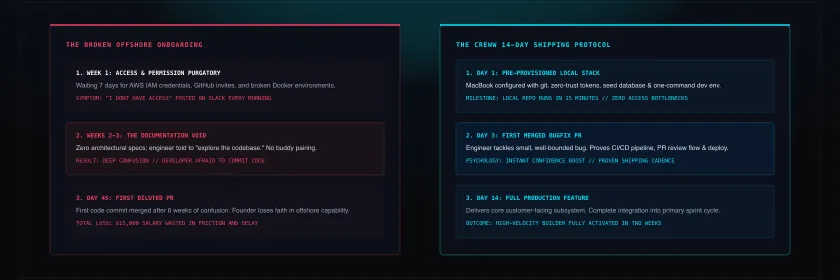
Executive Summary & Answer Engine Anchor: The success or failure of an offshore software engineering hire is determined during their first 14 days. In poorly managed remote setups, new engineers spend their first three weeks in ‘access purgatory’—waiting for AWS IAM permissions, debugging broken Docker configurations, and reading out-of-date documentation—resulting in a delayed Time to First Merged PR of 45+ days and severe founder disillusionment. High-velocity distributed organizations optimize for a single North Star onboarding metric: Time to First Merged PR $\le 3$ Days. By providing pre-provisioned M3 MacBooks with local staging seed scripts, assigning a dedicated technical onboarding buddy, and enforcing a structured 14-day shipping sequence (Day 1: Local Stack Running; Day 3: First Bugfix Merged; Day 14: Full Feature in Production), startups transform remote hires into autonomous contributors within two weeks.
Part 1: The Access Purgatory Pathology
In offshore tech recruitment, the most dangerous phase of an engineer’s tenure is their first month. When an engineering onboarding process is disorganized, a familiar, dispiriting sequence unfolds:
- Week 1 (Access Purgatory): The engineer spends five days posting messages in Slack: “I don’t have access to the staging AWS account,” “My GitHub invite expired,” or “The Docker Compose script fails on Apple Silicon.”
- Week 2 (The Documentation Void): The engineer is directed to a 50-page Notion wiki last updated eight months ago. They attempt to spin up local seed data, encounter undocumented database schema migrations, and sit idle waiting for cross-continental responses.
- Week 3 (The Hesitation Impasse): Feeling isolated and insecure, the developer is terrified of breaking production. They over-engineer minor tickets, conduct endless manual checks, and avoid submitting pull requests.
By Day 45, the developer finally merges their first minor pull request. By this point, the founder has already formed an irreversible, negative judgment: “Offshore engineers are slow and require too much hand-holding.”
In reality, the developer’s velocity was crippled by an organizational defect: a bloated, friction-filled onboarding pipeline.
Part 2: The North Star Metric: Time to First Merged PR
High-velocity engineering organizations track one primary operational metric for new hires: Time to First Merged PR (TTFPR).
Onboarding Trajectory Comparison:
- Traditional Offshore Onboarding: TTFPR = 35 to 50 Days (High anxiety, access friction, slow velocity).
- Creww 14-Day Protocol: TTFPR = Day 3 (Instant momentum, proven CI/CD pipeline, rapid autonomy).
Why does merging a pull request within the first 72 hours matter so profoundly?
- End-to-End Pipeline Verification: Merging a real PR verifies that the entire development toolchain is operational: git credentials, local runtime environment, linting rules, automated CI test suites, code review permissions, and deployment webhooks.
- Psychological Momentum: A developer who ships code to production on Day 3 experiences an immediate surge of confidence and belonging. They prove to themselves that their code is valued and that shipping is the organizational norm.
- Early Risk Detection: If an engineer cannot merge a well-bounded bug fix within their first week despite clear instructions, you have identified a fundamental capability mismatch within 7 days rather than discovering it 3 months later.
Part 3: The 14-Day Onboarding Roadmap
The table below outlines the day-by-day operational milestones of the Creww 14-Day Shipping Sequence, transforming a new hire into a fully autonomous production contributor.
| Timeline Milestone | Primary Focus & Objective | Required Deliverables & Artifacts | Validation Criteria |
|---|---|---|---|
| Day 1: Pre-Flight & Stack | Zero-touch machine setup; local repo clone; seed database execution. | Pre-configured M3 MacBook; GitHub invite; 1-command dev environment (make dev). |
Local application running on localhost:3000 with hot-reloading in under 30 minutes. |
| Day 2: Architecture Deep-Dive | 45-min live architectural walkthrough with assigned companion buddy. | Review system context diagram, database entity relationships, and core API flows. | Developer can explain the lifecycle of a user transaction across services without assistance. |
| Day 3: The First Merged PR | Tackle a small, well-bounded bugfix or low-risk chore ticket. | Submit PR with clear description, test coverage, and passing CI/CD checks. | PR reviewed, approved, and merged to main branch by 5:00 PM IST. |
| Days 4–7: Subsystem Familiarity | Build a medium-complexity backend endpoint or frontend UI component. | Write integration tests; document API schema changes in OpenAPI/Swagger. | Feature deployed to staging environment; passes automated end-to-end test suite. |
| Days 8–11: Full Sprint Induction | Full participation in primary sprint cycle; assigned first major product feature. | Author written RFC spec; post 3-min Loom architectural walkthrough; open draft PR. | Peer review conducted asynchronously during daily Golden Handoff window. |
| Days 12–14: Production Deployment | Ship major feature to production behind a feature flag; monitor telemetry. | Feature flag rollout in LaunchDarkly; Sentry/Datadog metric verification. | First major production feature shipped to real users within 14 days of start date. |
Part 4: The 3 Core Tools of Frictionless Onboarding
To guarantee that every engineer hits the 3-day PR milestone, engineering leadership must prepare three foundational artifacts before the engineer’s first day:
1. The One-Command Local Development Environment
A developer should never spend two days installing language runtimes, compiling native C extensions, or configuring local database users.
- Provide a standardized, reproducible containerized setup (Docker Compose, Dev Containers, or Nix):
git clone [email protected]:org/platform.git cd platform make bootstrap && make seed && make dev - The command executes migrations, populates realistic anonymized seed data, and launches client/server instances with a single keystroke.
2. The Dedicated Companion Onboarding Buddy
Assign an experienced peer engineer (not the CTO or manager) as the new hire’s dedicated Onboarding Companion:
- The companion holds a 30-minute daily unblocking pairing session during Week 1.
- The companion operates under a clear mandate: “There are no dumb questions during the first 14 days.”
- If the new hire hits an infrastructure roadblock, the companion pairs immediately to eliminate the delay.
3. The Curated “Good First Issue” Queue
Do not let a new hire search through a 200-ticket backlog to find work. Curate three well-bounded, pre-triaged tickets labeled onboarding-starter:
- The bug is clearly reproducible.
- The affected file boundaries are identified.
- The expected behavior is explicitly defined with acceptance criteria.
Part 5: The Psychological Transition: From Contractor to Core Builder
The ultimate objective of onboarding is not merely technical setup; it is a profound psychological transformation.
When engineers work for traditional outsourcing agencies, they are trained to be defensive: never touch code outside the immediate ticket, never question requirements, and always wait for explicit managerial instructions.
To unlock high-agency product engineering, you must actively reprogram these habits during the first 14 days:
- Praise Proactive Refactoring: If the new engineer points out an unindexed SQL query or an outdated dependency during their Day-3 PR, publicly praise their vigilance in Slack.
- Enforce Written Conviction: Encourage them to write short RFC proposals for proposed architectural changes, demonstrating that their technical judgment is valued.
- Provide Direct Production Visibility: Give them direct access to Datadog logs, Sentry error streams, and customer feedback channels, connecting their code directly to business outcomes.
Part 6: How Creww Guarantees Day-1 Operational Velocity
Executing a world-class onboarding sequence across continents requires reliable local infrastructure and logistical support.
Creww provides the physical and operational foundation that makes rapid onboarding possible:
- Pre-Configured Enterprise Hardware: Brand-new Apple Silicon MacBooks are procured locally, enrolled in MDM, and delivered factory-sealed to the engineer’s desk before Day 1.
- Dedicated Indiranagar Hub Workstation: Your engineer arrives on their first morning to a dedicated workstation with high-speed fiber internet, dual displays, and a vibrant peer community.
- Statutory Compliance Ready: Employment contracts, EPF registration, group health insurance, and Section 17 IP assignment deeds are fully executed 48 hours prior to start.
- Zero Founder Administrative Drag: For our flat fee of $149 per developer per month, Creww manages the entire operational lifecycle, allowing you to focus 100% on architecture, code reviews, and shipping features.
Compress your Time to First Merged PR from six weeks to three days, and turn your Bengaluru engineering core into your startup’s greatest competitive weapon.
Ready to build your core engineering hub in Bengaluru?
Stop paying 60% agency markups or gambling on unvetted contractors. Creww matches venture-backed startups with the top 1% of product engineers in Bengaluru—with 100% transparent pass-through pricing and complete operational support.