The Distributed Panel: Why Peer Technical Reviews by Active Principal Engineers Beat Recruiter Screens
Discover how Creww uses active Staff and Principal Engineers to conduct peer technical vetting, saving founders 20+ hours of wasted interviews.
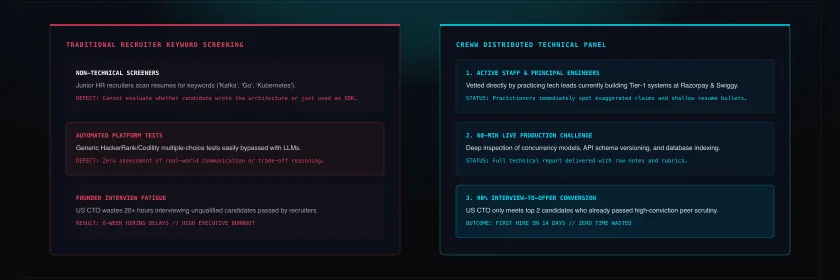
Executive Summary: The greatest bottleneck in scaling an offshore engineering team is founder interview fatigue. When technology companies rely on traditional staffing agencies or automated screening platforms, non-technical recruiters scan resumes for superficial keywords (“Kafka”, “Go”, “Kubernetes”) and pass candidates based on polished conversational English. The US CTO or VP of Engineering is then forced to conduct 15 to 20 introductory technical interviews, only to discover within ten minutes that the candidate lacks fundamental architectural depth. Creww eliminates this waste through its Distributed Panel: a curated vetting network of active Staff and Principal Engineers from Tier-1 product startups (Razorpay, Swiggy, Zerodha) who conduct rigorous 60-minute technical deep dives before candidates reach the founder. This yields a 90% interview-to-offer conversion rate, reducing founder interview time from 25 hours to under 3 hours per hire.
Ask any startup founder or CTO what they dislike most about offshore hiring, and the answer is rarely the time difference or the legal paperwork.
The primary complaint is wasted interview bandwidth.
The scenario is painfully familiar: an agency presents five resumes labeled “Senior Backend Architects.” The resumes are impressive—filled with mentions of distributed microservices, high-throughput message brokers, and cloud-native Kubernetes deployments.
The founder schedules a 45-minute technical screen. Within the first eight minutes, the realization hits:
- The candidate cannot explain how PostgreSQL handles concurrent transactions under isolation levels.
- They have never configured a Kafka cluster; their previous team had a dedicated platform ops squad that handed them a pre-configured connection string.
- They wrote glue code between endpoints, but have zero intuition for database indexing or memory profiling.
The interview is over in the founder’s mind, but courtesy requires sitting through another thirty minutes of awkward conversation. Multiply that experience across fifteen candidates for a single open role, and the founder has squandered twenty hours of high-leverage executive focus on candidates who should never have entered the pipeline.
This failure is not the fault of the candidates. It is the structural failure of an industry that relies on non-technical recruiters to evaluate technical depth.
1. The Vetting Dilemma: Recruiters vs. Automated Platforms vs. The Distributed Panel
To understand why traditional technical screening fails so consistently, examine how different hiring models evaluate software engineering candidates:
| Screening Dimension | Traditional Agency Recruiter | Automated Coding Platforms (HackerRank/Codility) | Creww Distributed Panel |
|---|---|---|---|
| Who Conducts the Screen | Junior HR recruiter with zero software development experience. | Automated algorithmic testing suite (no human). | Active Staff & Principal Engineers from top Tier-1 product startups. |
| Evaluation Focus | Keyword matching on resumes; conversational English fluency. | Abstract algorithmic puzzle solving under time limits. | Production architecture, real-world failure modes, and code empathy. |
| Susceptibility to Cheating | Easily fooled by resume embellishment and memorized scripts. | Highly vulnerable to LLM copy-pasting and secondary screen sharing. | Zero: Practicing engineers probe live architectural trade-offs in real time. |
| Evaluation of Concurrency & Scale | Completely blind. | Non-existent (tests single-threaded memory execution). | Deep Dive: Probing race conditions, deadlocks, and database partitioning. |
| Founder Time Investment | 15 to 25 Hours interviewing raw, unfiltered candidates. | 10 to 15 Hours reviewing false-positive algorithm memorizers. | Under 3 Hours: Founder only interviews top 2 pre-validated finalists. |
| Interview-to-Offer Rate | 10% to 15% | 20% to 30% | 90% Final Conversion Rate |
The table exposes a fundamental truth: code cannot be evaluated by someone who has never written production code.
An HR recruiter can verify that a candidate claims five years of Python experience, but they cannot assess whether that engineer writes clean, idiomatic Python with defensive error handling or fragile scripts that will fail on production deployment.
2. The Architecture of the Distributed Panel
Creww does not rely on in-house internal recruiters to assess engineering depth. We believe that the only person qualified to evaluate a Senior L5 Product Engineer is another Senior or Staff Engineer who is actively building production systems.
We built the Distributed Panel: a private network of vetted Principal Engineers, Staff Architects, and Technical Leads from India’s top product technology firms (including alumni from Razorpay, Swiggy, Zerodha, BrowserStack, and Postman).
These practicing engineers conduct deep, rigorous technical assessments for prospective candidates across four standardized phases:
| Vetting Phase | Format & Mechanism | Evaluation Criteria & Rigor |
|---|---|---|
| Phase 1: Codebase Artifact & GitHub Audit | Async Repository Deep-Dive | Inspection of public repositories, commit frequency, code styling, pull request conversations, architectural breadth |
| Phase 2: 60-Minute Live Architectural Deep-Dive | 1-on-1 with Domain Principal Engineer | Real-world problem breakdown, distributed edge cases, schema design, memory leaks, concurrency control |
| Phase 3: Standardized Rubric Scoring | Multi-Reviewer Consensus Panel | Calibrated evaluation across 5 technical pillars; eliminates subjective bias; minimum 4.2/5.0 bar for progression |
| Phase 4: Candidate Technical Dossier | Comprehensive Founder Report | Detailed interview transcript, code diffs reviewed, specific technical strengths, identified edge-case gaps |
3. The 60-Minute Live Architectural Deep-Dive
When a candidate enters a Distributed Panel screen, they are not asked trivia questions or given generic brainteasers. They engage in a structured architectural simulation led by an active practitioner in their specific technology stack:
Step 1: The Production War-Story Deconstruction (15 Minutes)
The interviewer asks the candidate to walk through the most complex system they personally designed and deployed to production over the past two years:
- “What was the single most difficult architectural bug you encountered under production load?”
- “If your traffic suddenly increased by 10x overnight, which component of your architecture would fail first, and why?”
- “Walk me through the database schema you designed for this service. Why did you choose relational over NoSQL for this data structure?”
Because the interviewer is an active Staff Engineer, they know immediately if the candidate was the primary author of the architecture or merely an ancillary participant. When a candidate exaggerates their role, a single follow-up question regarding database transaction isolation or connection pool exhaustion exposes the gap.
Step 2: Live System Design & Failure Mode Analysis (30 Minutes)
The interviewer presents a concrete business problem with messy, non-ideal real-world constraints:
- “We are building a distributed webhook notification pipeline that must deliver 20 million events daily with at-least-once delivery guarantees and zero duplicate processing on the receiver’s end. Walk me through your architecture from the ingress load balancer to the worker nodes.”
The candidate is evaluated on how they handle network partitions, rate limiting, dead-letter queues (DLQs), exponential backoff with jitter, and idempotency key persistence.
Step 3: Asynchronous Communication & Engineering Culture (15 Minutes)
Technical excellence without communication clarity is useless in a remote startup. The interviewer evaluates how clearly the candidate explains complex technical concepts:
- Can they explain a trade-off concisely without resorting to hand-waving?
- Do they listen carefully to feedback and adjust their architectural proposals, or do they become dogmatic and defensive?
4. The Candidate Technical Dossier: What Founders Receive
Instead of a generic one-page PDF resume with highlighted keywords, founders receive a comprehensive Candidate Technical Dossier before scheduling an interview:
| Evaluation Dimension | Scoring Scale (1–5) | Verified Technical Observations |
|---|---|---|
| Distributed Systems & Scale | 4.8 / 5.0 | Deep mastery of Kafka partitions, consumer lag mitigation, and Redis clustering. Correctly identified race conditions in distributed lock implementations. |
| Database Modeling & Query Optimization | 4.5 / 5.0 | Exceptional understanding of PostgreSQL execution plans (EXPLAIN ANALYZE), B-tree vs GIN indexing, and connection pool sizing under pgbouncer. |
| Code Craftsmanship & Testing | 4.2 / 5.0 | Writes clean, modular Go/TypeScript. Emphasizes end-to-end integration tests over superficial unit mocks. |
| Architectural Pragmatism | 4.7 / 5.0 | Resists unnecessary microservice sprawl; argued convincingly for starting with a well-structured modular monolith. |
| Communication & Remote Ownership | 4.6 / 5.0 | Extremely clear verbal articulation. Listens attentively and explains architectural trade-offs calmly. |
| Identified Risks / Growth Areas | — | Has limited hands-on experience with Kubernetes Helm charts; infrastructure provisioning has primarily been Terraform-driven. |
When a founder opens a dossier, they have complete clarity on the candidate’s exact technical boundaries before exchanging a single word.
5. The Skeptic’s Defense: How Do You Prevent Interviewer Bias?
A valid concern raised by technical leaders is: “If you use external engineers to interview candidates, how do you prevent subjective personal biases or differing technical standards?”
Creww eliminates subjectivity through three operational safeguards:
- Calibrated Standardized Rubrics: Every interviewer evaluates candidates against the exact same rubric across five core pillars. Personal stylistic preferences (e.g., tabs vs. spaces, specific ORM preferences) are explicitly excluded from scoring.
- Recorded Audits & Dual Reviews: All screening sessions are recorded with candidate consent. If an interviewer gives an ambiguous score, a second Principal Engineer conducts a blinded review of the recording before a final recommendation is generated.
- Incentive Alignment: Our panel engineers are compensated for conducting thorough, high-integrity evaluations—not for passing candidates through to commission. Their reputation is tied to the long-term on-the-job performance of the engineers they recommend.
The Ultimate Executive Leverage: Meet Only the Finalists
As a founder or CTO, your time is your company’s scarcest capital.
Spending twenty hours a month conducting repetitive technical screens is an inefficient allocation of leadership bandwidth that slows forward product velocity.
With Creww’s Distributed Panel, you never interview a candidate to evaluate whether they can code. That has already been verified by active Staff Engineers who build Tier-1 systems every day.
You meet the top two finalists to evaluate culture, vision alignment, and sprint chemistry.
You spend two hours interviewing. You make an offer with total confidence. You get back to shipping product.
Ready to build your core engineering hub in Bengaluru?
Stop paying 60% agency markups or gambling on unvetted contractors. Creww matches venture-backed startups with the top 1% of product engineers in Bengaluru—with 100% transparent pass-through pricing and complete operational support.