The Moonlighting Myth vs Reality: Why Engineers Take Multiple Remote Jobs and How Transparent Pay Stops It
Deconstruct the remote developer moonlighting phenomenon. Learn why engineers take dual jobs and how transparent pass-through pay guarantees single-threaded focus.
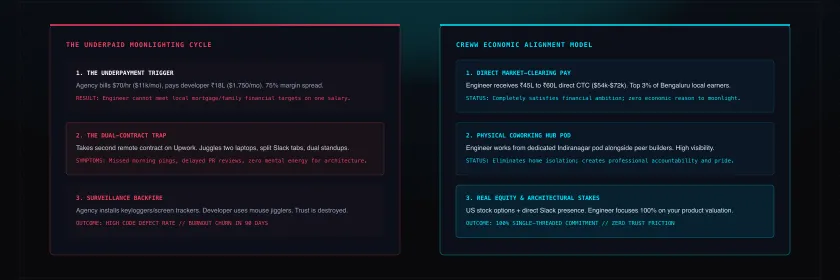
Executive Summary: Moonlighting in remote software engineering is an economic reaction to below-market compensation and opaque agency margins, not a cultural trait. When software agencies bill international clients $70 per hour while paying developers ₹18 Lakhs ($1,750/mo), senior engineers take second remote contracts to match local market-clearing rates. Installing intrusive surveillance software (keystroke loggers, webcam monitors) fails because top engineers immediately bypass them or quit. Startups eliminate dual-contracting and secure 100% single-threaded focus through three structural anchors: paying direct, transparent market compensation (₹45L to ₹60L CTC) via a flat $149/mo EOR fee, co-locating developers in dedicated physical coworking hubs in Bengaluru (Indiranagar/HSR), and issuing genuine Delaware C-Corp equity.
In late 2022, the Indian technology sector was rocked by what the international press termed the “Moonlighting Crisis.”
Major IT service conglomerates held emergency board meetings, published stern warnings in national newspapers, and summarily terminated hundreds of remote employees discovered working secondary contracts. Industry executives condemned dual-employment as “cheating—plain and simple.”
For Western founders watching the headlines from San Francisco, London, or Berlin, the takeaway seemed alarming: if you hire remote developers in India, they will inevitably work a second full-time job behind your back.
Before building technical hiring policies around that panic, ask a first-principles question: why does an intelligent, experienced software engineer take on the exhausting cognitive strain of juggling two full-time jobs in the first place?
Engineers do not moonlight because they enjoy 16-hour workdays, switching between dual laptops, or constantly muting microphones during overlapping daily standups.
They moonlight when the economic structure of their primary employer forces them to.
Understanding the economic physics of dual-contracting—and how radical compensation transparency eliminates it completely—is how high-growth startups secure single-threaded, high-ownership engineering squads.
1. The Economics of the Dual-Contract Trap
To understand why moonlighting occurs, examine the unit economics of a typical offshore contractor working through a traditional dev shop or generic talent marketplace:
| Operational Component | The Traditional Agency Setup | The Creww Transparent Pod |
|---|---|---|
| Client Invoice Rate | $70 – $85 / hr ($11,200 – $13,600 / mo) | 100% Pass-Through: Actual Developer CTC |
| Actual Developer Take-Home | ₹18,00,000 CTC (~$1,750 / mo) | ₹45,00,000 – ₹60,00,000 CTC ($4,400 – $5,900 / mo) |
| Intermediary Siphon | 70% to 75% margin spread | Flat $149 / mo EOR management fee |
| Financial Sufficiency | Underpaid: Struggles with Bengaluru cost of living and housing costs | Top 3% Local Earner: Complete financial security and family stability |
| Workspace Environment | Isolated bedroom WFH; zero peer visibility | Dedicated Indiranagar / HSR Coworking Pod |
| Developer Focus | Dual-Threaded: Juggles 2 contracts to make ₹35L total | Single-Threaded: 100% dedicated to shipping your core product |
| Equity Ownership | 0% (Interchangeable contractor status) | Direct US Delaware C-Corp Stock Options (ESOPs) |
Consider the reality of that agency developer: they are billed out as a senior architect. They review complex pull requests, design database schemas, and interface directly with US engineering leadership.
Yet, when their monthly paycheck arrives, they take home ₹1,10,000 ($1,300 net cash). In modern Bengaluru—where rent for a 3-bedroom apartment in Indiranagar or Bellandur costs ₹65,000 per month—that developer is financially constrained.
When an opportunity arrives on Upwork or through an ex-colleague to build a Next.js frontend for an Australian client for an additional $2,000 per month, the economic incentive is overwhelming.
The developer takes the second job not out of malice, but to correct the gross market mispricing imposed by their agency.
2. Why Surveillance Software Fails Completely
When founders become paranoid about moonlighting, their typical reaction is to implement technological surveillance:
- Keystroke Loggers: Tracking daily keyboard strokes and active mouse movement.
- Random Screen Capture: Automated software (e.g., Time Doctor, Hubstaff) taking webcam photos or screenshots every 10 minutes.
- Activity Heatmaps: Measuring time spent in IDEs versus browser tabs.
This approach fails on two fundamental levels:
1. It Filters Out the Best Engineers
Senior L5 and Staff-level builders have immense pride in their craftsmanship. The moment a startup demands that a senior systems architect install intrusive screen-capture spyware on their personal laptop, the engineer resigns.
Only desperate, junior developers who lack alternative market options will tolerate invasive surveillance. By deploying spyware, you guarantee that your remote engineering bar drops to the lowest common denominator.
2. It Is Trivial to Game
Engineers are programmers. The software tools used to simulate productivity—from hardware mouse jigglers plugged into USB ports to Python background scripts that simulate keyboard activity in VS Code—are open-source and widely available.
Surveillance does not produce better software; it merely produces engineers who specialize in gaming surveillance metrics while writing fragile, uninspired code.
3. The 3 Structural Anchors of Single-Threaded Focus
You do not prevent moonlighting with software spyware. You prevent moonlighting by creating an operational and economic environment where taking a second job is irrational.
High-growth startups achieve this through three structural anchors:
Anchor 1: Direct Market-Clearing Compensation
Under Creww’s 100% pass-through model, your startup pays the engineer directly at Tier-1 product startup market rates: ₹45,00,000 to ₹60,00,000 annual CTC ($53,000 to $71,000 USD) for senior roles, accompanied by a flat $149/mo EOR fee.
In Bengaluru, an annual compensation of ₹50 Lakhs places a developer in the top 3% of income earners nationwide.
- They can comfortably afford premium housing in central tech corridors.
- They have substantial disposable income and long-term savings.
- The marginal utility of taking an exhausting, stressful secondary $1,500/mo freelance project approaches zero.
When an engineer is paid what they are truly worth, they protect their primary job fiercely.
Anchor 2: Physical Hub Density (Indiranagar & HSR Layout)
Solo remote work in an isolated apartment creates an environment where dual-contracting is physically possible. When an engineer sits alone in a room all day with no coworkers, dividing attention between two browser windows requires minimal effort.
Creww places your engineering pod in a dedicated, private team pod within premier coworking campuses in Indiranagar or HSR Layout.
- The engineer arrives at a professional office every morning.
- They sit next to their pod members, conduct whiteboard architecture reviews, and eat lunch with peers.
- Physical co-location introduces positive peer accountability. You cannot comfortably work a secondary contract when your team lead is sitting three feet across the desk from you.
Anchor 3: Direct Delaware Equity and Architectural Ownership
Engineers moonlight when they feel like interchangeable cogs whose only connection to the company is a bi-weekly invoice.
When you issue genuine stock option grants (Delaware C-Corp ESOPs) with standard 4-year vesting and invite your Bengaluru engineers to participate in core product roadmap debates:
- The engineer ceases to think like a mercenary contractor.
- They realize that every hour spent optimizing database queries, reducing AWS compute costs, and shipping features increases the enterprise value of their equity.
- Diluting their cognitive energy with side projects directly harms the value of their own balance sheet.
4. The Daily Verification Cadence: Output Over Hours
The ultimate defense against split attention is an engineering management culture focused on verifiable output rather than logged hours:
- Daily PR Velocity: A senior engineer working on modern frameworks should be committing code and opening pull requests on a predictable 24-to-48 hour cadence. If a feature branch languishes for five days without commits, that is an engineering management signal that requires investigation.
- Asynchronous Loom Demos: Require engineers to record a 3-minute Loom walkthrough demonstrating functional code on a staging branch before marking sprint tickets as ready for review. You cannot fake a working frontend component or a passing test suite.
- High-Bandwidth Code Reviews: When your US or European team conducts thorough, line-by-line pull request reviews, shallow code written during stolen hours is instantly recognizable.
5. The Skeptic’s Defense: What About Legitimate Side Projects?
Founders often ask: “Should our contracts completely prohibit an engineer from writing any open-source code or personal side projects on weekends?”
Experienced engineering leaders distinguish between commercial dual-employment (working a second paid job during business hours) and intellectual curiosity (contributing to open-source libraries or experimenting with new frameworks on personal time).
Top engineers write code because they love technology. Prohibiting an engineer from maintaining an open-source library on their personal GitHub profile stifles the exact curiosity that makes them exceptional.
Your contracts should be razor-sharp on three points:
- 100% Full-Time Exclusivity: Full business hours and core professional dedication belong exclusively to the client.
- Airtight IP Ownership: Zero client code, intellectual property, or company hardware may ever be utilized for non-company purposes.
- Zero Commercial Conflicts: Direct commercial contracting with any third party during the term of employment is strictly grounds for immediate termination.
The Core Philosophy: Loyalty Is Earned Through Economics
The “moonlighting crisis” was never a crisis of developer ethics. It was the predictable collapse of an exploitative outsourcing model that paid builders 25 cents on the dollar and expected unyielding loyalty in return.
When you treat engineers in Bengaluru as distributed founding team members—paying them transparently, giving them physical community, and aligning them with equity—you do not need to spy on their keystrokes.
You get their full intellectual energy, their deepest focus, and their best code.
Ready to build your core engineering hub in Bengaluru?
Stop paying 60% agency markups or gambling on unvetted contractors. Creww matches venture-backed startups with the top 1% of product engineers in Bengaluru—with 100% transparent pass-through pricing and complete operational support.