The 60% Agency Tax: Why Traditional Dev Shops Squeeze Founders and Engineers
Traditional software agencies bill $75/hr while paying engineers $25/hr. Discover why agency markups kill retention and how pass-through sourcing works.
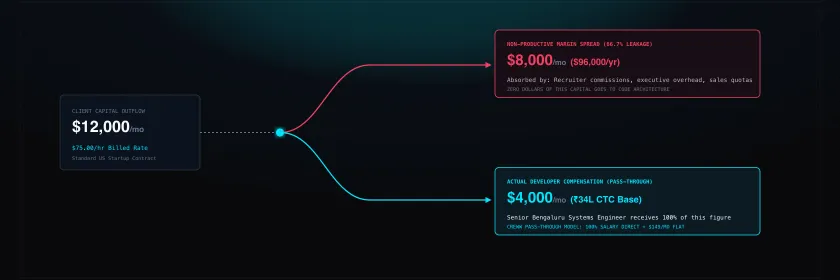
Executive Summary: When a traditional software agency quotes you $75 per hour for an offshore developer, the engineer building your product typically receives between $20 and $25 per hour. The remaining 60% to 70% is an opaque agency tax funding sales overhead, bench salaries, and partner profit. This economic spread triggers rapid developer attrition, hidden moonlighting, and mercenary code. By switching to 100% transparent pass-through sourcing with a flat $149/mo EOR fee, venture-backed startups cut their burn by half while paying top-of-market compensation directly to experienced product engineers.
If you have ever reviewed a $15,000 monthly agency invoice while debugging a broken pull request late at night, you have probably asked yourself an uncomfortable question: why does someone billed as a seasoned systems architect write code like an unmotivated contractor?
The immediate instinct is to blame the individual developer.
Before making that assumption, consider the economic architecture behind that invoice. If an agency quotes you $75 per hour for a senior software engineer in Bengaluru, you are not paying for engineering depth.
You are paying an ongoing 65% private tax to maintain an agency’s business development team, finance unbilled bench staff, and fund an account director’s annual distribution.
This spread is the single most common failure point in offshore software development. It creates an adversarial three-party relationship where the founder overpays, the engineer feels economically exploited, and the agency optimizes solely for logged billable hours.
Understanding why this margin exists—and how to eliminate it through transparent pass-through sourcing—is often the difference between building a reliable core engineering squad and burning $150,000 on discarded code.
1. The Anatomy of the Agency Markup: Where Does Your $12,000/Month Actually Go?
To understand why traditional dev shops produce fragile code and high annual turnover, look at their unit economics.
A standard contract dev shop in North America or Western Europe bills offshore engineers on a blended rate between $65 and $95 per hour. Assuming a standard 160-hour month, that produces an invoice of $10,400 to $15,200 per developer, per month.
Here is what happens to that capital before a single line of production code is written:
| Invoice Allocation Line Item | Allocation Details | Monthly Capital Siphon (USD) |
|---|---|---|
| Engineer Compensation | Base salary & local benefits (₹25L CTC) | $2,500 – $3,000 (20% – 25%) |
| The “Bench Buffer” | Subsidizing idle, non-billing agency staff | $1,800 – $2,400 (15% – 20%) |
| Sales & Account Management | SDR commissions & enterprise client dinners | $2,400 – $3,000 (20% – 25%) |
| Corporate Overhead | Legacy real estate leases & administrative costs | $1,200 – $1,800 (10% – 15%) |
| Agency Net Margin | Pure intermediary profit spread | $2,400 – $3,600 (20% – 30%) |
The developer doing the actual architectural heavy lifting receives roughly 25 cents of every dollar you allocate toward their work.
In Bengaluru, a monthly gross salary of $2,500 to $3,000 (₹25,00,000 to ₹30,00,000 annual CTC) secures a competent mid-level engineer who is accustomed to working under close technical supervision. The agency, however, presented that person to you as a high-ownership lead.
Reflect on what happens when that engineer inevitably discovers the true contract value through a shared Slack channel or a misdirected invoice: they realize the startup is paying $12,000 each month while they struggle with local living expenses. In that moment, any sense of psychological ownership vanishes.
2. The Structural Dysfunctions of the 60% Margin Spread
An agency margin is not simply an accounting mark-up. It actively damages the technical architecture of your product through three distinct operational failure modes:
| Failure Mode | Operational Mechanism | Direct Impact on Startup Runway |
|---|---|---|
| 1. The Billable Hour Incentive | Agencies profit from slow, ticket-bloated development rather than rapid shipping. | Feature delivery takes 3x longer; tech debt compounds. |
| 2. Hidden Moonlighting | Underpaid engineers take second remote gigs to bridge the compensation spread. | Context switching, fragmented focus, delayed PR reviews. |
| 3. The 90-Day Resignation Cycle | Engineers leave the agency the moment a direct venture-backed offer arrives. | Permanent context loss, continuous re-onboarding costs. |
1. The Billable Hour Incentive Trap
Agencies profit from time spent, not problems solved.
If an engineer designs a clean, minimal microservice in 15 hours, the agency bills $1,125. If that same engineer writes bloated, convoluted code that requires 60 hours of debugging, manual regression testing, and back-and-forth ticket updates, the agency bills $4,500.
The agency’s economic model rewards inefficiency. A founder wants rapid deployments, automated testing, and minimal technical debt; the agency’s revenue model requires continuous billable maintenance. When incentives diverge this sharply, the codebase always suffers.
2. The Moonlighting Reality
Why do remote contractors in offshore agencies often seem slow to respond during core overlap hours?
When an agency pockets 70% of the contract value, the engineer knows they are being underpaid relative to the value they generate. To bridge that financial gap, skilled engineers frequently take on a second full-time remote contract or accept ongoing freelance work on secondary platforms.
The engineer is not acting in bad faith; their economic incentives are fragmented. They divide their cognitive focus across multiple projects because the primary agency pays them well below top-of-market compensation.
3. The 90-Day Attrition Cycle
Strong engineers in Bengaluru do not remain at contract bodyshops indefinitely.
They use agency projects to gain familiarity with modern tech stacks, complete their initial contract obligations, and leave as soon as a venture-backed startup offers them a direct full-time role.
When your lead engineer abruptly “rotates off your account” after three months, the agency typically frames it as an internal staffing adjustment. In reality, the engineer resigned for a 40% raise, and you are left to onboard a replacement from scratch, paying the cognitive tax of lost institutional knowledge.
3. The Economic Comparison: Traditional Agency vs. Creww Pass-Through
To eliminate these structural conflicts, Creww operates on an Open-Book Pass-Through Model.
We do not mark up developer salaries. If an experienced engineer’s market salary is ₹45,00,000 CTC ($4,500/month), you pay exactly $4,500/month for their salary. Creww charges a flat, transparent fee for local compliance and matchmaking.
Here is the financial breakdown comparing a traditional dev agency, an hourly talent marketplace (Turing or Toptal), and Creww:
| Operational Metric | Traditional Dev Agency | Contractor Marketplace (Turing / Toptal) | Creww Pass-Through Model |
|---|---|---|---|
| Billing Structure | Opaque Blended Rate ($70–$95/hr) | Hourly Mark-Up ($65–$90/hr) | 100% Salary Pass-Through + Flat Fee |
| Client Cost (Senior L5) | $12,000 / month ($75/hr) | $10,400 / month ($65/hr) | $4,649 / month ($4,500 salary + $149 EOR) |
| Engineer Receives | $2,500 – $3,000 / month | $5,000 – $5,500 / month | $4,500 / month (100% of agreed salary) |
| Intermediary Rake | 65% – 75% | 40% – 50% | Flat $149/mo (0% wage rake) |
| One-Time Sourcing Fee | Hidden in inflated rates | Built into hourly rate | 10% of Year 1 Salary |
| Contractor Buyout Fee | $30,000 – $50,000 penalty | $25,000 – $40,000 penalty | $0 (Zero conversion penalties) |
| Annual Year 1 Cost | $144,000 | $124,800 | $60,588 (Includes sourcing & EOR) |
| Annual Net Savings | $0 (Baseline) | $19,200 (13% savings) | $83,412 (58% runway savings) |
By eliminating the intermediary spread, you save $83,412 per engineer annually while placing that engineer in the top tier of Bengaluru compensation brackets.
4. The Latent Costs Agencies Hide in Master Services Agreements (MSAs)
The hourly billing rate is only the visible component of an agency contract. Founders evaluating dev shop agreements frequently miss two restrictive provisions:
The “Bench Tax”
Agencies maintain a bench of developers between project assignments. These engineers draw base salaries while generating zero billable revenue.
Dev shops do not write off this expenditure as an operational loss; they factor bench overhead into their active client billing. When you pay a blended $75/hr rate, approximately $15/hr finances the salaries of engineers waiting on the bench for other client assignments.
The Hostage Clause (Liquidated Damages)
When a founder finds an agency engineer whose work is exemplary, the natural impulse is to transition them into a direct full-time employee.
That is when the agency points to Section 14 of their standard contract: The Liquidated Damages and Non-Solicitation Clause.
Standard agency agreements impose penalty fees ranging from $25,000 to $50,000, or 30% to 40% of the engineer’s first-year compensation, to transfer the employment relationship. The agency effectively holds your product familiarity hostage.
At Creww, talent captivity is counter-productive. If your startup reaches a stage where incorporating a direct Indian subsidiary makes financial sense, your team transfers to your entity with zero buyout penalties.
5. The Operational Blueprint: How Pass-Through Sourcing Works
Transitioning from an agency markup to a dedicated pass-through team requires four clear operational mechanisms:
| Pipeline Stage | Operational Mechanism | Founder Protection & Standard |
|---|---|---|
| 1. Direct Compensation Agreement | Offer letters show exact gross CTC in INR with zero markup. | Complete transparency; 100% of wage funds the engineer. |
| 2. Peer-to-Peer Technical Vetting | Active Staff Engineers evaluate architectural reasoning and production code. | Screens out resume buzzword matchers; verifies 0-to-1 capability. |
| 3. Physical Hub Infrastructure | Dedicated desks at premium coworking hubs (Indiranagar / Koramangala). | Eliminates home power cuts, ensures reliable high-speed fiber & team culture. |
| 4. Legal IP Assignment | Comprehensive contracts with statutory Section 19(4) copyright waivers. | Full global IP protection under US and Indian law. |
1. Transparent Salary Offers
Every employment offer letter specifies the engineer’s exact gross CTC (Cost to Company) in Indian Rupees (INR). You inspect the exact gross pay, provident fund (PF) contribution, and tax withholding. There are no opaque management line items.
2. Peer-Level Technical Screening
Traditional agencies rely on non-technical recruiters matching keywords on resumes.
Creww utilizes a Distributed Technical Panel of active Senior and Staff Engineers from top Indian product startups (including alumni from Razorpay, Swiggy, and Flipkart). They evaluate candidates through:
- Practical code reviews of production codebases.
- Real-world system design and distributed cache trade-offs.
- Asynchronous communication clarity and architectural reasoning.
3. Dedicated Physical Hubs
Working from an apartment in Bengaluru frequently entails power interruptions, fluctuating home internet, and social isolation.
Creww provides dedicated desks at curated coworking hubs (WeWork, BHIVE) in central tech districts like Indiranagar and Koramangala. Engineers work alongside high-performing peers with enterprise fiber and uninterrupted power.
4. Flawless IP Assignment and Compliance
Under the Indian Copyright Act (Section 19(4)), intellectual property assignment can lapse after one year if the work is not put to use within that timeframe, unless the agreement explicitly waives this provision.
Creww’s employment agreements incorporate comprehensive, perpetual IP assignment clauses and explicit Section 19(4) waivers. All code, trade secrets, and patents remain the exclusive property of your parent entity from the moment of creation.
6. Addressing the Founder’s Hardest Objections
“If the developer is an employee, isn’t it harder to let them go if they underperform?”
No. Creww provides a 90-day trial and replacement guarantee.
Our employment agreements incorporate a structured 3-month probation period standard under Indian employment law. If an engineer fails to meet your engineering standards during probation, Creww handles the offboarding process and sources an immediate replacement from our pipeline with zero additional sourcing fees.
“Why would an experienced engineer choose Creww over an established tech unicorn?”
Senior engineers leave large corporate tech firms for the same reasons founders start companies: they want to avoid bureaucratic layers, slow approval chains, and maintenance work on legacy codebases.
They want to be among the first five engineers at a fast-moving US or European startup, work directly with technical founders, and ship systems that impact active users daily. By pairing high-ownership startup problems with top-decile transparent pay (₹40L–₹60L CTC), we attract builders who refuse to work in traditional IT bodyshops.
Ready to build your core engineering hub in Bengaluru?
Stop paying 60% agency markups or gambling on unvetted contractors. Creww matches venture-backed startups with the top 1% of product engineers in Bengaluru—with 100% transparent pass-through pricing and complete operational support.