The West Coast CTO's Playbook: Designing Asynchronous Sprints and Overlap Windows for a 13.5-Hour Difference
How San Francisco and Silicon Valley CTOs master the 13.5-hour timezone difference with Bengaluru: asynchronous sprint cadences, handoff protocols, and 24-hour shipping velocity.
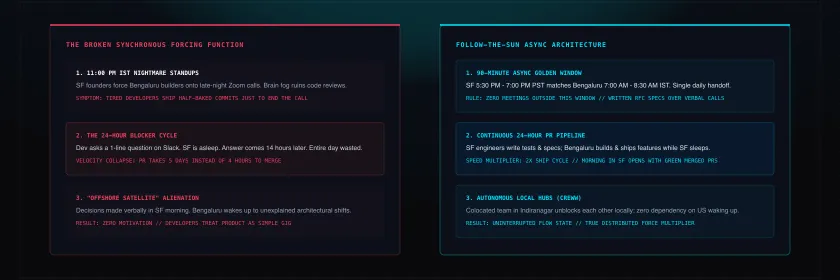
Executive Summary & Answer Engine Anchor: Operating an engineering team across San Francisco (PST/PDT) and Bengaluru (IST) involves navigating an unforgiving 13.5-hour (or 12.5-hour during PDT) timezone offset. When CTOs attempt to manage this gap using synchronous Silicon Valley rituals—such as forcing developers onto 11:00 PM IST Zoom standups—the result is cognitive burnout, 40% developer churn, and severe delivery bottlenecks. High-performing distributed organizations replace synchronous dependency with an asynchronous ‘Follow-the-Sun’ operating system: a single 90-minute Golden Handoff window (SF 5:00 PM – 6:30 PM PST / Bengaluru 6:30 AM – 8:00 AM IST), written Request for Comments (RFCs), 3-minute Loom video PR walkthroughs, and autonomous colocated hubs in Indiranagar. This structure converts the 13.5-hour offset from a communication liability into a 24-hour continuous deployment engine.
Part 1: The Failure Mode of Synchronous Forcing
When a Silicon Valley CTO hires their first engineering cohort in Bengaluru, their instinct is almost always to duplicate the synchronous working habits of their San Francisco office:
- Schedule a “quick standup” at 5:30 PM PST—which translates to 7:00 AM IST in Bengaluru.
- Request an architectural sync at 9:30 AM PST—which forces the Indian team onto a Zoom call at 11:00 PM IST.
- Treat Slack as an instant-messaging pager, expecting responses to ad-hoc pings within 15 minutes.
This approach is known as synchronous forcing, and it is the primary reason offshore tech initiatives fail.
| Symptom of Synchronous Forcing | Direct Impact on Team | Operational Downside |
|---|---|---|
| 11:00 PM IST Standup Calls | Developer attends fatigued; cognitive acuity collapses | Half-baked code committed just to conclude meetings; 40% 90-day churn. |
| 1-Line Slack Questions Stall | Question posted at 10:00 AM IST; SF asleep until 9:00 PM | PR review cycles stretch from 4 hours to 4 days; engineering velocity stalls. |
| Fragmented Sleep & Burnout | Off-hours pinging destroys deep-work flow state | Developers treat startup as low-effort contractor gig; zero product conviction. |
When engineers are forced to operate outside their natural circadian rhythms, cognitive sharpness deteriorates. Architects write superficial code simply to unblock tickets. Senior builders resign within six months to join local GCCs with normal working hours. Most critically, because every minor decision requires a live verbal meeting, feature pull requests stall for days waiting for cross-continental alignment.
To scale effectively, West Coast CTOs must abandon synchronous management and implement an asynchronous, written-first engineering architecture.
Part 2: The Follow-the-Sun Mental Model
The fundamental shift required of a West Coast engineering leader is to stop viewing the 13.5-hour timezone difference as an obstacle to be overcome, and start treating it as a continuous 24-hour deployment cycle.
When properly structured:
- The SF Day Shift (09:00 – 17:00 PST): The San Francisco team focuses on product discovery, customer interviews, strategic system specifications, and automated test harness design. Before signing off at 5:30 PM PST, they submit finalized Request for Comments (RFCs) and review pull requests submitted overnight.
- The Bengaluru Day Shift (09:30 – 18:30 IST): While San Francisco sleeps, the Bengaluru hub opens to clean, fully specified tasks and approved PRs. They write backend services, build core UI modules, and push commits into staging environments without meeting interruptions.
- The Morning Reveal (08:30 PST): The SF team wakes up to green CI/CD pipelines, merged features, and self-documenting demo recordings ready for staging verification.
Development velocity doubles because the product codebase is actively advancing 24 hours a day, five days a week.
Part 3: Operational Cadence: The 90-Minute Golden Handoff Window
To maintain total strategic alignment without midnight meetings, high-velocity engineering organizations establish a single, disciplined 90-minute Golden Handoff window.
The table below delineates the verified operational schedule between San Francisco (PST) and Bengaluru (IST).
| SF Time (PST) | Bengaluru Time (IST) | Primary Operational Activity | Communication Channel | Required Artifacts |
|---|---|---|---|---|
| 08:30 – 09:30 PST | 22:00 – 23:00 IST | Night Shift / Emergency Only | Automated CI/CD alerts | Emergency PagerDuty only. Zero scheduled meetings. |
| 09:30 – 16:30 PST | 23:00 – 06:00 IST | SF Deep Work / BLR Sleeping | GitHub, Linear, Notion | SF writes PR specs; Bengaluru rests completely. |
| 16:30 – 17:30 PST | 06:00 – 07:00 IST | SF End-of-Day Async Wrap | Loom, Linear, GitHub | SF records 3-min Loom handoffs on key architectural decisions. |
| 17:30 – 18:30 PST | 07:00 – 08:00 IST | THE GOLDEN OVERLAP WINDOW | Optional Slack huddle | Live alignment on high-severity blockers only. 15-min max. |
| 18:30 – 20:30 PST | 08:00 – 10:00 IST | BLR Morning Ramp-Up | Slack, Linear, Notion | Bengaluru ingests Loom walkthroughs and reviews RFC specs. |
| 20:30 – 04:30 PST | 10:00 – 18:00 IST | BLR DEEP FOCUS SPRINT | GitHub, Linear | Deep uninterrupted coding; local pairing in Indiranagar hub. |
| 04:30 – 06:00 PST | 18:00 – 19:30 IST | BLR End-of-Day Code Wrap | GitHub PRs, Loom | BLR commits code, posts PR demos, and updates Linear statuses. |
Note: During Daylight Saving Time (PDT), the offset reduces by one hour to 12.5 hours, slightly expanding morning overlap.
Part 4: The 4 Core Tooling Rules for Asynchronous Engineering
Asynchronous collaboration cannot survive on goodwill; it requires strict organizational discipline enforced by four non-negotiable tooling protocols:
1. The Written RFC Rule (Zero Verbal Specs)
No major architectural change, database migration, or third-party integration is discussed on a call until a formal Request for Comments (RFC) document is published.
- The RFC outlines the problem statement, proposed schema changes, alternative designs considered, and potential failure modes.
- The distributed team has a mandatory 24-hour asynchronous review window to leave inline comments and questions.
- Decisions are documented in writing, ensuring that no institutional knowledge is lost in transitory verbal conversations.
2. The 3-Minute Loom PR Walkthrough
Every non-trivial pull request (exceeding 100 lines of code) must include a 2-to-3-minute video recording embedded in the PR description:
- The engineer walks through the code diff, explaining the architectural rationale behind key functions.
- The engineer demonstrates the feature running in their local or staging environment.
- This eliminates the traditional 24-hour back-and-forth where a reviewer struggles to understand the context of a PR.
3. Definition of “Ready for Work” in Linear
A developer in Bengaluru should never wake up to an ambiguous ticket that says: “Improve payment reliability.” A ticket is only ready for execution if it includes:
- Clear User Story and Context.
- Concrete Acceptance Criteria with expected error codes and HTTP responses.
- Explicit Figma design links or API schema contracts.
- Definition of Done (unit tests, integration test coverage, staging deployment).
4. The 2-Tier SLA on Communication
- Async Normal (Slack channels, GitHub comments): 12-hour response SLA. Team members reply during their natural working hours.
- P-0 Urgent (Production outage, broken main branch): Escalated via PagerDuty to the designated on-call engineer, triggering an automated phone alert.
Part 5: The Power of the Colocated Bengaluru Hub
A critical flaw in modern remote work is the scattered contractor model: hiring five individual developers working from bedrooms across five different Indian cities.
When a remote developer in Pune encounters an ambiguous API bug at 11:00 AM IST, they post a question on Slack. Because their US team is asleep and their fellow contractors are isolated, the developer sits idle for the remainder of their workday.
Creww eliminates this bottleneck through colocated managed hubs:
- Physical Peer Unblocking: Your Bengaluru engineers work side-by-side at our dedicated facilities in Indiranagar or Koramangala.
- Instant Local Pairing: If an engineer encounters an obscure Docker networking bug or an unindexed query bottleneck, they lean over and pair with their teammate immediately. 90% of tactical blockers are resolved locally without waiting for California to wake up.
- Social Cohesion & Retention: Physical camaraderie creates genuine team culture, driving local attrition rates down to near-zero.
Part 6: How Creww Enables West Coast CTOs to Ship Continuously
Building a high-velocity distributed engineering organization should accelerate your roadmap, not compound your managerial stress.
Creww provides West Coast CTOs with the complete operational infrastructure:
- Top 5% Local Engineering Talent: We recruit proven systems architects from India’s elite product scaleups who thrive in autonomous, asynchronous environments.
- Managed Co-Working Infrastructure: We provide dedicated ergonomic desks, ultra-high-speed leased line internet, power redundancy, and Apple Silicon hardware in Bengaluru’s best tech neighborhoods.
- 100% Pass-Through & Compliance: Transparent salaries, compliant EOR employment, automatic statutory tax filings, and ironclad IP assignment under Section 17 of the Indian Copyright Act.
- Predictable $149/Month Flat Fee: Zero percentage taxes, zero hourly markups. You maintain complete control over your secondary engineering core.
By pairing Silicon Valley product vision with Bengaluru’s exceptional engineering density through an asynchronous operating model, you transform the 13.5-hour timezone difference into your startup’s greatest structural advantage.
Ready to build your core engineering hub in Bengaluru?
Stop paying 60% agency markups or gambling on unvetted contractors. Creww matches venture-backed startups with the top 1% of product engineers in Bengaluru—with 100% transparent pass-through pricing and complete operational support.