IRS Section 174 & The 15-Year Foreign R&D Amortization Trap: What US Startups Must Know Before Hiring in India
Navigate IRS Section 174 foreign R&D amortization rules. Understand the 15-year statutory trap, Section 162 bifurcation, and compliant contractor contracts.
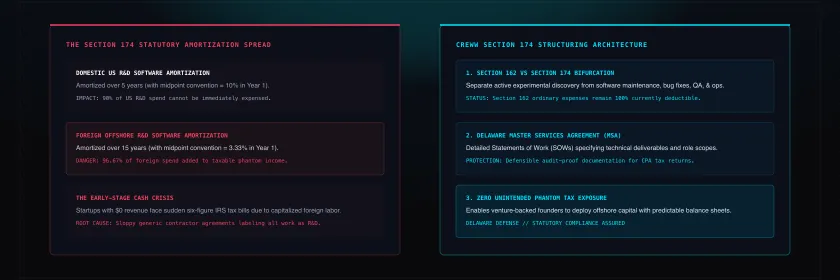
Executive Summary: Under Section 174 of the Internal Revenue Code (amended by the Tax Cuts and Jobs Act), US technology companies can no longer immediately deduct software development expenditures in the year they are incurred. While domestic US software development must be amortized over 5 years (with a mid-year convention yielding a 10% deduction in Year 1), foreign software development performed outside the United States must be amortized over 15 years (yielding just 3.33% in Year 1). This 10-year statutory spread can create unexpected “phantom taxable income” for early-stage startups. However, by properly bifurcating active experimental research (§ 174) from ordinary software maintenance, bug fixing, and infrastructure operations (§ 162) through structured Master Services Agreements, founders can remain fully compliant while maximizing their operational runway.
Disclaimer: This article provides operational and statutory analysis for technology founders and does not constitute formal tax or legal advice. Always consult with a qualified CPA or cross-border tax attorney regarding your company’s specific corporate filings.
In early 2023, technology founders across the United States began receiving frantic calls from their tax accountants.
Companies that had raised $3,000,000 in venture capital, generated zero revenue, and burned through $1,500,000 in software engineering expenses were suddenly handed six-figure federal tax bills.
The cause was the mandatory implementation of the modified Section 174 of the Internal Revenue Code (IRC), an obscure provision of the 2017 Tax Cuts and Jobs Act (TCJA) that eliminated the immediate expensing of research and experimental (R&E) costs.
For decades prior, startups could deduct 100% of their developer payroll in the tax year the cash left the bank. Under the new statutory regime, software development was explicitly categorized as an amortizable capital expenditure.
More crucially, the law created a severe statutory penalty for cross-border development: foreign software expenditures must be amortized over 15 years, compared to 5 years for domestic US labor.
For venture-backed founders building technical squads in Bengaluru, understanding the mechanics of Section 174 is essential to avoiding balance sheet shocks and structuring compliant overseas engagements.
1. The Statutory Spread: 5-Year Domestic vs. 15-Year Foreign Amortization
To understand how Section 174 impacts your startup’s tax liability, examine the statutory amortization schedules under IRC § 174(a)(2)(B):
- Domestic R&D (US-based engineers): Amortized straight-line over 5 taxable years (60 months), beginning with the midpoint of the taxable year in which expenditures are paid or incurred.
- Foreign R&D (Non-US engineers): Amortized straight-line over 15 taxable years (180 months), beginning with the midpoint of the taxable year.
The “midpoint convention” dictates that in the first tax year, a startup only receives half a year’s worth of amortization:
- Year 1 Domestic Deduction: 10% of total spend (1/5th × 50%)
- Year 1 Foreign Deduction: 3.33% of total spend (1/15th × 50%)
The Mathematical Spread: Tracking a $100,000 Software Spend
| Tax Year | Domestic US Software Spend ($100k) Amortization | Foreign Offshore Software Spend ($100k) Amortization | Non-Deductible Capitalized Spread (Foreign) |
|---|---|---|---|
| Year 1 (Midpoint) | $10,000 (10.0%) | $3,333 (3.33%) | $96,667 capitalized |
| Year 2 | $20,000 (20.0%) | $6,667 (6.67%) | $90,000 capitalized |
| Year 3 | $20,000 (20.0%) | $6,667 (6.67%) | $83,333 capitalized |
| Year 4 | $20,000 (20.0%) | $6,667 (6.67%) | $76,667 capitalized |
| Year 5 | $20,000 (20.0%) | $6,667 (6.67%) | $70,000 capitalized |
| Year 6 (Domestic Final) | $10,000 (10.0% — fully written off) | $6,667 (6.67%) | $63,333 capitalized |
| Years 7–15 | $0 (Already 100% amortized) | $6,667 / year | Amortizes over remaining 9 years |
In Year 1, 96.67% of foreign software development expenditures cannot be deducted from your taxable income.
If your startup generated revenue or received grant funding, this capitalization can create “phantom profit”—taxable income on paper even though your bank account is burning cash.
2. Does Section 174 Kill the Indian Talent Arbitrage? (The Mathematical Truth)
When non-technical advisors first see the 15-year amortization schedule, their immediate reaction is: “Doesn’t this make hiring engineers in India mathematically unviable?”
The answer is an emphatic no. The upfront cash savings of hiring Tier-1 builders in Bengaluru vastly outweigh the delayed tax deduction.
Consider a practical comparison: a startup allocating capital to build a new product module requiring $200,000 of engineering work:
Path A: Hiring in San Francisco
- Cash Outflow: $200,000 (1 SF engineer for ~8 months)
- Year 1 Tax Deduction: $20,000 (10%)
- Corporate Tax Shield (at 21% federal rate): $4,200
- Net Year 1 Cash Cost: $195,800
Path B: Hiring in Bengaluru (Creww Pod)
- Cash Outflow for Same Output: $50,000 (3 Bengaluru engineers for 4 months)
- Year 1 Tax Deduction: $1,667 (3.33%)
- Corporate Tax Shield (at 21% federal rate): $350
- Net Year 1 Cash Cost: $49,650
The Net Arbitrage:
Even under the strictest 15-year amortization rules, Path B saves the startup $146,150 in cold, hard cash in Year 1 alone.
Tax deductions only provide value if you have net taxable profit to shield. For 90% of early-stage startups operating at a net loss, cash in the bank is the only metric that matters. Saving $146,000 in payroll preserves your runway, regardless of how the IRS requires your accountant to capitalize the expense on Schedule M-1.
3. The Compliant Contract Solution: Section 162 vs. Section 174 Bifurcation
Not every dollar paid to an engineer is automatically classified as a Section 174 Research and Experimental expenditure.
In IRS Notice 2023-63, the Treasury Department provided detailed interim guidance on what constitutes software development for Section 174 purposes. The guidelines clarify that while the design and creation of new software algorithms fall under Section 174, post-launch operational software activities fall under IRC Section 162 (Ordinary and Necessary Business Expenses), which remain 100% currently deductible in the tax year paid.
The Statutory Classification Matrix
| Engineering Activity | Statutory Category | Tax Treatment | Description & SOW Language |
|---|---|---|---|
| New Architecture & Core Algorithms | Section 174 (SRE) | Capitalized (15-yr foreign / 5-yr US) | Discovering novel technical architectures, developing proprietary ML models, building 0-to-1 core engines. |
| Software Maintenance & Bug Fixes | Section 162 (Ordinary) | 100% Immediate Deduction | Resolving production defects, patching software vulnerabilities, routine refactoring, code maintenance. |
| DevOps & Cloud Infrastructure Ops | Section 162 (Ordinary) | 100% Immediate Deduction | Configuring CI/CD pipelines, managing Kubernetes clusters, monitoring server health, database index tuning. |
| Quality Assurance (QA) & Testing | Section 162 (Ordinary) | 100% Immediate Deduction | Writing end-to-end integration tests, manual user acceptance testing, regression suites, load testing. |
| Customer Support Engineering | Section 162 (Ordinary) | 100% Immediate Deduction | Troubleshooting user-reported tickets, building custom internal API integrations for clients, onboarding data. |
By working with an Employer of Record that structures distinct, itemized Statements of Work (SOWs) for your offshore team, your company can legitimately classify routine maintenance, infrastructure management, QA, and operational development under Section 162.
4. Operational Best Practices for US Founders
To ensure your cross-border engineering setup passes scrutiny during corporate audits and venture capital diligence, implement the following four legal safeguards:
1. Maintain Granular Statements of Work (SOWs)
Never sign a vague, one-line contractor agreement stating “Offshore software development services.” Ensure your Master Services Agreement (MSA) with your EOR incorporates specific SOWs that demarcate functional responsibilities:
- Separate SOWs for infrastructure maintenance, observability, and platform operations.
- Clearly documented project milestones distinguishing experimental feature discovery from routine product support.
2. Time Tracking by Activity Class
Require your engineering leads to categorize sprint tickets in Jira or Linear by functional domain:
Feature-Discoveryvs.Maintenance-Bugfixvs.Infra-Ops. When your CPA prepares your Form 1120 corporate tax return, having clean metadata supporting your Section 162 vs. Section 174 allocations makes your tax position defensible.
3. Leverage an Employer of Record with Compliant Invoicing
When you pay disparate individual contractors through PayPal or informal wire transfers, proving the nature of the underlying work during an IRS audit is an administrative nightmare.
Creww provides institutional-grade cross-border invoicing that cleanly categorizes payroll allocations, administrative platform fees ($149/mo), and operational deliverables under established Delaware commercial standards.
4. Optimize the Federal R&D Tax Credit (Form 6765)
Remember that Section 174 applies to both domestic and foreign software development. However, the Section 41 Research Credit (R&D Tax Credit), which allows startups to offset up to $500,000 per year against employer payroll taxes, only applies to US domestic labor.
The optimal capital structure for venture-backed startups is a barbell strategy:
- Keep your core US founders and architectural leads in the US to claim the Section 41 Payroll R&D Tax Credit.
- Deploy your 5-to-15 person product execution pod in Bengaluru to capture massive cash runway arbitrage.
The Strategic Balance: Managing Tax Architecture for Maximum Runway
Tax codes should never dictate product vision, but ignoring them can destroy early-stage balance sheets.
The 15-year foreign R&D amortization under Section 174 is a statutory reality that every founder must navigate. But it is not a barrier to building a high-velocity engineering squad in Bengaluru.
When you recognize that cash savings of 60% trump delayed tax write-offs, and when you structure your contracts with precision, you capture the ultimate startup advantage: unlimited shots on goal with years of financial runway.
Ready to build your core engineering hub in Bengaluru?
Stop paying 60% agency markups or gambling on unvetted contractors. Creww matches venture-backed startups with the top 1% of product engineers in Bengaluru—with 100% transparent pass-through pricing and complete operational support.