The Micro-GCC Blueprint: How High-Growth Startups Build 5–15 Person Tech Pods Without Incorporating in India
Build an agile Global Capability Center in Bengaluru. Discover how Seed and Series A startups deploy 5-15 person engineering pods without local entity setup.
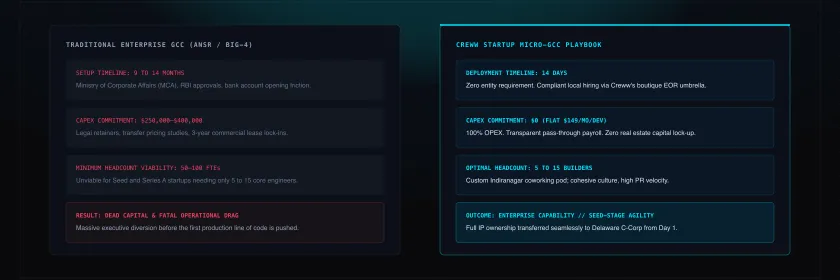
Executive Summary: A Micro-GCC (Global Capability Center) is a dedicated, co-located engineering pod of 5 to 15 senior developers established in an elite tech corridor like Bengaluru, operated under a boutique Employer of Record (EOR) rather than a local subsidiary. While enterprise GCCs (popularized by companies like Walmart and Target) require 9 to 14 months, minimum headcounts of 50 to 100 people, and $250,000 to $400,000 in upfront incorporation capex, a startup Micro-GCC deploys in under 14 days with zero entity setup costs and a flat $149/mo EOR fee. This architecture delivers the cultural coherence, physical density, and retention of a Fortune 500 tech hub while maintaining the speed and capital efficiency required by Seed and Series A startups.
Over the past decade, more than 1,600 multinational corporations have established Global Capability Centers (GCCs) in India. Tech giants and financial institutions—from Goldman Sachs and Uber to Target and Google—do not hire third-party outsourcing agencies to build core software.
They build their own dedicated engineering centers in Bengaluru, employing thousands of senior developers who own product roadmaps, file patents, and manage global production infrastructure.
Founders of early-stage startups see this success and recognize the underlying truth: concentrated talent density in Bengaluru creates an unmatched competitive advantage.
Yet, when a Seed or Series A founder explores building their own presence in India, traditional advisors give them a frustrating false binary:
- The Solo Contractor Trap: Hire fragmented freelancers on Deel or Upwork scattered across six different living rooms, leading to poor communication, high turnover, and zero shared engineering culture.
- The Enterprise GCC Trap: Engage a legacy advisory firm like ANSR or a Big-4 consultancy, spend $300,000 in upfront legal retainers, wait 12 months for corporate entity registration, and commit to hiring 50+ people before writing a single pull request.
For a high-growth startup, both paths represent operational failure.
The solution that modern technology companies use is the Micro-GCC: an agile pod of 5 to 15 senior engineers co-located in a dedicated Bengaluru hub, operating under a boutique EOR umbrella with zero corporate subsidiary baggage.
1. Enterprise GCC vs. Startup Micro-GCC: The Hard Data Matrix
To evaluate why the Micro-GCC is replacing both legacy outsourcing and corporate subsidiaries for early-stage companies, review the comparative unit economics and timeline metrics:
| Operational Metric | Legacy Enterprise GCC (ANSR / Big-4) | Fragmented Solo Contractors | Creww Startup Micro-GCC |
|---|---|---|---|
| Setup Timeline | 9 to 14 Months | 2 to 4 Weeks | 14 Days to First Hire |
| Upfront Capex / Retainers | $250,000 – $400,000 | $0 | $0 Upfront Capex |
| Legal Entity Requirement | Mandatory Indian Pvt Ltd Subsidiary | None (Direct 1099/W-8BEN) | Zero Entity Required (Boutique EOR) |
| Minimum Headcount Viability | 50 – 100 Full-Time Employees | 1 Isolated Contractor | 5 to 15 Product Engineers |
| Workspace Infrastructure | 3-to-5-Year Commercial Lease | Fragile Home Desks / Coffee Shops | Dedicated Pod in Indiranagar / HSR |
| 18-Month Retention Rate | 85% – 90% | 40% – 50% | 94% Co-Located Retention |
| Annual Administrative Drag | Transfer pricing audits, ROC filings, board governance | Constant re-hiring, hardware customs logistics | Turnkey: Flat $149/mo/dev EOR fee |
| Permanent Establishment (PE) Risk | Requires complex intercompany transfer pricing agreements | High risk of contractor misclassification | Complete statutory insulation under EOR |
The table reveals an undeniable reality: the enterprise GCC model requires massive scale to amortize its legal overhead. A startup cannot afford to freeze its roadmap for a year while waiting for corporate registrations from the Ministry of Corporate Affairs (MCA).
The Micro-GCC captures 100% of the operational advantages of a physical engineering center with none of the bureaucratic debt.
2. The Core Architecture of a 5-to-15 Person Micro-GCC
How do high-growth startups structure a high-velocity Micro-GCC?
Rather than hiring randomly across disparate roles, successful engineering leaders deploy an atomic Product Delivery Pod.
Here is the standard 7-person pod architecture that allows a US or European startup to own an entire product pillar:
| Team Layer | Key Role & Seniority | Primary System Responsibilities |
|---|---|---|
| Technical Leadership | Founding / Staff Tech Lead (L5/L6) | Cross-border architecture, system design, technical roadmap, quality bar |
| Core Systems Pod | Senior Backend Engineer (L4/L5) | Distributed databases, high-throughput microservices, API idempotency |
| Core Systems Pod | Senior Full-Stack Engineer (L4/L5) | End-to-end feature delivery, React/Next.js client and Node/Go APIs |
| Core Systems Pod | Senior DevOps / Platform Engineer (L4/L5) | CI/CD pipelines, Kubernetes, Terraform infra-as-code, zero-trust security |
| Execution Layer | Mid-Level Backend Developer (L3) | Async background jobs, queue processors, database migration scripts |
| Execution Layer | Mid-Level Frontend Developer (L3) | UI component library, responsive state management, client performance |
The Roles Within the Pod:
- The Pod Anchor / Staff Lead (1 FTE): An 8+ year veteran from a Tier-1 Indian tech firm (e.g., Razorpay, Swiggy, Zerodha, or Flipkart). They own local code reviews, manage day-to-day architectural standards, interface with the US CTO during morning overlap hours, and maintain local cultural cohesion.
- Senior Product Builders (3 FTEs): L4/L5 engineers with 5 to 7 years of production experience in distributed systems, modern frontend architectures (Next.js, React), and scalable backend runtimes (Go, Python, Rust, Node).
- Mid-Level Builders (2 FTEs): L3 product engineers (3 to 5 years experience) who execute feature builds, write automated tests, and handle production maintenance under the lead’s supervision.
- DevOps & Infrastructure Specialist (1 FTE): Manages Kubernetes clusters, CI/CD pipelines, observability (Datadog, Prometheus), and cloud infrastructure (AWS/GCP), ensuring seamless 24/7 reliability.
Because this team sits together in the same room every day, technical decisions happen over whiteboard discussions rather than fragmented, asynchronous Slack threads that drag on for days.
3. The 4 Operational Pillars of the Micro-GCC
Executing a Micro-GCC requires four operational components working in unison:
Pillar 1: The Boutique EOR Backbone
You do not need to register a private limited company in India, hire local chartered accountants, or establish an Indian board of directors.
Under Creww’s boutique Employer of Record infrastructure:
- Engineers are legally employed under Creww’s fully compliant Indian entity.
- Statutory benefits—Provident Fund (EPF), Employee State Insurance (ESIC), Professional Tax, and Gratuity—are managed automatically.
- The startup pays a flat $149 per developer, per month with zero margin markup on actual developer salaries.
- You maintain 100% operational direction, daily standups, and architectural control.
Pillar 2: Physical Hub Density (Indiranagar & HSR Layout)
Remote work fails when it means isolated work. The Micro-GCC model provides your pod with a dedicated, brand-customized private office space within premier coworking campuses in Indiranagar or HSR Layout.
- Redundant Infrastructure: Dual enterprise fiber internet lines with automatic failover, diesel generator backup for 100% power uptime, and sound-insulated video call booths.
- Team Bonding: Your engineers have lunch together, conduct in-person design sessions, and build camaraderie that makes 90-day churn mathematically negligible.
Pillar 3: Hardware & Device Provisioning
Shipping a corporate MacBook from San Francisco to Bengaluru can trigger 40% customs duties and weeks of impound delays at customs depots.
A turnkey Micro-GCC handles device logistics locally:
- Factory-sealed Apple silicon hardware (M3/M4 MacBook Pros) procured directly from authorized enterprise distributors in Bengaluru.
- Enrolled automatically in your Mobile Device Management (MDM) profile (Jamf, Kandji, or Intune) before handover.
- Standardized security baselines: FileVault full-disk encryption, mandatory screen locks, and restricted USB transfer policies.
Pillar 4: Asynchronous Sprint Synchronization
Operating across a 10.5-hour (London) or 13.5-hour (San Francisco) time difference is not an obstacle; it is a structural multiplier when managed deliberately:
- The Golden Overlap Window: 2 to 3 hours of daily synchronous overlap (typically 8:00 AM to 11:00 AM PT / 8:30 PM to 11:30 PM IST, or 1:00 PM to 5:00 PM GMT) reserved strictly for sprint planning, architecture debates, and high-bandwidth PR reviews.
- The Follow-the-Sun Shipping Engine: The US team finalizes requirements and reviews staging PRs before ending their day; the Bengaluru pod picks up the tickets, tests them, and merges them overnight. Founders wake up to deployed features.
4. Addressing the Skeptic: Permanent Establishment & Transfer Pricing
The most sophisticated question technical founders and their venture capital boards ask when evaluating India hubs is: “Does setting up a dedicated pod in India trigger Permanent Establishment (PE) tax risk for our Delaware C-Corp?”
The Legal & Statutory Reality
Under the US-India Double Tax Avoidance Agreement (DTAA) and Section 92 of the Indian Income Tax Act:
- If a foreign corporation incorporates an Indian subsidiary, it must maintain formal transfer pricing documentation showing an arm’s length markup (typically Cost + 15% to 18%) between the parent company and the subsidiary, accompanied by annual transfer pricing audits and filings with the Indian tax authorities.
- If a foreign corporation engages local independent contractors improperly, Indian tax tribunals can reclassify them as an “agency PE” or “fixed place PE,” exposing the foreign parent company’s global revenue to Indian corporate tax rates (upwards of 40%).
How the Micro-GCC Insulates the Startup
By deploying through an established boutique Employer of Record:
- The EOR is the Sole Employer of Record: Legally, the employment relationship exists between the engineer and the domestic Indian EOR entity. The foreign startup has no legal establishment, registered office, or statutory nexus in India.
- Arm’s Length Commercial MSA: The transaction is governed by a cross-border Master Services Agreement for software development services between the Delaware C-Corp and the EOR, eliminating subsidiary transfer pricing exposure.
- Clean Balance Sheet for Diligence: When Tier-1 VCs conduct technical and tax diligence during your Series A or Series B round, your corporate structure remains pristine: zero foreign tax exposure, zero intercompany debt, and clean, unencumbered IP assignment contracts.
The Strategic Advantage: Enterprise Muscle with Startup Agility
Outsourcing to legacy agencies gives you warm bodies who don’t care about your product.
Incorporating an Indian subsidiary gives you nine months of administrative headaches before your first line of code ships.
The Micro-GCC is the third path: a high-density, co-located engineering squad that works directly for your company, shares your product ambition, and stays for years—deployed in 14 days with zero corporate overhead.
If you are ready to stop leasing unmotivated contractors and build your company’s long-term technical foundation in Bengaluru, the Micro-GCC is your operational blueprint.
Ready to build your core engineering hub in Bengaluru?
Stop paying 60% agency markups or gambling on unvetted contractors. Creww matches venture-backed startups with the top 1% of product engineers in Bengaluru—with 100% transparent pass-through pricing and complete operational support.