Why We Don't Use LeetCode: Our Live System Design and Codebase Navigation Rubric for L5 Engineers
Discover why LeetCode algorithmic interviews fail for senior engineers and explore our practical 3-part system design and PR review evaluation rubric.
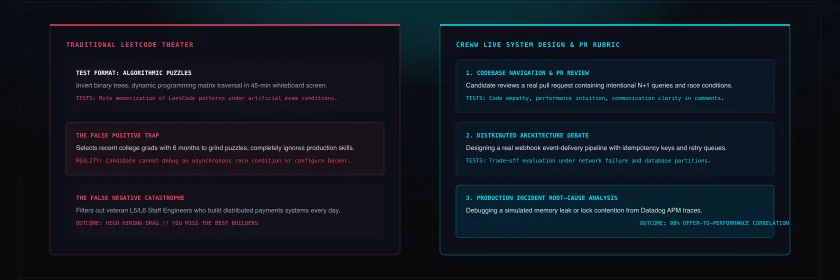
Executive Summary: Algorithmic whiteboard interviews (LeetCode “Hard” dynamic programming puzzles) systematically fail when screening senior remote software engineers. They produce massive false positives by selecting for recent university graduates with months of free time to grind puzzle patterns, while triggering devastating false negatives by alienating seasoned Staff and Senior (L5/L6) engineers who build resilient distributed systems every day. In production, engineers rarely invert binary trees; they navigate unfamiliar codebases, review peer pull requests for subtle race conditions, design idempotent event pipelines, and debug database contention under load. High-growth startups replace algorithmic theater with a practical 3-part production rubric: live pull request code review, real-world distributed system design, and unfamiliar codebase bug isolation—achieving a 98% correlation with 90-day production velocity.
If you have interviewed software engineers over the past decade, you are familiar with the standard 45-minute technical screen:
A candidate joins a shared Google Doc or CoderPad sandbox. The interviewer pastes an abstract algorithmic puzzle: “Given an array of integers, find the maximum sum of a non-empty subarray with at most one deletion in O(n) time.”
For the next forty minutes, the candidate stumbles through edge cases, memorized dynamic programming memoization matrices, and Big-O notation.
If they practiced that exact problem on LeetCode the previous weekend, they breeze through the solution and receive an enthusiastic “Strong Hire” recommendation. If they spent the last five years architecting payment reconciliation pipelines that process $50M daily in high-concurrency PostgreSQL clusters, they fail.
This interview process is not merely ineffective. For an early-stage startup hiring senior remote builders in Bengaluru, it is actively destructive.
It measures test-taking compliance under artificial stress, while measuring precisely zero of the competencies required to ship production software in an autonomous, distributed team.
1. The False Positive & False Negative Trap: The Comparison Matrix
To understand why algorithmic puzzles fail as a hiring filter for senior engineers, compare the competencies tested by LeetCode against the daily realities of production software engineering:
| Technical Competency | What LeetCode Whiteboard Screens Test | What Production Engineering Actually Demands | Hiring Outcome Under LeetCode |
|---|---|---|---|
| Problem Domain | Synthetic puzzle games (arrays, trees, graphs) with single mathematical answers. | Messy business logic with incomplete specifications and competing trade-offs. | False Positive: Selects puzzle memorizers who struggle with real-world requirements. |
| Code Readability & Empathy | 50-line clever algorithmic one-liners optimized for competitive execution speed. | Modular, self-documenting code with defensive error boundaries and clean abstractions. | False Positive: Promotes clever, unmaintainable code that causes outages. |
| Concurrency & Distributed Systems | Single-threaded memory execution; zero network I/O or database awareness. | Race conditions, distributed deadlocks, idempotency keys, and eventual consistency. | Blind Spot: Cannot evaluate whether candidate understands distributed failure modes. |
| Code Review & Collaboration | Solitary competitive performance against an adversarial interviewer. | Empathetic, thorough pull request review; mentoring junior peers via constructive comments. | Blind Spot: Completely ignores technical communication in PR reviews. |
| Senior Candidate Experience | Demeaning to experienced builders with verifiable production track records. | Respectful architectural dialogue between practicing senior peers. | False Negative: Top 5% Staff Engineers refuse to do junior whiteboard tests and drop out. |
The most dangerous consequence of LeetCode testing is the senior drop-off rate.
When you ask an L5 engineer who scaled infrastructure at Razorpay or Swiggy to invert a binary tree on a whiteboard, they interpret it as an institutional signal: this company does not know how to evaluate engineering craftsmanship. They politely withdraw from the pipeline and accept an offer from a founder who evaluates them on their actual architectural track record.
2. The 3-Part Production Engineering Evaluation Rubric
How do you evaluate technical depth, systems intuition, and product ownership without resorting to algorithmic trivia?
Creww’s technical vetting engine replaces whiteboard puzzles with a practical 3-part production rubric that mirrors the actual work of an autonomous software builder:
| Evaluation Stage | Time & Format | Target Assessment | Key Competencies Evaluated |
|---|---|---|---|
| Stage 1: Production PR Review | 40 Mins (Live Pairing) | Candidate reviews realistic PR with injected edge cases | Race conditions, N+1 query detection, error handling, security hygiene, communication empathy |
| Stage 2: Real-World Systems Debate | 40 Mins (Whiteboard / Excalidraw) | Concrete architectural trade-offs under real load | Webhook idempotency, queue backpressure, partition tolerance, database write amplification |
| Stage 3: Live Codebase Bug Isolation | 30 Mins (Local Repo) | Clone repository and trace error stack trace to source | Tooling fluency (git, debuggers, pprof), log analysis, hypothesis testing, targeted fix |
3. Stage 1: The Pull Request Code Review Challenge (40 Minutes)
In a distributed team, code review is the primary communication medium. Senior engineers spend as much time reviewing peer code as they do writing new lines.
The Exercise:
We present the candidate with an actual, functioning pull request (typically 200–300 lines of TypeScript, Go, or Python) implementing a common feature—for example, a multi-tenant subscription webhook handler.
The code compiles and passes basic unit tests. However, we have deliberately injected three real-world production defects:
- A Subtle Concurrency Race Condition: A non-atomic database read-then-write that fails under simultaneous webhook deliveries, resulting in duplicate credits.
- An N+1 Database Query Trap: An ORM loop fetching associated user metadata inside an iterative array, which will exhaust database connection pools at 500 RPS.
- An Unhandled Partial Network Failure: An external API call that lacks exponential backoff, circuit breaking, or an idempotency key.
What We Evaluate:
- Depth of Observation: Does the candidate spot the architectural landmines, or do they merely leave stylistic comments about variable naming and whitespace?
- Communication Tone: Are their comments condescending (“Why did you do this?”) or constructive and educational (“If two webhooks land simultaneously, this read-modify-write could overwrite balance; let’s consider using an atomic database increment or an advisory lock here”).
- Security Awareness: Do they check for SQL injection, unsanitized user inputs, or exposed credentials in configuration schemas?
4. Stage 2: Practical Distributed System Design (40 Minutes)
Forget designing generic, abstract systems like “Design Twitter” or “Build a URL Shortener”—questions whose answers have been memorized by thousands of candidates from YouTube tutorials.
The Exercise:
We ask the candidate to design a concrete, high-impact business system with realistic edge cases:
- “Design a payment reconciliation engine that matches incoming bank settlement webhooks against our internal ledger, handling out-of-order deliveries, network drops, and banking system maintenance windows.”
The Evaluation Dimensions:
| Evaluation Dimension | Junior / Mid-Level Signal (L3) | Senior / Staff-Level Signal (L5/L6) |
|---|---|---|
| Failure Mode Awareness | Assumes the network and database are always healthy. | Immediately asks: “What happens when the database primary fails over during a transaction write?” |
| Idempotency Strategy | Suggests checking if record exists before inserting. | Designs unique constraint keys and distributed locks (Redis Redlock / PostgreSQL advisory locks). |
| Data Partitioning & Scale | Recommends throwing Kafka and microservices at everything without calculation. | Calculates actual TPS (Transactions Per Second): “At 200 TPS, a well-indexed single PostgreSQL instance handles this easily; we don’t need Kafka yet.” |
| Observability & Recovery | Mentions basic server logging. | Defines dead-letter queues (DLQs), automated alerting thresholds, and replay scripts for failed batches. |
The hallmark of a true Staff Engineer is pragmatism. They do not over-engineer complex distributed architectures when a boring, reliable database table solves the business problem with zero maintenance overhead.
5. Stage 3: Real Codebase Navigation & Debugging (30 Minutes)
The ultimate test of a senior developer is their ability to become productive in an unfamiliar codebase without hand-holding.
The Exercise:
We provide the candidate with a Dockerized repository containing a multi-service web application. We launch the application, trigger a failing integration test, and provide an obfuscated stack trace representing a production incident.
The candidate shares their screen and walks us through their debugging methodology:
- How do they orient themselves in the file tree?
- Do they read the stack trace methodically, or do they randomly click through files hoping to spot the error?
- How do they use debugging tools (breakpoints, log outputs, database inspectors)?
What This Reveals:
In thirty minutes, this exercise exposes everything a resume conceals. You see how they handle terminal commands, how comfortably they navigate git history, and whether they approach an unexpected bug with calm, deductive logic or panicked trial-and-error.
6. The Skeptic’s Defense: Doesn’t LeetCode Prove Intellectual Ability?
The Counter-Argument:
Proponents of algorithmic interviews argue: “Even if binary trees aren’t used daily, solving a LeetCode Hard problem demonstrates raw IQ, problem-solving stamina, and computer science foundations.”
The Reality:
LeetCode does not measure raw intellectual capability; it measures available leisure time.
A 22-year-old recent graduate living in a university dormitory can spend six months studying 300 LeetCode patterns for eight hours a day.
A 32-year-old Staff Engineer with a family who spends their days scaling high-throughput production infrastructure at a tier-1 startup does not have forty hours a week to memorize competitive programming puzzles.
When you use LeetCode as your primary filter:
- You select for fresh graduates who excel at exam patterns but lack production battle scars.
- You systematically eliminate experienced product builders who know how to keep production systems online at 3:00 AM.
Build an Interview Process That Respected Builders Want to Take
Hiring senior engineering talent in Bengaluru is intensely competitive. The best developers have multiple competing options.
When your interview process consists of demeaning whiteboard games, the strongest candidates quietly opt out.
When your interview process consists of rigorous, respectful, peer-to-peer architectural evaluation, senior builders lean in. They recognize that they are speaking with an engineering organization that values real craftsmanship.
Kill the algorithmic theater. Evaluate real production judgment. Hire the builders who ship.
Ready to build your core engineering hub in Bengaluru?
Stop paying 60% agency markups or gambling on unvetted contractors. Creww matches venture-backed startups with the top 1% of product engineers in Bengaluru—with 100% transparent pass-through pricing and complete operational support.