Airtight Code Ownership: How to Ensure 100% IP Assignment from Bengaluru Engineers to Delaware C-Corps
Ensure 100% bulletproof IP assignment under the Indian Copyright Act of 1957. Avoid the Section 19(4) 1-year lapse trap and secure clean VC diligence.
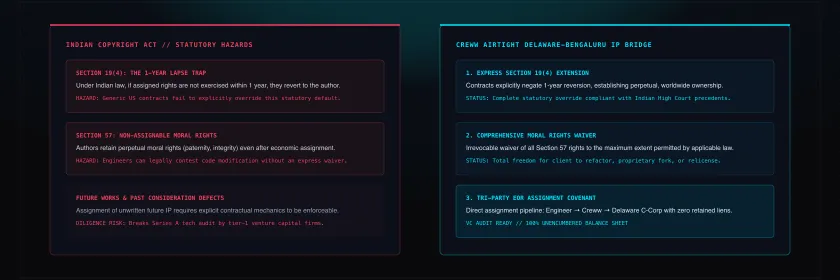
Executive Summary: A technology startup’s enterprise valuation is entirely derivative of its unencumbered intellectual property. However, when US Delaware C-Corps hire engineers in India using generic US contractor agreements (PIIAs), they frequently trigger catastrophic clouds on title during Series A venture diligence. Under Section 19(4) of the Indian Copyright Act of 1957, any assignment of copyright that is not exercised within one year automatically lapses and reverts to the individual author by statutory default, unless the contract explicitly overrides this timeframe. Furthermore, under Section 57, Indian engineers retain non-assignable “moral rights” to their code unless expressly waived. By utilizing a compliant tri-party Employer of Record (EOR) assignment architecture, venture-backed startups guarantee that 100% of code, algorithms, and trade secrets transfer perpetually, irrevocably, and globally to the US entity from the first line of code committed.
Disclaimer: This guide provides operational and statutory analysis for founders and does not constitute formal legal counsel. Technology companies should review cross-border intellectual property assignment agreements with their corporate attorneys.
During a Series A financing round, few moments are more terrifying for a technical founder than receiving the preliminary report from the lead investor’s legal diligence counsel.
The engineering team has built an exceptional distributed product. Monthly recurring revenue is growing at 20%. The code is clean, well-tested, and deployed on modern cloud infrastructure.
Then, the investor’s law firm flags a fatal defect on the capitalization and IP schedule: the startup does not cleanly own its core intellectual property.
The company hired three brilliant senior engineers in Bengaluru nine months prior. To save time, the founder downloaded a standard California Proprietary Information and Inventions Agreement (PIIA) from an online template, swapped the company name, and sent it to the engineers via DocuSign.
What the founder did not know—and what the investor’s counsel spotted immediately—is that Indian copyright law treats intellectual property assignment fundamentally differently from US common law.
Because the contract failed to account for mandatory Indian statutory protections, the intellectual property rights in the startup’s core algorithms are currently exposed to statutory reversion. The term sheet is paused until the issue is cured.
Understanding how to construct an airtight intellectual property bridge between Bengaluru developers and your Delaware C-Corp is not a bureaucratic technicality. It is the legal foundation of your company’s balance sheet.
1. The 4 Statutory Hazards of the Indian Copyright Act of 1957
When engaging remote engineers in India, standard US “work made for hire” boilerplate is legally insufficient. Under the Indian Copyright Act of 1957, software code is legally classified as a “literary work” (§ 2(o)).
Unless your contracts explicitly navigate four specific statutory clauses, ownership of your software can silently revert to the developer:
| Statutory Provision | The Hidden Legal Trap | What Happens Under Generic US Contracts | The Required Contractual Fix |
|---|---|---|---|
| Section 19(4): The 1-Year Lapse Default | If assigned rights are not exercised within one year, the assignment lapses and reverts entirely to the author. | If you build code that sits in a private repository or staging branch for 12 months without commercial release, you lose the IP. | Must include an explicit, express waiver stating that Section 19(4) shall not apply and rights are perpetual. |
| Section 19(5): The Territorial Default | If the geographical territorial extent of assignment is not explicitly stated in writing, it is presumed to extend only to India. | Your Delaware C-Corp owns the rights to distribute the code in India, but the engineer retains rights across the US and Europe. | Must explicitly state the assignment is worldwide, perpetual, and universal across all jurisdictions. |
| Section 19(6): The Royalty Default | If the agreement fails to specify royalty terms, Indian courts can determine and impose ongoing royalty obligations. | Departing developers can claim ongoing statutory royalties on future software subscription revenues. | Must specify that the agreed compensation represents full, final, and complete consideration for all IP rights. |
| Section 57: Author’s Moral Rights | Even after assigning economic copyright, the author retains statutory moral rights (the right of paternity and the right of integrity). | A developer can legally challenge code refactoring, forks, or deletion if they claim it damages their professional honor. | Must secure an irrevocable, perpetual waiver of all moral rights to the maximum extent permitted by law. |
2. Deconstructing Section 19(4): The Fatal 1-Year Reversion Clause
Section 19(4) of the Indian Copyright Act is the single most common reason international software contracts fail venture capital diligence. The statute reads:
“Where the assignee does not exercise the rights assigned to him within a period of one year from the date of assignment, the assignment in respect of such rights shall be deemed to have lapsed after the expiry of the said period unless otherwise specified in the assignment.”
Notice the critical final phrase: “unless otherwise specified in the assignment.”
Under Indian contract law, statutory protections apply by default unless the parties explicitly and affirmatively contract out of them. A standard US agreement stating “Developer hereby assigns all right, title, and interest in and to the code” does not count as specifying otherwise. It says nothing about the one-year reversion window.
The Real-World Vulnerability:
Imagine your team in Bengaluru spends eight months developing a proprietary machine learning recommendation model. Your product roadmap prioritizes other modules first, so the code sits safely in a GitHub repository on an internal staging server.
Twelve months pass from the date the engineer pushed the commit.
Under Section 19(4), the assignment has legally lapsed. The copyright in those algorithms has reverted to the engineer by operation of Indian law. If that engineer departs and joins a competitor, your Delaware corporation has zero legal standing in an Indian court to stop them from deploying that exact code.
To prevent this catastrophe, your agreements must contain explicit statutory exclusion language:
"The parties hereby expressly agree and acknowledge that the provisions of
Section 19(4) of the Indian Copyright Act, 1957, shall not apply to this
Agreement. The assignment of all intellectual property rights hereunder shall
not lapse, regardless of whether the Company exercises such rights within one
year from the date of assignment or at any time thereafter, and shall remain
perpetual, irrevocable, and worldwide."
3. The Moral Rights Minefield: Section 57
In the United States, an employer who owns a piece of software can delete, rewrite, open-source, or refactor the code at will.
In India (which follows the civil-law tradition of droit moral), Section 57 of the Copyright Act grants the author independent “moral rights”:
- The Right of Paternity: The right to claim authorship of the work.
- The Right of Integrity: The right to restrain or claim damages in respect of any distortion, mutilation, modification, or other act in relation to the work if it would be prejudicial to their honor or reputation.
Crucially, moral rights cannot be assigned. An engineer cannot legally transfer their moral rights to your Delaware corporation.
If a departing developer feels aggrieved, they can theoretically file an injunction in an Indian High Court claiming that your US team’s refactoring of their codebase constitutes a “mutilation” that harms their technical reputation.
The Legal Shield:
While moral rights cannot be assigned, they can be contractually waived.
Your agreements must incorporate a robust moral rights waiver clause:
"To the fullest extent permitted by applicable law, the Employee/Contractor
hereby irrevocably and unconditionally waives all moral rights, including
without limitation all rights of paternity and integrity under Section 57 of
the Indian Copyright Act, 1957, and all similar rights arising under the laws
of any jurisdiction throughout the world."
4. The 3-Tier EOR Assignment Architecture
How do venture-backed technology startups establish bulletproof intellectual property ownership without maintaining a local legal department in India?
The gold standard legal structure utilized by top-tier funds is the Tri-Party Employer of Record Assignment Architecture:
| Legal Entity / Party | Governing Instrument | Core Statutory Covenants & IP Protections |
|---|---|---|
| Delaware C-Corporation (US Parent) | Institutional Master Services Agreement (MSA) | Perpetual, worldwide assignment of all deliverables; Delaware governing law; complete corporate title. |
| Creww Operating Entity (Indian EOR) | Tri-Party Employment & Inventions Agreement | Statutory Employer of Record; holds direct enforceable employment contract with developer. |
| Senior Product Engineer (Bengaluru) | Employment Contract with Express IP Conveyance | Express Section 17(c) “Work Made for Hire” clause; explicit Section 19(4) waiver (no 1-year lapse); Section 57 moral rights waiver. |
Tier 1: The Local Indian Employment Agreement
The engineer signs a direct, locally enforceable employment contract governed by Indian law with the Employer of Record. Under Section 17(c) of the Indian Copyright Act, works created in the course of employment under a contract of service belong to the employer from inception.
The agreement includes:
- Explicit waiver of Section 19(4) (perpetual duration).
- Explicit waiver of Section 19(5) (worldwide territory).
- Explicit waiver of Section 19(6) (no future royalties).
- Comprehensive waiver of Section 57 moral rights.
- Pre-assignment of all future works and past consideration clauses.
Tier 2: The Cross-Border Delaware MSA
The Employer of Record signs an institutional Master Services Agreement with your Delaware C-Corp.
- The agreement immediately assigns 100% of all intellectual property, patent rights, trade secrets, and source code generated by the pod to the client.
- The EOR warrants that the code is free of encumbrances, third-party liens, and unauthorized copyleft open-source licenses (GPL/AGPL).
- Governed by Delaware law with full IP indemnification.
Tier 3: Endpoint Security & Zero-Leakage Infrastructure
Legal contracts are meaningless if source code is copied onto unmanaged personal devices.
- Creww provisions factory-sealed, MDM-managed Apple silicon hardware.
- Hard drive encryption (FileVault) is mandatory.
- Code repository access is authenticated via hardware-backed security keys (YubiKeys) and scoped single sign-on (SSO).
- Departing engineers have access revoked instantly across all repositories and internal systems.
5. The Diligence Checklist: Preparing for Series A Tech Audits
Before your next institutional financing round, have your corporate counsel verify the following five items on your IP schedule:
- Indian Statutory Overrides: Do all contracts with Indian engineers explicitly state that Section 19(4) of the Copyright Act of 1957 shall not apply?
- Territory Clause: Is the territory of assignment explicitly written as worldwide and universal (overriding § 19(5))?
- Moral Rights Waiver: Does the agreement contain an irrevocable waiver of Section 57 moral rights?
- Work for Hire Classification: Are engineers engaged under an employment contract of service (§ 17(c)) via a compliant EOR, rather than informal direct contractor invoices?
- Clean Open Source Usage: Does the engineering pod maintain strict automated license scanning (e.g., FOSSA or Snyk) to prevent contaminated GPL/AGPL libraries from entering the proprietary codebase?
Conclusion: Clean Title Is Enterprise Value
A startup cannot raise institutional venture capital, secure venture debt, or execute an acquisition with clouds on its intellectual property title.
When you hire engineers in Bengaluru, you are tapping into the greatest concentration of product engineering talent in the world. But you must respect the statutory mechanics of the jurisdiction.
Do not rely on informal contractor templates downloaded from the internet. Build your engineering team on an institutional, battle-tested legal foundation that guarantees 100% unencumbered code ownership from day one.
Ready to build your core engineering hub in Bengaluru?
Stop paying 60% agency markups or gambling on unvetted contractors. Creww matches venture-backed startups with the top 1% of product engineers in Bengaluru—with 100% transparent pass-through pricing and complete operational support.