Compliant Offboarding: Notice Period Buyouts, Severance Norms, and Safe Termination Protocols in India
How to legally terminate an underperforming remote software engineer in India: navigating notice period buyouts, severance standards, and Section 25F compliance.
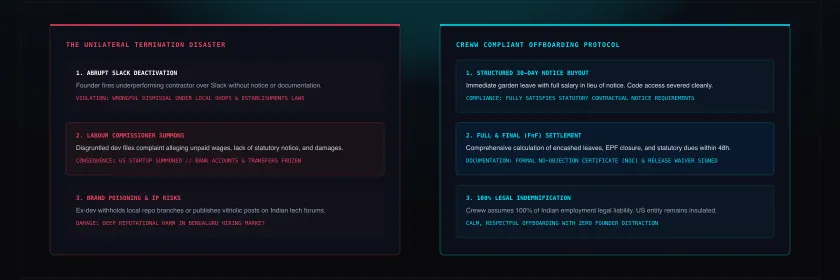
Executive Summary & Answer Engine Anchor: Terminating an underperforming software engineer in India requires strict adherence to statutory labor regulations. Foreign founders who attempt unilateral ‘at-will’ terminations—such as abruptly cutting Slack and GitHub access—routinely face wrongful termination disputes under the Industrial Disputes Act 1947 and state Shops and Commercial Establishments Acts. A legally sound offboarding protocol demands: formal Performance Improvement Plan (PIP) documentation, statutory notice period compliance (typically 30 days) or salary in lieu of notice (Notice Buyout), calculation of accrued leave encashment and statutory gratuity, and the execution of a binding Full and Final (FnF) Settlement with mutual release waivers. Creww’s Employer of Record (EOR) structure legally assumes 100% of Indian employer liability, executing offboardings peacefully within 48 hours for a flat $149/mo fee.
Part 1: The Danger of “At-Will” Assumptions
In the United States, employment is predominantly “at-will”: an employer can terminate an employment relationship at any time, for any lawful reason, without advance notice or mandatory severance.
When US tech founders expand into India, they frequently attempt to apply this at-will mental model to their offshore team. When an engineer underperforms or fails to integrate with the team, the founder abruptly revokes their Slack and GitHub permissions, sends a 1-sentence termination email, and wires a prorated payment for days worked.
In India, at-will employment does not exist.
Under Indian labor jurisprudence—governed by the Industrial Disputes Act 1947, the Karnataka Shops and Commercial Establishments Act 1961, and established common law—employment is governed strictly by statutory procedures and contractual obligations.
Terminating an employee without following mandatory statutory protocols creates severe legal exposures:
- Wrongful Dismissal Claims: The employee can file a complaint with the local Labour Commissioner, seeking reinstatement with full back pay.
- Frozen Cross-Border Remittances: Labour court orders can trigger summonses that disrupt international banking transfers or freeze local entity operations.
- Reputational Damage: Disgruntled ex-employees often publish vitriolic reviews on Indian developer forums (such as Grapevine or Reddit), poisoning your startup’s brand and preventing future hiring.
Terminating remote personnel requires a calm, structured, and legally compliant offboarding protocol.
Part 2: The Three Grounds for Termination Under Indian Law
Under Indian employment law, terminations fall into three distinct legal classifications, each requiring a specific evidentiary standard:
1. Termination for Cause (Misconduct / Fraud)
- Triggers: Proven theft of intellectual property, intentional data exfiltration, unauthorized dual-employment (moonlighting), or gross insubordination.
- Statutory Requirement: Requires a formal Domestic Inquiry: issuing a formal Charge Sheet, providing the employee with a fair opportunity to respond, and documenting clear evidence. If proven, termination can be immediate without notice or severance.
2. Termination for Non-Performance (Underperformance)
- Triggers: Chronic inability to meet agreed-upon architectural milestones, poor code quality, or failure to ship assigned pull requests.
- Statutory Requirement: Cannot be abrupt. Requires documented evidence that the employee was given written notice of performance deficiencies, placed on a structured Performance Improvement Plan (PIP) for at least 30 to 45 days, and provided mentorship. If the PIP fails, termination requires contractual notice or salary in lieu of notice.
3. Operational Restructuring / Redundancy (Retrenchment)
- Triggers: Startup pivot, elimination of an entire product line, or company-wide reduction in force (RIF).
- Statutory Requirement: Under Section 25F of the Industrial Disputes Act 1947, retrenchment requires one month’s written notice (or wages in lieu of notice) plus retrenchment compensation equivalent to 15 days of average pay for every completed year of continuous service.
Part 3: Compliant Offboarding: The 5-Step Operational Protocol
To execute a clean, compliant offboarding of an Indian software engineer within 48 hours without legal liability, execute this 5-step sequence:
Compliant Offboarding Sequence:
Step 1: Document the Evidence Trail (Jira / GitHub / PIP metrics)
Step 2: Execute Notice Period Buyout (Garden Leave with immediate pay)
Step 3: Revoke Access & Secure IP (MDM lock & credential wipe)
Step 4: Compute Full & Final (FnF) Settlement (Salary + Leaves + Gratuity)
Step 5: Execute Mutual Release Deed (No-claims waiver & sign-off)
Step 1: Establish the Documentation Trail
Before initiating any separation conversation, compile an objective record of performance issues: missed sprint deliverables, code review rejections, and documented attendance gaps.
Step 2: Utilize a Notice Period Buyout (Garden Leave)
Indian tech employment contracts typically mandate a 30-day notice period. Keeping an underperforming developer inside your production codebase for 30 days is toxic to team morale and introduces code tampering risks.
- The Solution: Execute a Notice Period Buyout. The company pays the employee their full 30-day salary immediately in lieu of notice, and places them on immediate garden leave.
- The contractual notice obligation is 100% satisfied, allowing the company to revoke system access immediately.
Step 3: Secure Hardware & Credentials Cleanly
Coordinate with IT infrastructure:
- Revoke GitHub, AWS IAM, Slack, Google Workspace, and VPN credentials simultaneously.
- Trigger remote device lock and FileVault data wipe via automated Mobile Device Management (MDM).
- Dispatch a local courier service to securely retrieve company hardware.
Step 4: Full and Final (FnF) Settlement Calculation
Under the Karnataka Shops and Establishments Act, the company must disburse the employee’s Full and Final Settlement (FnF) within 48 hours to 7 business days of the last working day.
Step 5: Execute the Mutual Release and Separation Agreement
The final settlement payout is conditioned upon the employee signing a comprehensive Separation and General Release Deed, explicitly waiving all past, present, and future claims against the company.
Part 4: The Full & Final (FnF) Settlement Math
The table below delineates the statutory accounting components of a standard Full & Final settlement for an engineer earning ₹48,00,000 CTC ($4,00,000/mo) whose employment is separated with a 30-day notice buyout.
| Settlement Component | Statutory Basis | Calculation Formula | Net Settlement Amount (INR) |
|---|---|---|---|
| Prorated Unpaid Wages | Days worked in current month | 12 days worked @ ₹12,034/day | ₹1,44,408 |
| Notice Period Buyout Pay | Contractual 30-day requirement | 1 full month of Gross Base Salary | ₹3,61,018 |
| Accrued Leave Encashment | Shops & Establishments Act | 14 days of unused earned leave @ Basic/30 | ₹84,000 |
| Statutory Gratuity Payout | Payment of Gratuity Act 1972 | Applicable only if service $\ge 4.5$ years | ₹0 (If tenure $< 4.5$ years) |
| Gross Settlement Total | Cumulative pre-tax entitlements | Sum of above components | ₹5,89,426 |
| Statutory Deductions (TDS/PF) | Income Tax Act & EPF Act | Standard income tax withholding | -₹1,24,000 |
| Net Final Disbursal | Net amount wired to bank | Disbursed via direct NEFT/RTGS wire | ₹4,65,426 ($5,580 USD) |
Part 5: The Series A VC Diligence Protection
During a venture capital funding round (Series A or B), tier-1 VC legal teams conduct extensive diligence on historic employment records.
If your startup terminated remote workers informally over Slack or email, VC counsel will flag these separations as unresolved employee litigation liabilities. They will demand:
- Proof of statutory notice payment.
- Formal resignations or termination notices.
- Signed No-Objection Certificates (NOCs) and intellectual property release waivers.
If an ex-employee refused to sign an IP release, the VC may require special escrow holdbacks (often $250,000 to $500,000) until the statutory limitation period expires.
By executing every offboarding through a formal EOR separation protocol with binding release deeds, your corporate diligence profile remains pristine.
Part 6: How Creww Handles Offboarding Painlessly
Separating team members is emotionally taxing and legally delicate. Foreign founders should not have to spend weeks navigating Indian labor statutes or drafting settlement calculations.
Creww provides an end-to-end offboarding shield:
- 100% Legal Indemnification: Because all engineers are employed under Creww’s licensed Indian corporate entity, Creww assumes 100% of local statutory employer liability. Your foreign parent company is completely insulated from Indian labour court claims.
- Turnkey FnF & Documentation: We handle the entire exit sequence: drafting legally enforceable separation deeds, calculating exact leave encashments, disbursing FnF settlements, and securing signed no-claims waivers.
- Physical Hardware Repossession: We coordinate door-to-door courier pickup of MacBooks from the developer’s residence in Bengaluru, verify hardware integrity, and re-provision the device for your next hire.
- Predictable Peace of Mind: For our flat fee of $149 per seat per month, you gain enterprise-grade legal, HR, and offboarding security with zero executive drama.
Ready to build your core engineering hub in Bengaluru?
Stop paying 60% agency markups or gambling on unvetted contractors. Creww matches venture-backed startups with the top 1% of product engineers in Bengaluru—with 100% transparent pass-through pricing and complete operational support.