The Hidden Buyout Fees and Conversion Traps in Developer Contracts
Staffing contracts bury $30k-$50k buyout penalties and ongoing margin markups. Discover how transparent pass-through contracts protect startup founders.
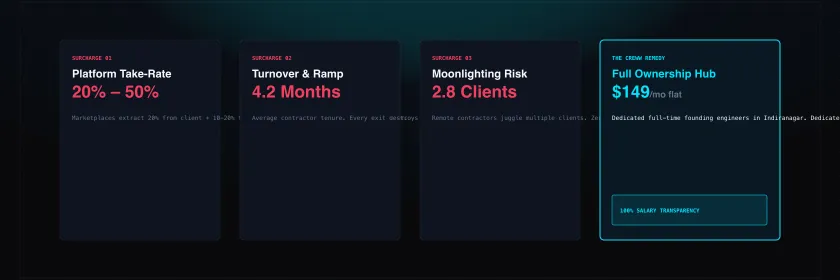
Executive Summary: Standard tech staffing contracts and developer marketplaces conceal aggressive conversion penalties ranging from $25,000 to $50,000, or 30% to 40% of annualized compensation, if a startup attempts to hire their developer directly. These liquidated damages and non-solicitation clauses effectively hold your product familiarity and institutional knowledge hostage. Creww replaces predatory conversion fees with an unencumbered transition model: a flat $149/month EOR fee, 100% transparent pass-through salaries, and $0 buyout penalties to transfer your engineers to your own corporate entity after 24 months.
Few moments in startup operations are as frustrating as the “Buyout Ambush.”
It typically unfolds like this: you engage an offshore staffing agency or contractor marketplace to hire an engineer. Over twelve months, that developer becomes indispensable. They build core product modules, resolve production outages, and understand your codebase better than anyone else.
Your startup closes a funding round. You decide to incorporate an Indian subsidiary or transition the developer to a direct full-time contract with company stock options.
You reach out to the agency to formalize the transition.
Within twenty-four hours, the agency’s account director points you to Section 14 of the Master Services Agreement you signed months ago: The Non-Solicitation and Liquidated Damages Clause.
To employ the person who built your product, the agency demands an immediate payment of $40,000, or threatens legal injunctions against the engineer.
Reflect on the absurdity of this dynamic: you are forced to pay a ransom to employ the very person whose salary you have already been funding.
1. Deconstructing the Staffing Hostage Clause
Staffing bodyshops and developer marketplaces make money on the spread between what they bill you and what they pay the engineer.
If you convert that developer into a direct employee, the agency loses their recurring 50% to 70% monthly margin. To prevent clients from escaping this margin trap, agencies draft restrictive legal barriers into their standard agreements:
| Contractual Mechanism | Operational Meaning in Agreement | Direct Impact on Founder Runway |
|---|---|---|
| 1. Blanket Non-Solicitation (12–24m) | Forbids you from working with the engineer under any format or entity | Traps startup into paying perpetual agency billing rates |
| 2. Liquidated Damages Penalty | Demands $25,000 – $50,000 cash buyout, or 35% of first-year compensation | Creates massive unexpected financial liability at conversion |
| 3. Codebase Injunction Threat | Claims potential IP complications or claims if developer switches direct | Seeds anxiety during venture capital diligence or financing |
The agency will claim this penalty protects their “recruitment investment.”
However, ask yourself: if an agency has already billed you $12,000 every month for a year while paying the developer $3,500, they have already extracted $102,000 in gross profit from your account.
Demanding an additional $40,000 buyout fee is not about recouping recruitment costs; it is about exploiting your switching costs and holding your institutional knowledge hostage.
2. Side-by-Side Comparison: Contract Buyout Terms Across Providers
| Contractual Dimension | Traditional Dev Agency | Contractor Marketplace (Turing / Toptal) | Creww Pass-Through Model |
|---|---|---|---|
| Buyout / Conversion Fee | $30,000 – $50,000 or 35% salary | $25,000 – $40,000 penalty clause | $0 after 24 months ($15k prior) |
| Non-Solicitation Period | 12 to 24 months post-contract | 12 to 18 months | Zero restriction to own entity |
| Salary Transparency | Completely hidden (Opaque spread) | Hidden inside hourly billing | 100% Open-Book CTC in INR |
| Monthly Management Fee | 60% – 70% hidden wage spread | 40% – 55% built-in spread | Flat $149 / month EOR fee |
| Upfront Sourcing Fee | Hidden in bloated rates | Built into hourly rate | 10% of Year 1 base salary |
| IP Assignment Certainty | Variable (often lacks Sec 19 waiver) | Platform-mediated assignment | Perpetual global IP with Sec 19(4) waiver |
3. How to Audit Your Current Staffing Contracts for Hidden Traps
Before signing any technical staffing or agency agreement, conduct a line-by-line audit of these three critical sections:
1. The Liquidated Damages Clause
Look for phrasing such as:
“In the event Client engages, directly or indirectly, any Personnel provided by Agency within eighteen (18) months of termination, Client shall pay Agency liquidated damages equal to forty percent (40%) of Personnel’s annualized billing rate…”
The Fix: Strike this clause. Insist on language that establishes an unencumbered transition: “Client may transition any personnel to a direct employment relationship or through a designated Employer of Record upon twelve (12) months of continuous engagement with zero conversion penalties.”
2. The Indian Copyright Act Section 19(4) Vulnerability
Under Indian copyright law, an assignment of copyright in any work lapses after one year from the date of assignment if the work is not put to use within that period, unless the agreement explicitly waives this provision.
Many Western agency contracts use generic US Delaware assignment clauses that fail to include the mandatory Section 19(4) waiver. If your agency’s contract omits this specific statutory waiver, you face latent IP vulnerabilities under Indian jurisdiction.
Creww’s tripartite employment agreements incorporate explicit, perpetual waivers of Section 19(4), ensuring that all intellectual property created by your Bengaluru team remains irrevocably owned by your parent entity globally.
4. The Creww Clean Transition Framework
At Creww, we believe that holding engineers captive is fundamentally counter to how great technology companies are built.
Our business model is simple and transparent:
- We earn our living on service, not captivity: We charge a flat $149/month EOR fee and a 10% one-time placement fee.
- 100% Salary Pass-Through: Every dollar allocated for developer salary goes directly to the developer in Indian Rupees.
- Clean Entity Transfer: When your startup scales to the point where setting up an Indian Private Limited subsidiary makes financial sense (typically 20+ engineers), your entire team transfers to your entity with zero buyout fees.
We succeed when your startup scales, not when you are trapped in an artificial margin loop.
5. Addressing the Hard Objection
“Why shouldn’t an agency protect its recruitment investment with a conversion penalty?”
A recruitment partner deserves to be fairly compensated for sourcing exceptional talent. That is why Creww charges a transparent 10% placement fee when an engineer joins your team.
However, charging a placement fee is very different from demanding a recurring 60% monthly salary spread for two years and then demanding a $40,000 buyout fee when you want to make them a permanent employee.
Recruitment is a one-time service; holding an engineer’s career and your codebase hostage is an anti-competitive practice that destroys organizational trust.
Ready to build your core engineering hub in Bengaluru?
Stop paying 60% agency markups or gambling on unvetted contractors. Creww matches venture-backed startups with the top 1% of product engineers in Bengaluru—with 100% transparent pass-through pricing and complete operational support.