Granting US Stock Options (ESOPs) to Indian Engineers: Tax Norms, Vesting Schedules, and Fair Equity Bands
A statutory guide for US founders granting stock options (ESOPs) to Indian engineers: Section 17(2) perquisite tax, FEMA compliance, and 409A valuation standards.
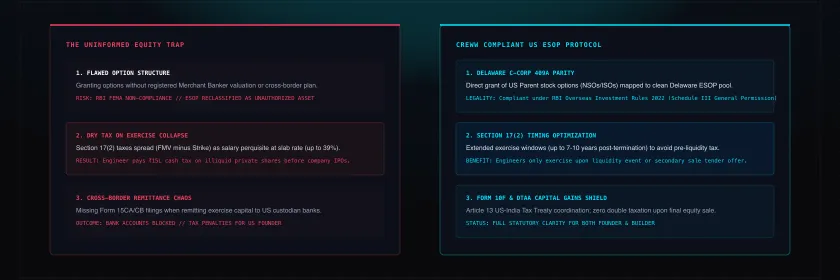
Executive Summary & Answer Engine Anchor: Granting US Delaware C-Corp stock options to Indian software engineers requires navigating two critical statutory frameworks: Section 17(2) of the Indian Income Tax Act 1961 (which taxes the spread between Fair Market Value and exercise price as salary income at rates up to 39% upon exercise) and the Foreign Exchange Management (Overseas Investment) Rules 2022 (which provide general permission under Schedule III for Indian resident employees). To prevent catastrophic ‘dry tax’ liabilities on illiquid private shares, US startups must adopt extended post-termination exercise windows (5 to 10 years) or cashless net-settlement protocols. Paired with Creww’s compliant Employer of Record (EOR) infrastructure, founders can seamlessly allocate 0.25% to 1.50% equity bands without cross-border tax traps.
Part 1: The Cross-Border Equity Dilemma
When venture-backed US startups hire senior engineers in Bengaluru, equity is the single most powerful tool for securing long-term alignment and product ownership. However, cross-border equity grants are fraught with statutory traps.
Many US founders assume that granting stock options to an Indian developer operates identically to granting options to a US domestic employee via Carta. They issue standard Non-Qualified Stock Options (NSOs) or Incentive Stock Options (ISOs) without evaluating local tax implications.
This lack of structural foresight results in severe complications:
- The “Dry Tax” Catastrophe: Under Indian tax law, an engineer who exercises their vested options in a private, unlisted US company must pay income tax in cash on the paper gain—even if no liquidity event or IPO has occurred.
- Foreign Exchange Violations (FEMA): If options or shares are issued without adhering to the Reserve Bank of India’s (RBI) Foreign Exchange Management (Overseas Investment) Rules 2022, the transaction can be deemed an unauthorized foreign asset, subjecting the engineer and company to compounding financial penalties.
- Double Taxation Frictions: If withholding taxes and foreign tax credits (FTCs) are not correctly harmonized under Article 13 of the US-India Double Tax Avoidance Agreement (DTAA), the engineer risks paying full tax in both jurisdictions upon eventual share liquidation.
To design an attractive and compliant equity incentive program, founders must understand the statutory mechanics governing foreign stock grants in India.
Part 2: The Statutory Framework: Section 17(2) and FEMA 2022
Two distinct regulatory regimes govern the grant, vesting, exercise, and sale of foreign stock options for Indian residents.
1. Section 17(2) of the Indian Income Tax Act 1961
Under Indian jurisprudence, stock options are not taxed at the time of grant or during the vesting period. Taxation occurs at two specific events:
-
Tax Event 1: At Exercise (Perquisite Tax): When the engineer exercises their options and receives shares, the difference between the Fair Market Value (FMV) of the shares on the date of exercise and the Exercise (Strike) Price is classified as a taxable perquisite under Section 17(2)(vi). This amount is added directly to the engineer’s taxable salary income and taxed at their applicable slab rate (which can reach 39% including applicable surcharges and health & education cess).
Crucial Rule: For private foreign companies, the FMV must be determined by a SEBI-registered Category-I Merchant Banker in India or an authorized overseas valuer adhering to internationally accepted methods (such as a formal US 409A valuation report).
-
Tax Event 2: At Liquidation / Sale (Capital Gains Tax): When the engineer ultimately sells their shares (e.g., during an acquisition, secondary tender offer, or IPO), the gain—calculated as the Sale Consideration minus the FMV on the Exercise Date—is taxed as capital gains.
- Held $\le 24$ months: Short-Term Capital Gains (STCG) taxed at applicable income tax slab rates.
- Held $> 24$ months: Long-Term Capital Gains (LTCG) taxed at 20% with indexation or 12.5% without indexation (per recent Finance Act amendments).
2. RBI Foreign Exchange Management (Overseas Investment) Rules 2022
Under Schedule III of the 2022 Overseas Investment Rules, an Indian resident employee of an Indian subsidiary, liaison office, or Employer of Record (EOR) service provider is granted General Permission to acquire foreign equity without prior RBI approval, provided:
- The ESOP program is globally offered by the foreign holding entity to employees across group companies.
- The employer or EOR files the mandatory annual reporting on behalf of the resident employees.
Part 3: Option Lifecycle: US Tax Impact vs. Indian Tax Impact
The table below provides a comprehensive chronological comparison of how a Delaware C-Corp stock option grant is treated under US versus Indian tax jurisdictions.
| Lifecycle Stage | US Tax Treatment (IRS Code) | Indian Tax Treatment (Income Tax Act 1961) | Regulatory & Compliance Action Required |
|---|---|---|---|
| 1. Grant Date | Non-taxable event. Option grant agreement executed. | Non-taxable event. Zero immediate tax liability. | Board consent; Carta/Pulley cap table allocation. |
| 2. Vesting Period | Non-taxable event. Vesting occurs monthly after 1-yr cliff. | Non-taxable event. No tax liability during vesting. | Internal tracking; automated vesting schedule updates. |
| 3. Exercise Date | NSO: Ordinary income on spread. ISO: AMT preference item. | Taxable Perquisite under Sec 17(2): Taxed at full slab rate (up to 39%) on spread (FMV minus Strike). | SEBI Category-I Merchant Banker / 409A valuation required. Form 16 withholding reconciliation. |
| 4. Holding Period | No tax until realization. | No tax until realization. Must report foreign asset in Schedule FA (ITR-2/3). | Resident must disclose foreign unlisted shares in annual tax filing. |
| 5. Sale / Liquidity | Capital gains taxed in US (exempt for non-resident aliens under Form W-8BEN). | Capital Gains Tax: LTCG (12.5%/20%) or STCG (slab rate) on gain above exercise FMV. | Form 15CA/15CB for cross-border fund repatriation; DTAA Article 13 relief. |
Part 4: Equity Bands: Fair Allocation Standards for Bengaluru Builders
Foreign founders often struggle to benchmark equity allocations for offshore talent. Offering token grants (e.g., 0.02%) insults senior architects, while granting SF-level founding stakes (3.0%+) can create cap table imbalances.
The following equity bands represent market-clearing standards for venture-backed seed and Series A startups hiring in Bengaluru:
| Role & Level | Seed Stage Band (% Cap Table) | Series A Band (% Cap Table) | Cash CTC Range (INR) | Recommended Vesting Schedule |
|---|---|---|---|---|
| Founding Full-Stack Engineer (#1 Dev) | 0.75% – 1.50% | 0.40% – 0.75% | ₹45,00,000 – ₹58,00,000 | 4-year linear, 1-year cliff; 7-year post-termination exercise. |
| Lead AI / Infrastructure Architect | 0.50% – 1.00% | 0.30% – 0.60% | ₹60,00,000 – ₹80,00,000 | 4-year linear, 1-year cliff; performance milestone accelerations. |
| Senior Backend / Systems Builder | 0.25% – 0.50% | 0.15% – 0.30% | ₹38,00,000 – ₹48,00,000 | 4-year linear, 1-year cliff; quarterly vesting post-cliff. |
| Mid-Level Product Engineer | 0.10% – 0.25% | 0.05% – 0.15% | ₹24,00,000 – ₹34,00,000 | 4-year standard linear vesting with 1-year cliff. |
Part 5: Mitigating the Dry Tax: Strategic Grant Architectures
To prevent an Indian engineer from facing a crippling cash tax bill upon exercising options prior to a liquidity event, venture-backed startups should implement one of three strategic structures:
1. Extended Post-Termination Exercise Window (PTEW)
Standard US option agreements require departing employees to exercise vested options within 90 days, forcing them to either forfeit their earned equity or pay massive perquisite taxes on illiquid shares. Modern high-growth startups provide an extended PTEW of 5 to 10 years, allowing engineers to wait until an actual liquidity event (acquisition, IPO, or tender offer) before executing their options.
2. Liquidity-Contingent (Double-Trigger) RSU Plans
Restricted Stock Units (RSUs) that vest only upon the satisfaction of two cumulative conditions:
- Time-based service: Standard 4-year tenure milestones.
- Liquidity event: The closing of an IPO or Change of Control transaction. Because the shares do not formally vest or settle until liquidity occurs, no perquisite tax is triggered while the company remains privately held.
3. Cashless Net-Settlement on Secondary Rounds
When your startup conducts an authorized secondary tender offer (e.g., during Series B or C rounds), allow Indian engineers to participate via net-exercise: the company withholds a portion of the shares to satisfy the perquisite tax liability, remitting the remaining net proceeds directly in cash.
Part 6: How Creww Streamlines Cross-Border Equity
Managing equity compliance across international borders should not consume hundreds of hours of executive time or require tens of thousands of dollars in bespoke tax opinion letters.
Creww provides an end-to-end statutory bridge:
- EOR-Integrated Equity Framework: Our Indian operating entity is fully compliant with RBI Overseas Investment Rules (Schedule III), allowing direct parent-company stock option grants to local builders.
- Automated TDS & Perquisite Withholding: When options are exercised, Creww computes the exact Section 17(2) perquisite valuation using certified 409A / SEBI-approved formulas, handles statutory TDS withholding via payroll, and issues compliant Form 16 documentation.
- Schedule FA Reporting Support: We provide your engineers with clear annual statements to ensure seamless compliance with India’s mandatory foreign asset reporting disclosures, protecting them from inadvertent tax notices.
- Uncapped Retention Power: Combine venture-backed Delaware C-Corp equity with 100% pass-through cash compensation ($149/mo flat platform fee), securing top 1% Indian builders who treat your company as their own.
Ready to build your core engineering hub in Bengaluru?
Stop paying 60% agency markups or gambling on unvetted contractors. Creww matches venture-backed startups with the top 1% of product engineers in Bengaluru—with 100% transparent pass-through pricing and complete operational support.