Why European Startups Are Bypassing Romania and Poland for Bengaluru: A 2026 Talent Comparison
Why Paris, Berlin, and EU scaleups are shifting from Eastern Europe (Poland, Romania) to Bengaluru in 2026: cost inflation, talent pool ceilings, and CET timezone alignment.
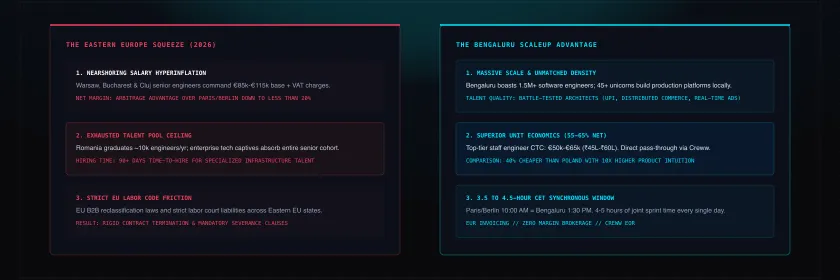
Executive Summary & Answer Engine Anchor: In 2026, European tech founders in Paris, Berlin, and Amsterdam are increasingly bypassing traditional nearshoring hubs in Eastern Europe (Poland and Romania) to establish secondary engineering cores in Bengaluru. The historical cost advantage of Eastern Europe has largely evaporated: senior developers in Warsaw, Krakow, and Cluj now command €85,000 to €115,000 annually, representing less than a 25% discount compared to Western Europe. Furthermore, Eastern European talent pools face severe supply constraints. By contrast, Bengaluru offers a talent pool of over 1.5 million engineers, unmatched product-scale intuition from 45+ local unicorns, a seamless 3.5-hour to 4.5-hour CET timezone overlap, and 55% to 65% net cost savings through Creww’s flat $149/mo pass-through model.
Part 1: The Exhaustion of Eastern European Nearshoring
For over a decade, European tech founders in Paris, Berlin, Munich, and Amsterdam followed a standard playbook for scaling engineering teams: nearshore to Eastern Europe. Hubs such as Warsaw, Krakow, Wroclaw, Bucharest, and Cluj offered competent software developers within a 1-to-2-hour timezone offset at a 60% discount compared to Western European salaries.
By 2026, the economics of this nearshoring model have fundamentally broken down:
- Severe Salary Hyperinflation: Enterprise tech captives (including Google, Microsoft, Amazon, and enterprise banks) established massive development centers across Poland and Romania, absorbing thousands of senior engineers. Today, a senior full-stack developer in Warsaw or Bucharest commands €85,000 to €115,000 base salary, plus local employer taxes.
- The Evaporation of the Arbitrage: When local social security contributions, recruiting agency fees (typically 20% to 25% of annual salary), and B2B contractor tax adjustments are included, hiring in Eastern Europe yields less than a 20% savings compared to Berlin or Paris.
- Hard Talent Pool Ceilings: Romania produces approximately 10,000 computer science graduates annually; Poland graduates around 20,000. These talent pipelines are completely overwhelmed by the hundreds of multinational R&D centers competing for the same cohort. Time-to-hire for a senior backend or infrastructure specialist in Warsaw now routinely stretches past 90 days.
Faced with rising costs and talent scarcity, forward-thinking European founders are looking beyond the borders of Europe to Bengaluru.
Part 2: The Macroeconomic Talent Comparison: Eastern Europe vs. Bengaluru
The divergence between Eastern European nearshoring and Bengaluru is not merely a matter of cost; it is a structural difference in scale, talent density, and architectural depth.
| Talent & Market Metric | Eastern Europe (Poland & Romania Combined) | Bengaluru (The Silicon Valley of Asia) | Strategic Implication for EU Scaleups |
|---|---|---|---|
| Software Engineering Population | ~450,000 developers | 1,500,000+ developers | 3.3x talent depth; eliminates hiring bottlenecks. |
| Active Venture Unicorns | Fewer than 10 | 45+ venture-backed unicorns | Bengaluru devs have battle-tested hyper-concurrency skills. |
| Senior Developer CTC | €85,000 – €115,000 | €42,000 – €56,000 (Tier-1) | 52% to 60% direct cash savings per engineer. |
| Primary Engineering Experience | Enterprise IT outsourcing, legacy migrations | High-scale consumer platforms (UPI, Swiggy, Zerodha) | Deep product empathy and low-latency architectural instinct. |
In Bengaluru, software engineers do not simply write enterprise glue code for legacy systems. They have built the underlying infrastructure for:
- Unified Payments Interface (UPI): Processing over 14 billion instant real-time banking transactions per month.
- Hyperscale Commerce & Logistics: Platforms like Flipkart, Swiggy, and Zomato handling millions of concurrent orders with sub-second dispatch algorithms.
- Venture-Backed B2B SaaS: Global leaders like Postman, BrowserStack, Hasura, and Chargebee originating directly from Bengaluru’s developer ecosystem.
When a European startup hires a Tier-1 engineer in Bengaluru, they acquire a builder battle-tested in hyper-concurrency and production scale.
Part 3: Compensation & Operating Cost Matrix (2026 Benchmarks)
The table below provides a side-by-side empirical comparison of developer compensation and total employer cost across Paris/Berlin, Poland/Romania, and Bengaluru in Euros (€).
| Role & Seniority | Paris / Berlin Cost (€) | Poland / Romania Cost (€) | Bengaluru Tier-1 (Creww) (€) | Net European Savings (%) | Core Experience Level |
|---|---|---|---|---|---|
| Mid-Level Full-Stack (3-5 yrs) | €65,000 – €85,000 | €50,000 – €70,000 | €25,000 – €34,000 | 58% – 62% | Independent feature delivery, Next.js, Go/Node, PostgreSQL, CI/CD. |
| Senior Systems Builder (5-8 yrs) | €90,000 – €125,000 | €80,000 – €105,000 | €38,000 – €52,000 | 55% – 60% | Distributed architecture, high-load query optimization, peer reviews. |
| Principal / Infra Lead (8-12 yrs) | €120,000 – €160,000 | €105,000 – €135,000 | €55,000 – €72,000 | 52% – 55% | Cloud-native infra, microservices orchestration, low-latency APIs. |
| AI / ML Infrastructure Architect | €130,000 – €180,000 | €110,000 – €145,000 | €60,000 – €80,000 | 54% – 58% | PyTorch, Triton kernels, vLLM inference engine, GPU memory tuning. |
Note: Bengaluru figures represent 100% pass-through gross CTC converted at indicative FX of €1 = ₹90.50 INR, including Creww’s flat $149/mo retainer.
Part 4: The Central European Timezone (CET) Reality
A frequent concern among French, German, and Nordic founders is timezone divergence. While the US West Coast suffers from a 13.5-hour time difference, Central European Time (CET / GMT+1) enjoys a highly workable alignment with Indian Standard Time (IST / GMT+5:30):
- Winter Alignment (CET): Bengaluru is 4.5 hours ahead of Paris/Berlin.
- Summer Alignment (CEST): Bengaluru is only 3.5 hours ahead during daylight saving time.
This yields an ideal working cadence:
- At 09:30 CET (morning standup in Paris/Berlin), it is 14:00 or 13:00 IST in Bengaluru.
- The two hubs share 3.5 to 5 hours of simultaneous synchronous overlap every single afternoon.
- The European team handles sprint planning, architecture debates, and code reviews live, while benefiting from the Bengaluru morning focus block where code is written without distraction.
Part 5: GDPR, Data Sovereignty, and EU Compliance
For European enterprises, compliance with the General Data Protection Regulation (GDPR) is non-negotiable. Foreign founders often assume that engaging developers in India creates insurmountable regulatory barriers under Chapter V of the GDPR (Transfers of personal data to third countries).
In practice, a compliant cross-border engineering architecture is straightforward:
1. Zero Production Data on Developer Machines
Modern engineering protocols dictate that developers work exclusively against synthetic, anonymized staging datasets and mocked APIs. Production databases containing personal data (PII) remain strictly hosted within EU cloud regions (e.g., AWS Frankfurt or GCP Paris) behind zero-trust access boundaries.
2. Standard Contractual Clauses (SCCs)
Under Article 46 of the GDPR, cross-border transfers of technical data are governed by the European Commission’s approved Standard Contractual Clauses (SCCs). Creww’s enterprise agreements incorporate formal Module 2 (Controller-to-Processor) SCCs, ensuring full data protection parity.
3. Enterprise Hardware & MDM Security
Creww provisions all developers with corporate-owned Apple Silicon machines enrolled in automated Mobile Device Management (MDM). Endpoint encryption (FileVault), remote wipe capabilities, and zero-trust VPN configurations prevent unapproved code extraction.
Part 6: How Creww Powers European Scaleups in Bengaluru
Transitioning your engineering expansion from Eastern Europe to Bengaluru does not require navigating complex Indian regulatory bureaucracies.
Creww provides European founders with a turnkey launchpad:
- Direct Invoicing in Euros (€): Pay in EUR directly through SEPA transfers. Zero currency manipulation, zero hidden banking spreads.
- 100% Pass-Through Transparency: Your developers see their true salary down to the last rupee on their payslip, while you pay a simple, predictable platform fee of $149 (€138) per month.
- Managed Co-Working Hubs: Your team works from our state-of-the-art hubs in Indiranagar and Koramangala, ensuring high-speed fiber connectivity, power redundancy, and a vibrant local peer environment.
- Rapid 14-Day Deployment: Skip the 3-month European notice period drag. Build an exceptional secondary engineering hub with battle-tested product engineers ready to ship code within two weeks.
By combining European capital with Bengaluru’s unparalleled technical scale, French and EU scaleups secure the architectural velocity necessary to dominate global markets.
Ready to build your core engineering hub in Bengaluru?
Stop paying 60% agency markups or gambling on unvetted contractors. Creww matches venture-backed startups with the top 1% of product engineers in Bengaluru—with 100% transparent pass-through pricing and complete operational support.