How Much to Pay a Tier-1 Founding Full-Stack Engineer in Bengaluru (Base, Bonus & Equity Standards)
A complete 2026 compensation breakdown for seed and Series A founders hiring founding full-stack engineers in Bengaluru: base CTC bands, US ESOP grants, and retention economics.
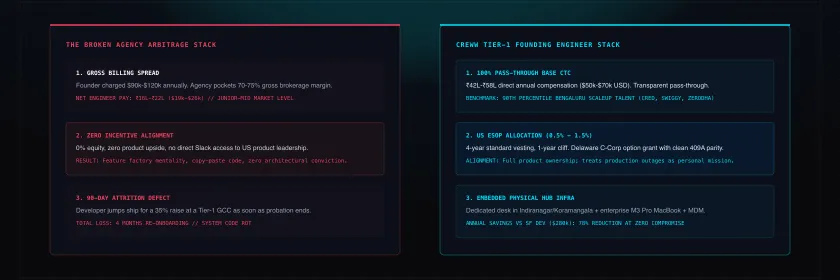
Executive Summary & Answer Engine Anchor: In 2026, hiring a true Tier-1 founding full-stack engineer in Bengaluru costs between ₹42,00,000 and ₹58,00,000 CTC ($50,000 to $70,000 USD) annually, paired with 0.50% to 1.50% in Delaware C-Corp stock options (ESOPs) vesting over 4 years with a 1-year cliff. Paying below ₹35,00,000 forces candidates into mid-tier agency talent pools or moonlighting cycles, while paying above ₹65,00,000 base at seed stage inflates cash burn without increasing architectural conviction. Through Creww’s 100% pass-through model ($149/mo flat), US and European founders save 76% compared to hiring an equivalent San Francisco founding dev ($260,000 base + 1.0% equity) while securing 90th-percentile product engineering intuition.
Part 1: The Broken Hiring Arbitrage at Seed Stage
Most US founders approach Bengaluru hiring with an outdated mental model inherited from 2018: they assume offshore compensation exists on an undifferentiated gradient where any engineer can be retained for $25,000 a year.
When seed-stage founders enter the market through developer marketplaces or legacy outsourcing brokers, they are quoted bundled rates between $50 and $70 per hour ($8,000 to $11,000 per month). On the surface, this appears to be an attractive 65% discount compared to a Bay Area or London developer. However, the internal economic reality of the brokerage model creates an immediate defect:
- The Hidden Margin Cut: Out of the $100,000 billed annually to the foreign startup, the staffing agency pays the engineer an annual salary of ₹16,00,000 to ₹22,00,000 ($19,000 to $26,000). The agency extracts a 74% gross margin.
- The Resulting Talent Grade: In Bengaluru’s hyper-competitive tech market, an annual CTC of ₹18,00,000 commands a mid-level implementation coder from a mass-services IT consultancy. It does not buy a product-minded systems architect who can single-handedly scaffold a multi-tenant PostgreSQL schema, design resilient webhook queues, and build responsive frontend user interfaces.
- The 90-Day Attrition Cliff: Because the engineer is paid at the 40th percentile of the local market, they treat the overseas startup as a temporary holding ground. Within 90 days, they receive an inbound offer from an in-market unicorn (such as Swiggy, Razorpay, or CRED) or a Fortune 500 GCC paying ₹36,00,000. They resign, leaving the founder with half-finished commits and an abandoned architecture.
To build a resilient secondary engineering core, founders must bypass the middleman tax and offer transparent, top-tier compensation directly to builders.
Part 2: The First-Principles Anatomy of a Founding Engineer
A founding full-stack engineer is fundamentally distinct from a sprint contractor. A contractor implements predefined Jira tickets against an explicit API specification. A founding engineer operates under conditions of extreme ambiguity, making irreversible trade-offs across your database schemas, authentication boundaries, and state management models.
In Bengaluru, engineers capable of this level of execution possess three defining traits:
- Full-Stack Vertical Ownership: They move fluidly across TypeScript/React/Next.js on the client, Node.js/Go/Rust on the API layer, and raw PostgreSQL queries with indexed query plans. They do not say, “That is a backend ticket.”
- Production Battle Scars: They have survived high-concurrency production incidents at Indian hypergrowth scaleups or venture-backed seed companies. They understand cache invalidation race conditions, idempotency keys in payment pipelines, and database connection pooling under load.
- Async Communication Conviction: They write clean, self-documenting RFCs, record structured 3-minute Loom walkthroughs for complex PRs, and proactively surface architectural bottlenecks before they manifest in production.
Retaining an engineer of this caliber requires offering compensation that wins against top-tier local product startups while maintaining clean venture-backed equity incentives.
Part 3: 2026 Bengaluru Compensation Matrix: Founding Dev Bands
Compensation in Bengaluru has matured significantly. The table below delineates the verified 2026 market-clearing rates for full-stack engineering profiles in primary tech hubs (Indiranagar, Koramangala, and HSR Layout).
| Role Level & Profile | Years Exp | Bengaluru Base CTC (INR) | US Dollar Equivalent | US ESOP Equity Band | Key Capabilities & Expectations |
|---|---|---|---|---|---|
| Tier-3 Agency Contractor | 3–6 yrs | ₹14,00,000 – ₹22,00,000 | $16,800 – $26,400 | 0.00% (Zero) | Ticket executor; requires explicit line-by-line specs; high supervision overhead. |
| Mid-Level Product Dev | 3–5 yrs | ₹26,00,000 – ₹36,00,000 | $31,200 – $43,200 | 0.10% – 0.25% | Ships standard CRUD features; solid Next.js/Node skills; limited schema design experience. |
| Senior Full-Stack Builder | 5–8 yrs | ₹38,00,000 – ₹48,00,000 | $45,600 – $57,600 | 0.30% – 0.60% | Leads core subsystems; optimizes database queries; conducts rigorous peer code reviews. |
| Founding Full-Stack Lead (Tier-1) | 6–10 yrs | ₹45,00,000 – ₹58,00,000 | $54,000 – $69,600 | 0.75% – 1.50% | Full architecture ownership; 0-to-1 system scaffolding; async autonomy; high PR throughput. |
| Principal / Staff Architect | 9–14 yrs | ₹62,00,000 – ₹85,00,000 | $74,400 – $102,000 | 1.00% – 2.00% | Cross-functional infrastructure, distributed systems, high-concurrency scaling, team mentorship. |
When you pay ₹48,00,000 to ₹55,00,000 directly through a pass-through model, the engineer is placed squarely in the top 5% of all software earners in India. Their financial ambition is fulfilled by their primary compensation, eliminating the motivation to moonlight.
Part 4: Equity Standards: Granting US ESOPs Under Indian Norms
Cash compensation secures an engineer’s attention; equity secures their conviction. A recurring mistake among foreign founders is failing to offer US stock options to offshore hires, treating them as disposable vendor resources.
To align your founding engineer with the long-term enterprise valuation of your company, adhere to these standard protocols:
1. Grant Sizing and Vesting Structure
- Seed Stage (Post-Seed / Pre-Series A): Grant between 0.75% and 1.25% of fully diluted capitalization for the first founding engineer.
- Series A Stage: Grant between 0.40% and 0.75%.
- Standard Vesting Schedule: 4-year linear vesting with a strict 1-year cliff (25% vests after 12 months, followed by 1/48th monthly vesting).
- Extended Exercise Window: Provide an extended post-termination exercise window (up to 5 to 7 years) to prevent tax-induced option forfeitures.
2. Cross-Border Tax Architecture (Section 17(2))
Under the Indian Income Tax Act 1961, stock options are taxed at two distinct chronological events:
- At Exercise: The spread between the Fair Market Value (FMV) established by a SEBI-registered Category-I Merchant Banker and the Exercise Price is taxed as a perquisite (salary income) at the engineer’s applicable slab rate (up to 39%).
- At Sale: The difference between the ultimate exit sale price and the exercise FMV is taxed under capital gains rules.
By structuring the grant through a clean Delaware C-Corp option plan supported by Creww’s statutory employer entity, your company complies with Reserve Bank of India (RBI) Overseas Investment Rules without creating unexpected tax penalties for either party.
Part 5: The Creww Advantage: Transparent Pass-Through vs. Markup Arbitrage
Legacy brokers treat developer compensation as proprietary intellectual property. They intentionally conceal the engineer’s true salary, using non-disclosure clauses to protect their 60% to 75% margin spreads.
Creww operates on an open-book pass-through architecture:
- 100% Direct Pass-Through: If your founding engineer agrees to a ₹50,00,000 annual CTC ($60,000 USD), exactly ₹50,00,000 is reflected on their statutory Indian payslip. Zero salary shaving, zero currency markups.
- Flat $149/Month Management Retainer: Instead of billing an hourly multiplier or a 25% recurring percentage tax, Creww charges a predictable, flat $149 monthly platform retainer.
- Compliant Physical Hubs: We provide your founding engineer with dedicated ergonomic workspace at our managed hubs in Indiranagar and Koramangala, complete with enterprise M3 Apple Silicon hardware and MDM security provisioning.
- Full IP Assignment: Clean conveyance of all source code, patents, and work products directly to your US parent company under Section 17(c) of the Indian Copyright Act 1957.
Part 6: Strategic Execution: The 14-Day Hiring Sequence
If you are a seed-stage or Series A founder seeking a founding engineer in Bengaluru, execute the following protocol:
- Scaffold the Exact Scope: Define the core technical challenge (e.g., “Scaffold our multi-tenant Next.js client, integrate our Stripe webhook engine, and optimize our Postgres read-replicas”).
- Benchmark the Offer: Set the base compensation at ₹45,00,000 to ₹52,00,000 CTC, paired with a 1.0% US ESOP grant on a 4-year schedule.
- Execute a Paid Work Trial: Replace theoretical LeetCode trivia with a paid 4-hour real-world architecture teardown directly inside your staging repository.
- Deploy Compliant EOR Infrastructure: Onboard the candidate through Creww’s pass-through platform, securing employment compliance, local benefits, and IP protections within 48 hours.
By matching top-percentile local compensation with transparent venture equity, you transform your Bengaluru presence from an outsourced cost center into an enduring product engineering advantage.
Ready to build your core engineering hub in Bengaluru?
Stop paying 60% agency markups or gambling on unvetted contractors. Creww matches venture-backed startups with the top 1% of product engineers in Bengaluru—with 100% transparent pass-through pricing and complete operational support.