The Feature-Factory Trap: Screening Developers for Product Sense and Empathy
Legacy bodyshops train developers to write syntax without questioning specs. Learn how to screen for product-minded engineers who optimize user outcomes.
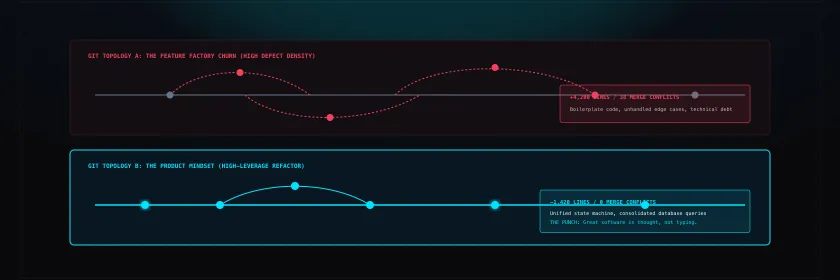
Executive Summary: The most common failure mode in distributed engineering hiring is falling into the Feature-Factory Trap: hiring engineers who write syntactically correct code but lack product sense, user empathy, and architectural judgment. Trained by legacy IT maintenance firms to passively execute Jira tickets without questioning specifications, these programmers build features that technically satisfy requirements but fail in real user workflows. By using a Product-Minded Engineering Interview Rubric that tests edge-case anticipation, telemetry instrumentation, and user empathy, venture-backed startups filter out passive coders and secure builders who protect product velocity.
If you have ever shipped a feature that matched the product specification down to the last sentence—yet completely failed to solve the customer’s problem—you have experienced the Feature-Factory Trap.
The sequence is familiar to early-stage founders:
You write a Jira ticket for a new user onboarding flow. The offshore engineer implements the frontend form, connects the database endpoints, and marks the ticket “Resolved.” Every automated unit test passes.
Then you test the staging deployment as an actual user.
You enter an invalid email format: the form resets completely, wiping out five fields of input without showing an error message. You disconnect your WiFi momentarily: the interface hangs indefinitely with no loading indicator. You look at the telemetry: zero event tracking was instrumented to tell you where users drop off.
When you ask the engineer why these critical details were overlooked, they provide the classic feature-factory response:
“That wasn’t in the Jira acceptance criteria.”
Reflect on that answer: the code was syntactically correct, but the engineering was an operational failure.
1. Syntax Implementers vs. Product-Minded Builders
To understand why this problem is prevalent, examine how software development has historically been taught in outsourcing ecosystems.
In traditional IT outsourcing companies, engineers are actively discouraged from questioning requirements.
A business analyst writes a waterfall specification. The programmer’s job is to write syntax that matches that document. If the programmer spends three hours debating whether a button placement is confusing or whether a database index will slow down write queries, they are penalized for delaying ticket delivery.
| Engineering Dimension | The Syntax Implementer | The Product-Minded Builder |
|---|---|---|
| Requirements Handling | Awaits exhaustive, bulleted specifications | Challenges incomplete PRDs and proposes lean alternatives |
| Success Metric | Optimizes for closing tickets in Jira sprints | Optimizes for customer retention, speed, and conversion |
| Edge-Case Behavior | Ignores boundary conditions not explicitly listed | Anticipates user failure modes during system design |
| Telemetry & Observability | Skips analytics and error instrumentation | Ships production metrics and alerts on Day 1 |
| Code Longevity | Leaves architecture brittle to minimize immediate effort | Refactors code for long-term clarity and maintainability |
When an early-stage startup hires someone with this mindset, founder productivity collapses.
Instead of focusing on customer acquisition, fundraising, and strategic architecture, the CTO is forced to spend twenty hours each week writing micro-specifications, anticipating every potential edge case in writing, and hand-holding the developer through basic UX workflows.
2. Hard Data Comparison: The Three Tiers of Engineering Mindset
To diagnose engineering caliber accurately, evaluate candidates across these three operational tiers:
| Operational Dimension | Tier 1: Legacy Feature-Factory Coder | Tier 2: Competent Syntax Specialist | Tier 3: Product-Minded Product Builder |
|---|---|---|---|
| Response to Ambiguous PRD | Builds assumptions blind; silent | Asks basic clarifying questions | Identifies logical gaps; suggests simpler UX |
| User Empathy & Error States | Only handles happy path | Implements standard error toasts | Prevents user data loss; designs graceful fallbacks |
| Telemetry & Observability | Zero tracking unless ticketed | Adds basic backend console logs | Instruments funnel events & error tracking natively |
| Technical Debt Management | Compounds debt to close tickets | Cleans debt only when assigned | Proactively refactors code to keep system nimble |
| Impact on Founder Bandwidth | High drag: requires micromanagement | Moderate drag: requires clear specs | Negative drag: expands founder leverage |
| Typical 2026 Compensation | ₹12L – ₹20L CTC ($15k–$24k USD) | ₹25L – ₹35L CTC ($30k–$42k USD) | ₹40L – ₹65L CTC ($48k–$78k USD) |
Attempting to save $15,000 annually by hiring a Tier 1 feature-factory coder is an expensive mistake. You pay the difference five times over in rewritten code, delayed releases, and lost customer trust.
3. The Operational Blueprint: The 4-Part Product-Minded Screening Rubric
Standard technical interviews—such as LeetCode algorithmic puzzles or multiple-choice syntax tests—completely fail to detect product sense. Algorithmic trivia tests memorization, not system empathy.
Creww’s Distributed Technical Panel screens for product intuition using four behavioral and architectural evaluation exercises:
| Evaluation Stage | Diagnostic Scenario | High-Signal Green Flag |
|---|---|---|
| 1. The Flawed Spec Test | Present an intentionally vague or logically contradictory feature request | Immediately challenges the underlying premise before writing code |
| 2. The Simplification Test | Ask candidate to design a complex multi-table workflow | Proposes a lean 1-table MVP that ships in 2 days instead of 2 weeks |
| 3. The Metric Probe | Ask how they knew their last production project succeeded | Cites real business instrumentation metrics (e.g. drop-off rates) |
| 4. The Empathy Audit | Ask about an edge-case failure that impacted a real customer | Demonstrates genuine concern for user frustration over defensive pride |
1. The “Ambiguous Ticket” Exercise
Present the candidate with an intentionally incomplete user story:
“We need to allow workspace admins to invite external collaborators to review confidential financial documents via a shareable link.”
Observe how they respond:
- The Feature-Factory Candidate: Immediately begins whiteboarding database tables with a
shareable_linkstring column and an expiration timestamp. - The Product-Minded Candidate: Pauses and asks foundational questions:
- “What happens if a recipient forwards the link to someone outside the domain?”
- “Do we need audit logging to track which IP addresses accessed the document?”
- “Should we require one-time SMS verification or email OTP to prevent unauthorized viewing?”
They think about user security, permissions, and failure modes before writing a single line of code.
2. The Telemetry and Metrics Probe
Ask the candidate:
“You just deployed a new multi-step onboarding flow to production. How do you know if it is successful tomorrow morning?”
A feature-factory coder answers: “I check the deployment logs to make sure there are no 500 internal server errors.”
A product-minded builder answers: “Before shipping, I instrumented PostHog event tracking on step transitions. Tomorrow morning, I inspect the drop-off rate between step two and step three, check the median time to completion, and monitor Sentry alerts for uncaught frontend exceptions.”
3. The “Kill the Feature” Scenario
Ask the candidate:
“Tell me about a time you convinced a product manager or founder NOT to build a feature they requested.”
Great software engineering often consists of preventing code from being written. Look for candidates who can describe a situation where a stakeholder wanted a complex custom feature, and the engineer demonstrated how an existing workflow or standard library could achieve 90% of the value with 10% of the complexity.
4. The Code Review Empathy Check
Give the candidate an active pull request from a junior engineer and observe their review comments:
- Do they nitpick stylistic formatting that should be handled by a linter?
- Or do they ask substantive questions about API ergonomics, variable naming clarity, and whether a future developer will understand the intent six months from now?
4. Addressing the Founder’s Hardest Question
“Shouldn’t our Product Manager define the specs, while the engineer simply writes the code?”
In large corporate IT departments, rigid functional separation is standard.
In an early-stage startup, that separation is fatal.
At Seed and Series A, your product requirements change every two weeks as customer feedback arrives. If your engineers treat your PRDs as inviolable legal contracts rather than starting hypotheses, your development cycle slows to a crawl.
When an engineer understands the business objective behind a feature, they frequently propose technical shortcuts that achieve the exact same user outcome in half the development time. That shared context is the engine of startup velocity.
Ready to build your core engineering hub in Bengaluru?
Stop paying 60% agency markups or gambling on unvetted contractors. Creww matches venture-backed startups with the top 1% of product engineers in Bengaluru—with 100% transparent pass-through pricing and complete operational support.