The Mathematics of Runway: What 1 SF/NY Senior Engineer Costs vs 3 Bengaluru Tier-1 Product Engineers
Mathematical runway comparison: 1 fully loaded SF Senior Engineer ($285k) vs 3 Bengaluru Tier-1 builders ($165k). Discover how to extend runway by 14+ months.
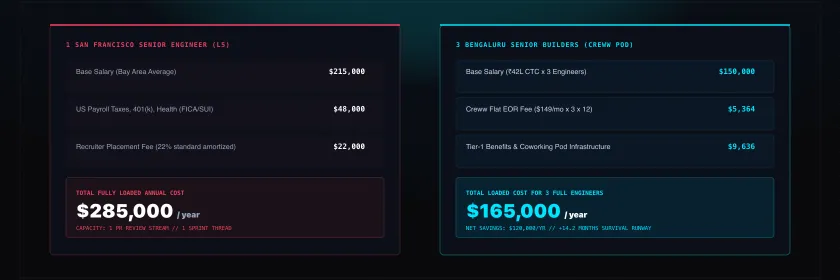
Executive Summary: One fully loaded Senior Software Engineer (L5) in San Francisco or New York costs a venture-backed startup approximately $285,000 per year when accounting for base salary ($215k), mandatory employer payroll taxes, healthcare benefits, and amortized recruiting fees. For $165,000 to $190,000 per year, the same startup can deploy three Senior Tier-1 Product Engineers in Bengaluru through a transparent pass-through Employer of Record (EOR). This capital reallocation yields $95,000 to $120,000 in immediate annual cash savings, triples parallel shipping bandwidth across sprint cycles, and extends startup survival runway by 14.2 months on a standard $2M seed round.
In early-stage technology startups, capital efficiency is not an accounting vanity metric. It is the physics of survival.
Every company begins with a fixed bank balance and an unproven thesis. The formula for achieving product-market fit is simple: how many high-quality product iterations can you ship before your bank account hits zero?
If your burn rate is $150,000 per month, an 18-month seed round affords you 18 months of experimentation. If you reduce your burn rate to $85,000 per month while maintaining the exact same shipping velocity, your runway expands to 32 months.
That additional 14 months of survival is often the difference between finding product-market fit or joining the graveyard of well-funded startups that ran out of cash during a challenging fundraising climate.
The largest single line item on any software startup’s profit and loss statement is engineering payroll. And the single most consequential financial decision a founder makes is where that engineering capital is deployed.
1. The Fully Loaded Cost Breakdown: 1 SF Engineer vs. 3 Bengaluru Builders
When founders budget for a US senior engineer, they often look only at the base salary quoted on an offer letter—say, $215,000.
This creates a dangerous blind spot. In reality, the true cash drain of a full-time employee in California or New York includes mandatory employer payroll taxes, healthcare plans, workers’ compensation, 401(k) matching, and recruiter placement fees.
Here is the audited line-item unit economic comparison between 1 Senior (L5) Engineer in San Francisco and 3 Senior (L4/L5) Product Engineers in Bengaluru (under Creww’s 100% pass-through model):
| Cost Component | 1 San Francisco Senior Engineer (L5) | 3 Bengaluru Senior Engineers (Creww Pod) | Variance / Delta |
|---|---|---|---|
| Base Salary | $215,000 | $150,000 (₹42.5L CTC x 3) | -$65,000 |
| Employer Payroll Taxes (FICA, SUI, FUTA) | $22,500 (~10.5%) | $0 (Handled in local EOR retiral structures) | -$22,500 |
| Healthcare, Dental & Vision | $18,000 (US Gold plan standard) | $4,800 (Tier-1 private group health in India) | -$13,200 |
| Workers Comp & Administrative Insurance | $3,500 | Included in flat EOR fee | -$3,500 |
| Recruiting Placement Fee | $26,000 (20% recruiter fee amortized over 2 yrs) | $15,000 (10% one-time transparent placement fee) | -$11,000 |
| Platform / EOR Administration | $0 (Direct domestic payroll) | $5,364 ($149/mo x 3 developers x 12 months) | +$5,364 |
| Hardware & Dedicated Desk Infrastructure | $0 (Home WFH assumption) | $9,600 (Dedicated private pod in Indiranagar) | +$9,600 |
| Total Annual Cash Outflow | $285,000 / year | $184,764 / year | -$100,236 / year |
| Engineering Headcount & Throughput | 1 Engineer (1 PR stream) | 3 Engineers (3 Parallel PR streams) | +200% Shipping Bandwidth |
The mathematical reality is stark: for $100,000 less per year, a founder can employ three senior product builders instead of one.
2. The Runway Extension Model: Simulating a $2,000,000 Seed Round
To evaluate the compounding impact of this arbitrage, run a financial simulation on a venture-backed startup with a fresh $2,000,000 seed round and zero initial revenue.
Assume the startup maintains a lean baseline non-engineering burn of $25,000 per month (founder salaries, cloud hosting, legal, SaaS subscriptions).
Scenario A: The Pure US Engineering Model
- The founder hires 2 Senior Engineers in San Francisco:
- Engineering Burn: $570,000 / year ($47,500 / month)
- Non-Engineering Burn: $300,000 / year ($25,000 / month)
- Total Monthly Cash Burn: $72,500 / month
- Total Survival Runway: 27.5 Months
- Total Parallel Feature Capacity: 2 Work Streams
Scenario B: The Hybrid Bengaluru Pod Model
- The founder hires 1 US Lead/CTO ($250k loaded) + 4 Senior Engineers in Bengaluru ($246k loaded):
- Engineering Burn: $496,000 / year ($41,333 / month)
- Non-Engineering Burn: $300,000 / year ($25,000 / month)
- Total Monthly Cash Burn: $66,333 / month
- Total Survival Runway: 30.1 Months
- Total Parallel Feature Capacity: 5 Work Streams (1 Lead + 4 Builders)
Scenario C: The Lean Offshore Core Model
- The founder employs themselves as Product Lead + 3 Senior Bengaluru Builders:
- Engineering Burn: $184,764 / year ($15,397 / month)
- Non-Engineering Burn: $300,000 / year ($25,000 / month)
- Total Monthly Cash Burn: $40,397 / month
- Total Survival Runway: 49.5 Months
- Total Parallel Feature Capacity: 3 Full-Time Builders
| Operational Model | Team Composition | Monthly Burn | Runway on $2M Seed | Product Cycles Possible |
|---|---|---|---|---|
| Model A: US Only | 2 SF Senior Devs | $72,500 / mo | 27.5 Months | ~18 Sprint Milestones |
| Model B: Hybrid Squad | 1 US Lead + 4 BLR Devs | $66,333 / mo | 30.1 Months | ~45 Sprint Milestones |
| Model C: Lean Pod | 3 BLR Senior Devs | $40,397 / mo | 49.5 Months | ~54 Sprint Milestones |
In Scenario C, the startup secures over four years of runway. The founders are completely insulated from short-term market downturns, venture capital freezes, and sudden fundraising shocks. They have the temporal breathing room to iterate their product until it succeeds.
3. The Myth of the “10x Developer” vs. Parallel Shipping Bandwidth
A common objection raised by Bay Area purists is: “I’d rather pay $285k for a single 10x engineer in SOMA than hire three remote developers.”
This argument rests on a flawed premise: it compares an exceptional US engineer against entry-level offshore contractors who lack product sense.
When you hire through a transparent, high-bar sourcing engine in Bengaluru, you are not hiring junior ticket-takers. You are hiring engineers who:
- Graduated from the Indian Institutes of Technology (IIT) or BITS Pilani.
- Spent four years building high-concurrency microservices at Indian unicorns handling millions of transactions per second.
- Write idiomatic TypeScript, Go, Python, and Rust.
The Mathematics of Parallel Execution
Even the most talented single engineer in San Francisco is constrained by fundamental operational physics:
- Context Switching: A single engineer cannot build a high-performance backend, implement complex React UI states, and configure zero-downtime Kubernetes deployment pipelines simultaneously without severe cognitive thrash.
- Review Bottlenecks: A single engineer has no local peer to conduct rapid, high-bandwidth pull request reviews. PRs sit waiting for the founder or CTO.
- Bandwidth Limits: When a production bug strikes on a single-developer team, all forward product velocity drops to zero.
With a pod of three senior builders in Bengaluru:
- One engineer focuses exclusively on backend data models and API services.
- One engineer focuses exclusively on frontend state, performance, and user interface polish.
- One engineer focuses on infrastructure, background job queues, and automated test coverage.
Your product moves forward on three distinct fronts every single day. The compound momentum of three senior builders working together in a co-located Indiranagar pod routinely outperforms a solitary developer in San Francisco by a factor of three.
4. The 24-Hour Development Loop
Beyond the raw cash savings, deploying a 3-person pod in Bengaluru unlocks a structural operational advantage: the follow-the-sun development cycle.
Because Bengaluru is 12.5 to 13.5 hours ahead of the US West Coast:
- US Daytime: The US founder and design team conduct customer research, finalize Figma specifications, and write detailed PRDs.
- The Evening Handover (5:00 PM PT / 5:30 AM IST): The founder posts sprint tickets, Loom walkthroughs, and architecture requirements.
- US Night / India Daytime: The Bengaluru pod convenes at their Indiranagar hub. They review the tickets, conduct in-person whiteboard architecture debates, write clean production code, and open pull requests.
- US Morning (8:00 AM PT / 8:30 PM IST): The founder wakes up to review fully tested, working pull requests ready for staging deployment.
Product cycles that take two weeks in a single-timezone company collapse into 72-hour turnaround loops.
5. The Skeptic’s Defense: What About Management Overhead?
The Counter-Argument:
“Doesn’t managing three remote engineers consume far more of my time than managing one engineer sitting next to me?”
The Operational Solution:
Managing remote engineers consumes excessive time only when you hire isolated junior contractors who lack context and require granular task assignment.
When you assemble a senior pod with an L5 Lead Builder, local management is self-contained:
- The lead reviews daily code pull requests locally before they ever reach the US CTO.
- The pod sits together in a dedicated physical coworking hub, resolving blockers across the desk rather than waiting for asynchronous Slack replies.
- The US leadership interfaces with the team during a dedicated 2-hour daily synchronous window for sprint alignment, leaving the rest of the day for deep technical execution.
Conclusion: Capital Allocation Is Destiny
Startups fail when they run out of money before solving their customer’s core problem.
Paying $285,000 for a single developer in a hyper-expensive Western market is a luxury that only well-capitalized growth-stage companies can afford. For early-stage startups, it is often an existential gamble.
For less than the fully loaded cost of that single hire, you can build a cohesive, co-located squad of three experienced product builders in the world’s fastest-growing tech capital.
Triple your shipping capacity. Double your survival runway. Build with mathematical discipline.
Ready to build your core engineering hub in Bengaluru?
Stop paying 60% agency markups or gambling on unvetted contractors. Creww matches venture-backed startups with the top 1% of product engineers in Bengaluru—with 100% transparent pass-through pricing and complete operational support.