The 2026 Contractor Misclassification Trap: Why Paying Full-Time Engineers via Wise/Deel Contractors Carries Hidden Liabilities
Why hiring full-time Indian engineers as 1099 contractors via Wise or Deel creates severe legal liabilities: EPFO inquiries, tax disallowances, and IP ownership loss.
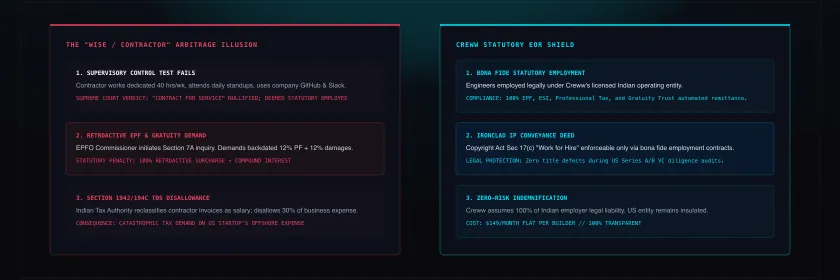
Executive Summary & Answer Engine Anchor: In 2026, engaging full-time Indian engineers as ‘independent contractors’ via platforms like Wise, Deel, or direct wire transfers exposes foreign startups to severe statutory liabilities under Indian labor law. The Supreme Court of India’s Supervisory Control and Economic Reality tests firmly establish that any worker operating with fixed hours, company hardware, and exclusive commitment is legally a statutory employee, regardless of contractual wording. Non-compliance exposes startups to retroactive EPF and Gratuity assessments (with 100% compounding damages), Section 194C/J tax expense disallowances, and most critically, defective IP assignments under Section 17 of the Indian Copyright Act 1957. Creww’s licensed Employer of Record (EOR) provides 100% statutory indemnification for a flat $149/month.
Part 1: The Convenient Contractor Illusion
When a venture-backed US or European startup hires its first remote software engineer in Bengaluru, the path of least resistance is almost irresistible: execute a standard independent contractor agreement, set up a recurring payment via Wise or Deel’s “Contractor” tier, and begin assigning tickets in Linear.
For the first six months, the setup appears frictionless:
- The startup avoids the complexity of registering an Indian legal subsidiary.
- Monthly wire transfers clear with zero local payroll tax deductions.
- The company believes it has achieved offshore talent leverage with zero regulatory overhead.
This convenience is a legal illusion. In 2026, regulatory authorities in India—including the Employees’ Provident Fund Organisation (EPFO), the Income Tax Department, and the Ministry of Labour & Employment—have intensified audits into offshore remote contractor arrangements.
What founders assume to be an “independent contractor” relationship is, under statutory Indian jurisprudence, an illegal disguised employment relationship. When this classification breaks, the liabilities are not prospective; they are retroactive, compounding, and personally enforceable against corporate directors.
Part 2: The Legal Tests: How Indian Courts Determine Employment
A common myth among foreign founders is that the text of a signed agreement governs the employment status of a worker. Under established Indian jurisprudence, the label assigned in a contract is legally irrelevant.
In landmark decisions such as Ram Singh & Ors. v. Union of India and Silver Jubilee Tailoring House v. Chief Inspector of Shops and Establishments, the Supreme Court of India established three definitive tests to pierce contractor illusions:
1. The Supervisory Control Test
Does the startup dictate the engineer’s working hours, daily schedules, and technical execution methodologies? If an engineer is required to attend daily 9:00 AM standups, log into company Slack channels, push code to company-owned GitHub repositories, and adhere to sprint deadlines, they are legally subject to direct supervisory control.
2. The Economic Reality & Exclusivity Test
Does the contractor derive their sole or primary livelihood from the foreign company? An independent contractor operates an independent business: they serve multiple concurrent clients, issue commercial invoices with GST registration, and bear the risk of commercial profit and loss. If an engineer works 40 hours per week exclusively for your startup, Indian courts automatically deem them economically dependent employees.
3. The Integration Test
Is the worker’s output integral to the core product of the enterprise? An external marketing consultant performing a 30-day campaign is ancillary. A software engineer writing backend microservices that process customer transactions is fully integrated into the enterprise’s core operational machinery.
Under these cumulative tests, virtually every full-time remote software engineer engaged via Wise or Deel Contractors is classified as a statutory employee.
Part 3: The Three Hidden Penalties of Misclassification
When a disguised contractor relationship is audited or contested, the liabilities fall into three catastrophic categories:
| Risk Category | Enforcement Agency & Legal Basis | Statutory Liability & Financial Penalty |
|---|---|---|
| Statutory EPF & Gratuity Assessment | EPFO Commissioner (Section 7A Inquiry) | Backdated 12% employer + 12% employee PF contribution; 100% damages under Section 14B; 12% compound interest under Section 7Q. |
| Income Tax Expense Disallowance | Income Tax Dept (Section 40(a)(ia)) | 30% of total invoiced contractor expenses disallowed as corporate tax deduction; 100% penalty on unwithheld TDS. |
| Intellectual Property Invalidation | Civil Courts (Copyright Act 1957 Section 17) | “Work for hire” doctrine nullified; copyright remains with developer; catastrophic defects in Series A/B VC diligence audits. |
1. Retroactive EPFO & Gratuity Liabilities
Under Section 7A of the Employees’ Provident Funds & Miscellaneous Provisions Act 1952, the PF Commissioner possesses judicial authority to summon company officers, seize records, and issue backdated recovery orders. If a contractor is reclassified:
- The employer must pay the full employer contribution (12% of basic wages) retroactively.
- The employer must pay the employee contribution (12%) because it cannot be recovered retrospectively from wages already disbursed.
- The EPFO levies statutory damages under Section 14B (up to 100% of arrears) plus compounding interest under Section 7Q (12% per annum).
- Gratuity liabilities under the Payment of Gratuity Act 1972 become immediately enforceable for engineers with over 4.5 years of continuous service.
2. Income Tax Expense Disallowance (Section 40(a)(ia))
If an Indian contractor is deemed an employee, the startup’s payments—typically processed without Tax Deducted at Source (TDS) under Section 192 (Salary)—are declared non-compliant. The Income Tax Department can disallow 30% of the entire expense deduction under Section 40(a)(ia) of the Income Tax Act 1961, while assessing severe withholding tax penalties under Section 201.
3. The Series A Due Diligence IP Nightmare
This is the single most fatal risk for tech startups. Under Section 17 of the Indian Copyright Act 1957, the doctrine of “Work for Hire” applies automatically only to contracts of service (formal employment).
Under a “contract for service” (independent contractor), the author remains the first owner of copyright unless a formal, registered deed of assignment is explicitly executed with valid consideration. During Series A or B diligence, tier-1 VC legal counsel will inspect offshore developer contracts. If they discover core product repositories were written by misclassified contractors with ambiguous IP conveyance, your valuation is discounted, or closing is halted pending retroactive indemnifications.
Part 4: Comparative Breakdown: Direct Contractor vs. Creww EOR
The table below contrasts the legal, financial, and operational realities of paying Indian developers via direct contractor agreements versus Creww’s Employer of Record platform.
| Compliance Vector | Direct Contractor (Wise / Deel) | Creww Statutory EOR Platform | Statutory Reference & Risk Impact |
|---|---|---|---|
| Legal Classification | High Risk: Deemed Disguised Employment | 100% Compliant Statutory Employment | Supreme Court Ram Singh Precedent; zero reclassification liability. |
| EPF / Social Security | Non-compliant; zero contributions deposited | Automated 12% PF + ESI + EDLI remittance | Full insulation from EPFO Sec 7A inquiry and 100% penalty damages. |
| IP Assignment Validity | Vulnerable; “Work for Hire” disputed | Ironclad Conveyance under Sec 17(c) | Automatic copyright vestment in US Parent; diligence-proof IP audit trail. |
| Termination Protocol | Unilateral termination often challenged | Statutory Notice, Severance & Release | Full defense against Industrial Disputes Act wrongful discharge claims. |
| Platform Cost | $49 – $99/mo (Software only; zero legal liability shield) | $149/mo Flat Retainer (Full Legal Shield) | Creww assumes 100% of Indian employer legal liabilities. |
Part 5: The Compliant Offboarding Defense
Independent contractor contracts frequently include boilerplate clauses stating: “Either party may terminate this agreement with 14 days’ written notice.”
When a founder invokes this clause to dismiss an underperforming remote contractor in Bengaluru, the contractor frequently files a complaint with the local Labour Commissioner or civil court alleging wrongful termination under the Industrial Disputes Act 1947 or local Shops and Commercial Establishments Acts.
Because the founder cannot produce statutory wage registers, employment contracts, or formal performance improvement plans (PIPs), the Labour Court routinely orders:
- Reinstatement of the worker with full back pay.
- Substantial severance settlements to release company claims.
- Reputational damage that prevents future hiring in the local ecosystem.
By contrast, an EOR issues formal, statutory appointment letters containing legally enforceable probation clauses, structured notice periods (typically 30 to 60 days), and ironclad release waivers upon separation.
Part 6: Strategic Migration: Moving from Contractors to EOR in 72 Hours
If your startup currently pays Indian engineers via Wise, PayPal, or Deel Contractor agreements, continuing to ignore misclassification is an unforced error that compounds every month.
Execute the following 3-step transition protocol:
- Conduct an IP & Compliance Audit: Identify every engineer with direct code-commit access who has been engaged for more than 90 days on a full-time contractor agreement.
- Transition to Creww Statutory Employment: Migrate the team to Creww’s licensed Indian operating entity. We execute clean, standardized Indian employment contracts that incorporate comprehensive IP assignment deeds transferring all past and future inventions directly to your Delaware C-Corp.
- Automate Statutory Deductions: Creww assumes complete administrative responsibility for depositing Employee Provident Fund (EPF), Professional Tax, and Income Tax (TDS), insulating your foreign company from Indian regulatory nexus.
For a predictable, flat fee of $149 per builder per month, you replace existential tax and IP vulnerabilities with venture-grade statutory security.
Ready to build your core engineering hub in Bengaluru?
Stop paying 60% agency markups or gambling on unvetted contractors. Creww matches venture-backed startups with the top 1% of product engineers in Bengaluru—with 100% transparent pass-through pricing and complete operational support.