The BOT Model Exposed: Why Traditional Build-Operate-Transfer Contracts Lock Startups into Golden Handcuffs
Deconstruct the Build-Operate-Transfer (BOT) offshore software model. Expose hidden 30% transfer fees, bundled hourly markups, and contractual hostage traps.
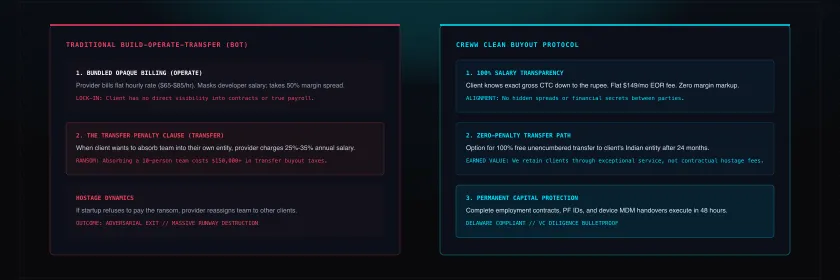
Executive Summary: The Build-Operate-Transfer (BOT) model is marketed to technology founders as the ideal offshore scaling vehicle: a vendor builds your engineering team, operates all administrative functions, and transfers the team into your own legal subsidiary once you reach scale. In reality, traditional BOT contracts function as financial golden handcuffs. During the “Operate” phase, providers hide 50% to 65% margin spreads inside bundled hourly rates ($70 to $95/hr). When the startup exercises its right to “Transfer,” the vendor triggers predatory fine print demanding a 25% to 35% transfer buyout penalty on the entire team’s annual compensation. For a 10-person engineering team, this creates a sudden $150,000+ transfer ransom. Creww replaces this adversarial structure with 100% transparent pass-through pricing ($149/mo flat EOR fee) and a guaranteed zero-penalty buyout transfer after 24 months.
On paper, few offshore arrangements sound more reasonable to a founder than the Build-Operate-Transfer (BOT) framework:
- Build: The vendor recruits senior software engineers in a talent hub like Bengaluru according to your exact technical specifications.
- Operate: The vendor manages local payroll, office space, statutory benefits, and employee compliance under their local corporate entity.
- Transfer: When your company raises a growth round and incorporates its own Indian subsidiary, the vendor hands over the employment contracts, assets, and operational workflows.
It sounds like a low-risk, gradual ramp to establishing a permanent global engineering hub.
Yet, when founders reach the “Transfer” stage two years later, they routinely find themselves locked in bitter legal and financial negotiations.
The vendor’s corporate counsel opens the original Master Services Agreement to the termination annex and points to the clause the founder skimmed over during the initial sales cycle: the Transfer Fee.
To legally transition their own engineering squad into their newly incorporated subsidiary, the startup is informed that they must pay a “recruitment amortized transfer fee” equal to 30% of the team’s combined annual gross compensation.
For a 10-person senior engineering team earning a collective $500,000, that single contractual clause represents a $150,000 exit penalty.
If the startup refuses to pay, the provider exercises its contractual rights: the engineers remain legally employed by the vendor and are reallocated to other client accounts. The startup loses two years of institutional knowledge, code architecture context, and sprint momentum overnight.
The BOT model was never designed to facilitate an easy transfer. It was designed to make transferring so financially painful that the startup remains trapped as a perpetual, high-margin billing customer.
1. Traditional BOT vs. Creww Clean Buyout: The Comparison Matrix
To evaluate how traditional BOT providers extract margin compared to transparent pass-through sourcing, review the comparative financial mechanics:
| Contractual Dimension | Traditional BOT Vendor (The Scalers / Classic Consultancies) | Creww Clean Buyout Architecture |
|---|---|---|
| Billing Structure (Operate Phase) | Opaque bundled hourly rate ($65 – $95 / hr). Developer salary hidden. | 100% Pass-Through: Client sees exact CTC down to the rupee. |
| Intermediary Siphon | 50% to 65% margin spread pocketed by vendor every month. | Flat $149 / month / developer EOR management fee. |
| Transfer Buyout Penalty | 25% to 35% of total team annual payroll triggered upon handover. | $0 / Zero Penalty: 100% free unencumbered transfer after 24 months. |
| Cost to Transfer 10 Senior Engineers | $125,000 to $175,000 in buyout fees before handover completes. | $0 in transfer fees. |
| Developer Sentiment During Operate | Resentful; developers discover vendor takes a massive spread on their labor. | Motivated; engineers know they receive 100% of top-of-market compensation. |
| Notice Period & Exit Friction | Complex 6-month notice requirement; legal disputes over asset transfers. | Turnkey: Complete PF, tax, and employment record handover in 48 hours. |
| IP Assignment Clarity | Retained vendor liens until transfer fees are paid in full. | Direct, perpetual, worldwide assignment to Delaware C-Corp from Day 1. |
The table reveals the underlying economic reality: traditional BOT providers make their profit twice.
First, they siphon a 50%+ spread during the “Operate” phase. Then, they penalize you with a six-figure ransom when you attempt to exercise the very “Transfer” promised in their sales deck.
2. The 3 Structural Siphons in Traditional BOT Agreements
How do traditional BOT consultancies legally trap growing technology startups? Three specific contractual mechanisms are embedded in standard vendor MSAs:
Siphon 1: The Opaque “All-Inclusive” Rate
During the “Operate” phase, BOT providers bill on an all-inclusive hourly or monthly rate: for example, $12,500 per month for a “Lead Cloud Architect.”
They tell founders that this rate bundles salary, physical office space, hardware, healthcare, and administrative overhead.
What they do not disclose is that the actual engineer is paid ₹26,00,000 annually ($30,500 USD, or ~$2,540 per month). The provider is pocketing nearly $10,000 per month in gross margin on a single engineer.
Over a two-year “Operate” cycle, the startup pays $300,000 in total billing for an engineer who received barely $60,000 in actual salary.
Siphon 2: The Restrictive Non-Solicitation Handcuff
Under standard common law, non-compete clauses on individual employees in India are generally void under Section 27 of the Indian Contract Act, 1872.
To circumvent this, BOT vendors insert aggressive business-to-business non-solicitation covenants in the Master Services Agreement between the US startup and the vendor entity:
- The startup covenants that it shall not, directly or indirectly, solicit, employ, or contract with any vendor employee for a period of 12 to 24 months following agreement termination.
- Liquidated damages for breach of this covenant are set at 50% of the employee’s annual billing value.
If you attempt to hire your engineers directly without paying the vendor’s transfer ransom, the vendor sues your Delaware C-Corp for breach of contract in a US federal district court.
Siphon 3: The Equipment & Commercial Lease Markup
When the transfer phase finally arrives, the vendor informs the founder that transferring the physical infrastructure requires purchasing the team’s used hardware at inflated book value, assuming commercial real estate sub-leases at above-market rates, and paying legal administrative fees to execute local contract novation.
3. The Creww Clean Buyout Protocol: Earned Retention
Creww was founded on a simple contrarian principle: partnerships should be built on earned retention, not contractual hostage penalties.
We believe that if we provide exceptional technical vetting, transparent pass-through pricing, and high-energy coworking pod infrastructure in Indiranagar, you will choose to remain on our platform as your team scales.
However, if your company reaches Series B or Series C maturity and your board decides to incorporate an Indian Private Limited subsidiary, we facilitate that transition with zero transfer fees:
How the Clean Buyout Works:
- 100% Pass-Through from Day 1: You always know down to the single rupee what every engineer earns. There is no hidden spread to unwind.
- Transparent Administrative Fee: Creww charges a flat $149 per developer, per month for EOR administration. You never pay a percentage-based markup on salaries.
- Guaranteed Zero-Fee Transfer After 24 Months: After 24 months of continuous operation, you can transfer your entire engineering pod into your own Indian entity with $0 in transfer fees, $0 in buyout penalties, and zero legal restrictions.
- Seamless Contract Novation: We assist in transferring local Provident Fund (EPF) accounts, health insurance policies, and employment records directly to your new corporate entity within 48 hours.
4. The Diligence Audit: 4 Red Flags to Look for in Vendor MSAs
Before signing any offshore software development agreement or BOT proposal, have your corporate legal counsel audit the contract for these four red flags:
- Opaque Rate Cards: Does the contract quote flat hourly or monthly rates ($75/hr) without an itemized, binding addendum stating the exact salary paid to the developer?
- Transfer Buyout Clauses: Does the agreement contain any clause specifying a fee (e.g., 20% to 35% of annual compensation) to transition developers to your own subsidiary?
- Indefinite Non-Solicitation Liens: Does the contract prohibit you from directly hiring engineers even after the master agreement terminates, without paying liquidated damages?
- Vague IP Assignment Contingencies: Does the contract state that IP assignment is contingent upon “full and final payment of all outstanding invoices and transfer fees”? (This allows vendors to hold your IP hostage during buyout disputes).
Conclusion: True Partnership Requires Mutual Freedom
A vendor that relies on six-figure transfer penalties and non-solicitation threats does so because their underlying service cannot retain clients on its own merits.
When an offshore provider treats your engineering team as their private inventory, alignment is broken from the start.
Build your engineering team on an open, transparent foundation. Pay your builders top-of-market compensation directly. Retain them through physical community and shared equity.
And ensure that the code, the culture, and the engineers belong to your company—today, tomorrow, and forever.
Ready to build your core engineering hub in Bengaluru?
Stop paying 60% agency markups or gambling on unvetted contractors. Creww matches venture-backed startups with the top 1% of product engineers in Bengaluru—with 100% transparent pass-through pricing and complete operational support.