2026 Bengaluru Startup Engineering Compensation Index: Real USD & INR Benchmarks for L3–L6 Roles
Unvarnished 2026 engineering salary benchmarks for Bengaluru product startups. Compare real INR CTC to USD equivalents across L3 to L6 seniority bands.
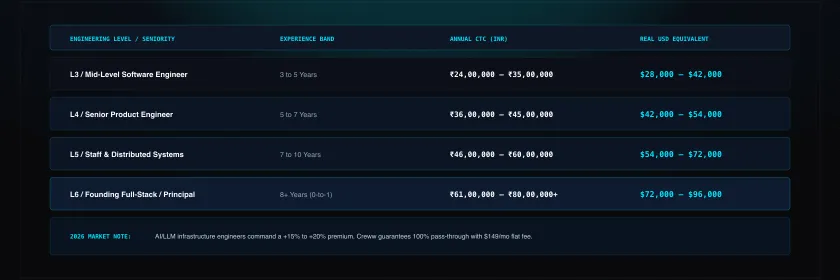
Executive Summary: In 2026, software engineering compensation in Bengaluru’s Tier-1 product startup ecosystem ranges from $28,000 to $42,000 (₹24L to ₹35L CTC) for Mid-Level L3 developers, $42,000 to $54,000 (₹36L to ₹45L CTC) for Senior L4 engineers, $54,000 to $72,000 (₹46L to ₹60L CTC) for Staff/Lead L5 architects, and $72,000 to $96,000 (₹61L to ₹80L+ CTC) for Founding Full-Stack L6 engineers. Specialized AI/LLM infrastructure engineers command an additional 15% to 20% premium. Unlike misleading aggregate reports from Glassdoor or PayScale that blend 4 million legacy IT service workers earning $7,000/yr, these benchmarks represent true market-clearing rates for product builders capable of operating autonomously in venture-backed US, UK, and European startups.
When Western founders begin researching developer compensation in Bengaluru, they almost always encounter two wildly conflicting sets of numbers:
- The Legacy Aggregate Distortions: Sites like Glassdoor and PayScale report average software developer salaries in India between $6,000 and $10,000 per year (₹5L to ₹8L). These figures aggregate hundreds of thousands of junior manual testers, maintenance clerks, and entry-level IT services staff at massive outsourcing conglomerates. If you attempt to hire a product engineer at this rate, you will hire someone who requires continuous line-by-line supervision and writes fragile, unmaintainable code.
- The US Agency Markups: On the other extreme, international recruitment agencies and venture marketplaces quote flat blended rates of $120,000 to $160,000 per year ($75 to $100/hr) for “vetted offshore leads,” pocketing a 60% margin spread while paying the actual engineer a fraction of that figure.
Neither number represents reality.
The actual market-clearing rate for top-tier product builders in Bengaluru—engineers who graduated from Tier-1 institutions (IITs, BITS, NITs) and scaled distributed systems at companies like Razorpay, Swiggy, Zerodha, or Postman—sits squarely in the middle.
This index establishes transparent, defensible 2026 compensation benchmarks in both Indian Rupees (INR) and US Dollars (USD).
1. The 2026 Bengaluru Startup Engineering Compensation Matrix
The following benchmarks represent guaranteed base plus performance packages for high-ownership product engineers based in Bengaluru (assuming an exchange rate baseline of 1 USD ≈ ₹85.00 INR):
| Seniority Level | Experience Band | Core Technical Competency | Annual CTC (INR) | Real USD Equivalent | In-Hand Monthly Cash (Approx.) |
|---|---|---|---|---|---|
| L3 // Mid-Level Engineer | 3 to 5 Years | Autonomously ships features; owns API endpoints, frontend state, and unit test suites. | ₹24,00,000 – ₹35,00,000 | $28,200 – $41,200 | ₹1,55,000 – ₹2,20,000 |
| L4 // Senior Product Engineer | 5 to 7 Years | Architectures microservices; deep mastery of concurrency, database optimization, and CI/CD. | ₹36,00,000 – ₹45,00,000 | $42,300 – $52,900 | ₹2,30,000 – ₹2,85,000 |
| L5 // Staff / Lead Architect | 7 to 10 Years | Designs distributed systems; manages technical trade-offs, high-throughput pipelines, and mentors pod. | ₹46,00,000 – ₹60,00,000 | $54,100 – $70,500 | ₹2,90,000 – ₹3,75,000 |
| L6 // Founding / Principal | 8+ Years (0-to-1) | Full-stack polymath; writes production code across DB, cloud, and client; acts as proxy CTO. | ₹61,00,000 – ₹80,00,000+ | $71,700 – $94,100+ | ₹3,80,000 – ₹5,00,000+ |
| Specialist: AI/LLM Infra | 4 to 8 Years | Fine-tuning models, vLLM/Triton inference pipelines, vector embeddings, RAG architectures. | ₹50,00,000 – ₹75,00,000 | $58,800 – $88,200 | ₹3,15,000 – ₹4,65,000 |
Note: In-hand monthly net cash estimates reflect standard deductions for Employee Provident Fund (EPF) and Indian personal income tax brackets under the New Tax Regime.
2. Deconstructing the Indian “Cost to Company” (CTC)
Western founders are frequently bewildered when an Indian candidate states that their expected compensation is “42 Lakhs CTC.”
In the United States, an offer letter states a base salary (e.g., $150,000), while employer payroll taxes and benefits sit outside that figure. In India, employment contracts utilize Cost to Company (CTC), a comprehensive figure that bundles gross base salary together with statutory benefits, employer retirals, and allowances.
Here is the exact line-item anatomy of a ₹42,00,000 CTC ($49,400 USD) package for a Senior L4 Product Engineer:
| CTC Component | Statutory / Contractual Purpose | Percentage of CTC | Annual Amount (INR) | Annual Amount (USD) |
|---|---|---|---|---|
| Basic Salary | Taxable core earnings; forms the calculation baseline for statutory contributions. | 40% – 50% | ₹16,80,000 | $19,765 |
| House Rent Allowance (HRA) | Legally designated housing allowance; tax-exempt upon proof of rent receipts. | 20% – 25% | ₹8,40,000 | $9,882 |
| Special / Flexible Allowance | Taxable discretionary component balancing the gross base salary. | 15% – 20% | ₹9,51,000 | $11,188 |
| Employer Provident Fund (EPF) | Mandatory statutory retirement savings (12% of basic salary capped or uncapped). | ~5% | ₹2,01,600 | $2,372 |
| Gratuity Allocation | Statutory reserve under Payment of Gratuity Act 1972 (payable after 5 years tenure). | ~2% | ₹80,800 | $950 |
| Annual Performance Bonus | Performance-linked variable component paid upon meeting sprint milestones. | ~10% | ₹4,20,000 | $4,941 |
| Total Annual CTC | Full statutory and cash commitment | 100% | ₹42,00,000 | $49,412 |
When you hire through a transparent Employer of Record, you do not need to manually calculate gratuity reserves or PF filings. The EOR manages these deductions automatically, ensuring the engineer receives their statutory benefits without administrative burden on the founder.
3. The Runway Arbitrage: San Francisco vs. Bengaluru
To understand how these numbers transform startup survival metrics, calculate the runway impact for a typical Series A technology company.
Consider an engineering pod consisting of 3 Senior L4/L5 Product Engineers:
| Expense Category | 3 Senior Engineers in San Francisco / NY | 3 Senior Engineers in Bengaluru (Creww Pod) |
|---|---|---|
| Annual Base Salaries | $660,000 ($220k avg) | $150,000 (₹42.5L avg) |
| Employer Taxes, Healthcare & 401(k) | $145,000 (~22% loaded) | $9,600 (Tier-1 local insurance & retirals) |
| Recruiting Placement Fees | $66,000 (20% agency standard amortized) | $15,000 (10% one-time transparent placement) |
| Physical Infrastructure | $27,000 (SOMA office desks) | $10,800 (Dedicated Indiranagar coworking pod) |
| EOR / Administrative Platform Fees | $0 (Direct domestic payroll) | $5,364 ($149/mo/dev flat fee) |
| Total Annual Engineering Burn | $898,000 / year | $190,764 / year |
| Annual Cash Savings | — | $707,236 / year saved |
With a $2,000,000 seed round, the US-only hiring model affords the startup roughly 14 months of survival runway before cash depletion.
By anchoring their core development squad in Bengaluru, the startup extends its runway to 32+ months—more than doubling the company’s lifespan and giving the founding team twice as many product iterations to achieve true product-market fit.
4. The Equity Equation: Do Indian Engineers Value US Stock Options?
A persistent myth among Western founders is that Indian engineers only care about immediate cash CTC and place zero value on startup equity.
While this was historically true for engineers working at legacy IT bodyshops (who were treated as disposable contractors), it is entirely untrue for senior product builders in 2026.
Senior engineers from Bengaluru unicorns have witnessed substantial liquidity events (such as Razorpay’s and Swiggy’s secondary share sales). They understand how capitalization tables function and actively seek equity upside in international startups.
Best Practices for Structuring Stock Options (ESOPs) for Bengaluru Engineers:
- Use Standard Delaware C-Corp Stock Option Plans: Issue standard Incentive Stock Options (ISOs) or Non-Qualified Stock Options (NSOs) under your primary US equity plan.
- Maintain Standard Vesting Schedules: 4-year vesting with a 1-year cliff. Avoid offering back-loaded vesting structures, which signal lack of trust.
- Provide Transparent Exercise Mathematics: Explain the current 409A valuation, strike price, and potential upside under future valuation scenarios. When founders speak transparently about company valuation, candidates treat their equity as real wealth rather than speculative paper.
5. The Skeptic’s Defense: “Will Salaried Engineers Demand Massive Hikes Every 6 Months?”
The Counter-Argument:
Founders often ask: “I’ve heard Indian developers expect 30% to 40% salary hikes every appraisal cycle. Won’t our cost advantage evaporate in two years?”
The Market Mechanism:
Hyper-inflationary salary jumps occur primarily when engineers are underpaid relative to the market median or trapped in opaque agency contracts where they discover their employer was taking a 65% spread. When a developer starts at ₹22 Lakhs while their true market value is ₹40 Lakhs, they naturally jump to another company the moment an offer arrives.
When you offer a competitive, transparent CTC (e.g., ₹42L to ₹55L for a Senior L5 role) combined with a flat $149/mo pass-through model, the engineer begins at true market clearing value.
Annual merit adjustments settle into predictable startup norms (8% to 12% based on milestone delivery), preserving your runway advantage over multi-year horizons.
The Rule of Transparent Compensation
Engineering excellence cannot be bought at discount-basement rates, nor should it be held hostage by 60% agency markups.
In Bengaluru, paying top-of-market compensation directly to the engineer costs a fraction of an equivalent hire in San Francisco, London, or Berlin—while buying you the loyalty, velocity, and architectural ownership of a true founding team member.
Know the numbers. Pay transparently. Build with permanence.
Ready to build your core engineering hub in Bengaluru?
Stop paying 60% agency markups or gambling on unvetted contractors. Creww matches venture-backed startups with the top 1% of product engineers in Bengaluru—with 100% transparent pass-through pricing and complete operational support.