ANSR Alternatives for Startups: How to Set Up a Dedicated Tech Center Under 50 Headcount
Looking for ANSR alternatives? Discover how venture-backed startups build dedicated 5-50 person engineering centers in Bengaluru without enterprise GCC capex.
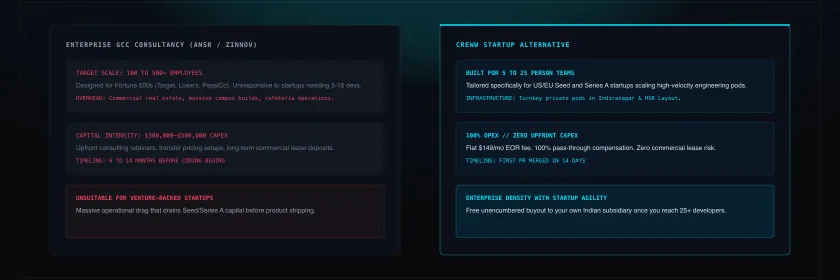
Executive Summary: Enterprise Global Capability Center (GCC) consultancies like ANSR, Zinnov, and the Big-4 are masterclasses in establishing 200 to 1,000-person offshore development centers for Fortune 500 corporations (such as Target, Lowe’s, and PepsiCo). However, their operational model is structurally unviable for venture-backed Seed, Series A, and Series B startups. Enterprise setups require minimum headcount commitments of 50 to 100 employees, $300,000 to $500,000 in upfront capital expenditure, and 9 to 14 months of entity registration and commercial lease negotiations before the first pull request is merged. Startups building 5 to 50-person engineering pods require an agile alternative: zero upfront capex, deployment in under 14 days, turnkey private coworking pods in Bengaluru’s startup corridors (Indiranagar/HSR), and a flat $149/mo EOR fee with a clean, unencumbered transfer path to a wholly owned subsidiary once scale is achieved.
Over the last fifteen years, ANSR has established itself as the undisputed titan of the Indian Global Capability Center ecosystem.
They have designed, built, and operated massive, state-of-the-art capability centers for some of the largest enterprises on earth. If you are the Global CIO of a multinational retailer or financial institution looking to transition 800 IT positions from North America to a bespoke 50,000-square-foot campus in Bengaluru, ANSR is an exceptional partner.
The problem arises when venture-backed startups attempt to use enterprise playbooks for early-stage engineering teams.
Founders of fast-growing technology companies hear about the immense advantages of India’s GCC model—the talent density, the direct ownership, the 90%+ retention rates—and reach out to enterprise GCC advisory firms.
The initial discovery calls are intoxicating. The advisory firms present glossy decks showcasing glass skyscrapers, dedicated cafeterias, and enterprise HR playbooks.
Then comes the commercial reality:
- A minimum headcount requirement of 50 to 100 full-time employees.
- Upfront consulting retainers and entity setup fees of $300,000 to $450,000.
- Mandatory commitments to 3-to-5-year non-cancellable commercial real estate leases.
- A projected timeline of 9 to 12 months before corporate bank accounts, RBI transfer pricing, and ROC registrations are finalized.
For a Series A startup with 18 months of runway, committing half a million dollars and a year of calendar time to an infrastructure setup is corporate suicide.
Startups do not need an enterprise GCC. They need an agile, high-velocity capability hub designed for sub-50 engineering teams.
1. Enterprise GCC vs. Creww Startup Hub: The Operational Comparison
To evaluate why enterprise GCC frameworks break down for venture-backed startups, compare the mechanics of both models side-by-side:
| Operational Metric | Enterprise GCC Advisory (ANSR / Zinnov) | Traditional Dev Agency / Bodyshop | Creww Startup Capability Hub |
|---|---|---|---|
| Target Company Stage | Fortune 500 / Global 2000 Enterprises | Non-technical SMBs & legacy firms | Seed, Series A & Series B Tech Startups |
| Minimum Headcount | 50 – 100+ Full-Time Employees | 1 – 5 Freelance Contractors | 5 to 25 Product Builders |
| Upfront Setup Capex | $300,000 – $500,000 | $0 | $0 Upfront Capex |
| Time to First Production PR | 9 to 14 Months | 2 to 4 Weeks | Under 14 Days |
| Entity Architecture | Mandatory Indian Pvt Ltd Subsidiary | Third-party agency entity | Boutique EOR (Zero local entity required) |
| Commercial Real Estate | 3-to-5-year commercial lease lock-in | None (Fragmented home offices) | Turnkey dedicated private pod (Indiranagar/HSR) |
| Pricing Transparency | Bundled management fees & lease markups | 60% to 75% hidden salary markup | 100% Pass-Through: Flat $149/mo/dev EOR fee |
| Transfer to Own Entity | Already incorporated as a subsidiary | 25%–35% buyout penalty fee | 100% Free, clean transfer after 24 months |
The table clarifies the structural divergence: enterprise consultancies are real estate and corporate entity operators. Their revenue models depend on large-scale headcount volume and long-term facility leases.
A technology startup requires an operational partner that delivers the exact same talent density and physical co-location without the balance sheet debt.
2. The 4 Reasons Enterprise GCC Models Break for Startups
Why does applying an enterprise GCC framework to an early-stage startup result in operational gridlock? Four systemic issues make the model incompatible with venture velocity:
1. Headcount Minimums vs. Lean Startup Pods
Enterprise GCC firms operate on volume. Their operational overhead—dedicated legal teams, commercial real estate brokers, and corporate recruiters—cannot be profitably sustained on a team of 8 engineers.
To make their unit economics work, they push founders to commit to hiring 40 to 60 people within the first year. For a high-growth startup, hiring ahead of product traction is the fastest way to accelerate cash burn and dilute engineering quality.
2. The Commercial Lease Trap
Enterprise GCC setups require leasing physical office space. In Bengaluru’s primary corporate corridors (Outer Ring Road, Whitefield), enterprise landlords demand:
- 3-to-5-year non-cancellable commercial lease agreements.
- 6 to 10 months of security deposit locked up in cash.
- Massive interior capital expenditure for HVAC systems, access control, and specialized cabling.
If your startup pivots, scales up faster than expected, or downsizes during a market correction, you are legally locked into an immovable multi-year real estate liability.
3. The Corporate Bureaucracy Cultural Mismatch
The talent pipelines managed by enterprise GCC firms are optimized for corporate stability, not startup agility. They source engineers accustomed to working in 500-person organizations with rigid hierarchies, designated scrum masters, and slow release cadences.
If you place a corporate IT developer into a seed-stage codebase where specifications change weekly and engineers must talk directly to customers, they freeze. Startups need polymath builders who thrive in ambiguity, not enterprise ticket implementers.
4. Premature Entity & Transfer Pricing Drag
Incorporating an Indian Private Limited subsidiary triggers mandatory regulatory compliance from day one:
- Appointing resident Indian directors with personal statutory liability.
- Annual transfer pricing documentation and audits under Section 92E of the Indian Income Tax Act.
- Monthly GST reconciliations and Registrar of Companies (ROC) filings.
Managing these administrative burdens drains the CEO and CTO’s attention away from shipping product and closing customers.
3. The Creww Micro-GCC Architecture: Built for Under-50 Teams
Creww was purpose-built to give Seed and Series A founders the exact advantages of an enterprise GCC—dedicated teams, physical density, 100% IP ownership, and direct cultural alignment—without the enterprise overhead.
Here is how our boutique hub architecture operates:
1. Fast Deployment via Boutique EOR (Under 14 Days)
You do not need to wait nine months for corporate entity incorporation. Your engineers are employed under Creww’s established, fully compliant Indian Employer of Record umbrella:
- We administer local payroll, statutory Provident Fund (EPF), health insurance, and local labor compliance.
- Your Delaware C-Corp interfaces via a clean Master Services Agreement governed by Delaware law.
- The startup pays a flat $149 per developer, per month with zero margin markup on actual developer salaries.
2. Flexible Pod Workspaces in Premier Startup Hubs
Instead of locking your company into a long-term commercial lease, Creww provisions dedicated, private team pods within premier coworking facilities in Indiranagar and HSR Layout:
- Zero Real Estate Capex: Turnkey private pods with custom branding, ergonomic furniture, and high-speed fiber redundancy.
- Elastic Scalability: Start with a 4-person engineering pod. Expand to 12 people in month six. Scale to 25 people in month twelve. You only pay for the desks your team actively uses.
3. Sourcing Exclusively from Tier-1 Product Ecosystems
We do not recruit from legacy IT service bodyshops. Our sourcing engine and Distributed Vetting Panel headhunt senior builders from India’s top product unicorns (Razorpay, Swiggy, Zerodha, CRED, Flipkart):
- Engineers who have built distributed systems under high concurrency.
- Autonomous builders who write production code, review peer PRs, and participate actively in sprint planning.
4. The Graduation Path: How to Transition to Your Own Subsidiary
The most powerful feature of Creww’s model is the clean graduation bridge:
| Growth Stage | Scale & Headcount | Operating Architecture & Creww Playbook |
|---|---|---|
| Stage 1: Seed / Series A | 1–15 Engineers | Operate 100% through Creww Boutique EOR; zero corporate entity overhead; $0 capex; flat $149/mo platform fee; rapid validation of product velocity. |
| Stage 2: Series B / Scale | 15–35 Engineers | Expand footprint across dedicated Indiranagar hubs; maintain lean EOR compliance; local team self-contained; zero transfer pricing exposure. |
| Stage 3: Institutional Maturity | 35+ Engineers | Incorporate wholly owned Indian Private Limited subsidiary; execute 100% free unencumbered transfer of all contracts & assets; zero buyout penalties. |
Unlike traditional Build-Operate-Transfer (BOT) providers who charge a 30% transfer tax on total team payroll when you want to absorb your engineers, Creww supports clean, unencumbered buyouts after 24 months with zero penalty fees.
We believe in earned retention: if we provide exceptional infrastructure and transparent value, you will choose to remain on our platform. When your company reaches the scale where incorporating your own subsidiary makes financial sense, we facilitate the transition seamlessly.
Conclusion: Match the Tool to Your Stage
Enterprise GCC consultancies built an incredible industry for Fortune 500 corporations with nine-figure balance sheets.
If you have 1,000 employees and five years to plan an offshore transition, hire ANSR.
If you are a venture-backed technology startup that needs to double shipping velocity, preserve seed runway, and deploy an elite 5-to-15 person product engineering pod in Bengaluru within fourteen days—build on Creww.
Enterprise capability. Startup agility. Built for the builders.
Ready to build your core engineering hub in Bengaluru?
Stop paying 60% agency markups or gambling on unvetted contractors. Creww matches venture-backed startups with the top 1% of product engineers in Bengaluru—with 100% transparent pass-through pricing and complete operational support.